Glad you’re here (or click here for a PDF of this site’s content).
For many years, the teaching of Universal Objective Justification (we’ll call it UOJ) has sparked a lot of debate and/or confusion as Lutheran Christians have attempted to “wrap their heads around” the true meaning and significance of this all-important doctrine. (For clarity, this site addresses the topic of UOJ as taught by Lutherans not other variations such as are found in other Christian circles.)
The objectives of this site are to:
1. Take UOJ and boil it down to it’s bare bones in an effort to make it as clear and easy to understand as possible (not always so easy to accomplish)
2. Point out some of the confusion and controversy surrounding UOJ, while attempting to keep things as simple as possible in order to avoid further misunderstanding and/or confusion
3. Lay out a clear and concise scriptural view of justification
4. Address common questions/objections about UOJ in general and/or (more specifically) the information provided on this site
5. Keep things lighthearted as we dive into such an important and heavy subject
6. Honor and glorify God with the information presented here
Navigating the Site The site has been laid out primarily as a one-page parallax site. The majority of the content is on this one page and is divided into sections which coincide with the main menu navigation (above), as well as the floating sidebar navigation menu (to the right). Each section (and its content) naturally flows into the next as you either scroll down or navigate (using the menus) down the page. It’s recommended that you read through each section in order (beginning to end), as you make your way down the page.
Having said that, you might find you desire to skip around a bit once you reach the Q & A section, which itself, is divided into 3 Category Tabs with a series of Q & A’s listed under each tab.
The Q & A section is pretty extensive, so don’t forget to round out your journey through the site content, by continuing to the Final Thoughts section.
That’s about all I’ve got for you in this introduction, so let’s jump right in.
UOJ Basics
The Basics of UOJ First things first. UOJ stands for Universal Objective Justification. Each word is very important. Let’s look at each term individually:
“When we put all three of these terms together, what we end up with is this: All people for all time have been legally declared, “not guilty.”
Universal The universal aspect of UOJ refers to the fact that Jesus’ sacrifice on the cross was for all people, of all time…it’s (get this…) universal. So too, according to the teaching of UOJ, God has justified the whole world (all people, for all time…everybody…not one single person left out), through the “once-for-all” sacrifice of Christ.
Objective The objective aspect of UOJ refers to (now, don’t over think this just yet) the concept that the universality of God’s justification is true, even if some people don’t believe it. Put another way, according to the doctrine of UOJ, all people (the whole world, every single person…well, hopefully you’ve got that part by now) have been justified whether or not anyone is aware of it, understands it, or believes it. It is said to be objectively true, even if you don’t know about it. One might say, “It’s not true when or because you believe it, rather you should believe it because it is true.”
Justification Justification simply refers to God’s formal (if you will) legal declaration that a sinner has been found “not guilty” in the eyes of God. This is not because a person is without sin, but because each and every sin has been accounted for, by way of Christ’s once-for-all sacrifice on the cross.
UOJ in a Nutshell When we put all three of these terms together, what we end up with is this: All people for all time have been legally declared, “not guilty,” not because each one is without sin (or because their sin does not matter), but because Christ’s sacrifice on the cross was fully sufficient and therefore no one during his lifetime (this side of eternity) is legally held accountable for his wrongdoings in the eyes of God (more on this in a moment).
In other words, UOJ teaches us that according to God’s courtroom judgement, justice has been served and therefore, all have been found “not guilty.”
Once again, UOJ states clearly that this is objectively true, even if no one believes it. In other words, this universal justification is not dependent upon faith. This legal declaration is said to be true with or without faith.
I know, I know, I can practically hear (through your internet connection) all of the objections being raised. What about faith? Doesn’t the Bible teach justification by faith? Wasn’t the Reformation all about justification by faith A-L-O-N-E!
Well, before we can rightly move on from here, there is one more very important word which gets added to the UOJ mix…the word, “subjective.”
The Subjective Aspect of UOJ Understood correctly, UOJ teaches us that even though God’s declaration of “not guilty” applies to all people of all time, even if they do not believe it (or are even aware of it), no one receives the benefit of this declaration unless he “apprehends” it through saving faith. This is known as Subjective Justification.
We might think of it this way, UOJ teaches that all (each and every one) are objectively justified with or without faith, but each one is subjectively (personally) justified only through faith. Therefore (though not in this lifetime, as mentioned above), the unbeliever will be held accountable for his sin in eternity (the next “life”).
Confused?
Hold on, there’s more. Unfortunately, things may seem to get a bit worse before they get better. But, hang in there, I’ve done my very best to keep the complicated nature of the topic as simple as possible and (I hope) you will find much clarity in all I have included, particularly when we look at the God Says section of the site. But, we’re not quite there yet. Stay with me.
Ready? Here we go.
Controversy
A Controversial Teaching
Confusion The subject of UOJ is a controversial one, if for no other reason, because it can be soooo confusing for soooo many. And, in my experience, the way in which it is often taught only leads to further confusion.
Such as this…often times when teaching on the subject of UOJ pastors, professors and others use biblical concepts (and the words associated with them) interchangeably/synonymously. For example, the conversation will not be exclusively about justification alone, but instead it will be about justification, acquittal, forgiveness, and righteousness with each of these terms being used interchangeably. More than this, the discussion often comes with little to no explanation as to why these words can or should be used interchangeably or how someone came to this conclusion.
Now, imagine sitting through an hour-long Bible class while continually going back and forth from justification to forgiveness to righteousness to acquittal and back to justification again and so on. Ugh!
Beyond Confusion But, the controversy associated with UOJ goes well beyond mere confusion. Many would argue that the doctrine of justification is at the heart and center of all of Scripture. How is man made right with God and restored to him? Is this not what the Christian faith, indeed the whole of our existence in a fallen world, is all about?
Any variation in beliefs on this topic and we can expect debate, attempts at correction, sinful temperatures rising and yes, controversy.
Furthermore, over the years, numerous church members, pastors and even whole congregations have been disfellowshiped from their church body for disagreeing with UOJ.
Yes, UOJ is a confusing and controversial teaching.
Simplicity & Clarity But what if the doctrine of justification doesn’t need to be so complicated? What if it doesn’t need to be so divisive?
What if…
What if Scripture actually speaks more clearly than those on either side of the debate have allowed themselves to consider or to comprehend?
What if…gasp…those on both sides of the debate are…actually…right? Huh?
What’s Possible? Some will say, “But, that’s not possible!”
Or, is it? Don’t dismiss this possibility too quickly. Don’t forget, “With God, all things are….”
Well…just keep reading.
First, we’ll look at both sides of the debate in some detail. Then, we’ll look to see how God’s truth may have already brought both sides of the debate together, while debaters were busy focusing too heavily on Lutheranwritings rather than on that which was right in front of them in God’s Word all along.
Could it really be that simple? See for yourself.
First things first, though. So, what exactly is this debate all about anyhow?
Key Concept
Justification For All Here’s a statement for you. “Justification for the whole world, both believer and unbeliever alike!”
Yay! Sounds great, doesn’t it?
Did you know there is a sense in which both proponents and opponents of UOJ could agree on the above statement? It’s true. Yet, it is true only because each side would cling to one of two very different meanings for the statement.
And, I would suggest this is the key concept for a correct understanding of UOJ and the debate associated with it. This is what it all boils down to. Everything hinges on this. (Are you getting the hint? This really matters!) When it comes to the subject of UOJ, the importance of what I am about to share cannot be overstated.
Here it is:
Available or Realized (Acquired or Applied)? Is justification “merely” available on behalf of the whole world or has it been fully realized for the whole world?
What’s the difference?
Many Lutherans (though certainly not all) believe in UOJ (pretty obvious, right?). Many others, however, reject UOJ in favor of (what has become known as) Justification By Faith Alone (JBFA – because, after all, Lutheranism needs more initials and/or acronyms…ya know, we’ve got ELCA, LCMS, WELS, ELS, UOJ, etc. Why not JBFA too? And, just for fun, I’ll add another to the mix in just a bit.) 😉
As I stated, each side (proponents of UOJ as well as proponents of JBFA) could agree on my carefully worded statement from above, “Justification for the whole world, both believer and unbeliever alike!”
Yet, each side would cling to a different meaning behind this statement. And, it all comes down to (what I have come to call) the distinction between available vs realized justification.
Please hear me correctly. I suspect many have concluded that the debate is all about whether or not the objective aspect of UOJ is true or not. And, in a sense, that would be an accurate assessment. But, the whole thing goes even deeper than this. More than just whether or not objective justification is true, is the question of exactly how the objective aspect of justification is defined.
You see, I personally believed in UOJ for quite some time…or, so I thought.
“Objective justification (as it is officially defined) means that forgiveness is more than “merely” available, yet it is less than fully received…it’s realized justification.
But after years of digging into it deeper, trying to figure out why (on the one hand) I believed UOJ, even while (on the other hand) I found that it didn’t quite sit well with me either, I finally came to understand there was a subtle (or not so subtle) distinction to be made in my belief system. I had come to recognize that all along, I had been effectively believing that objective justification meant that justification, forgiveness, righteousness, etc. were all fully available on behalf of each and every individual person, but not realized for all. Christ had (in my view) won each person’s forgiveness and so in a sense, there was real-deal, viable, tangible (if you will) forgiveness for all, yet this forgiveness was not fully realized (again, in my view) for each person (including the unbeliever). In other words, what I had finally come to understand for myself is that for many years I had been trying to force “realized justification for all” into my “available justification for all” understanding of Scripture. One might even say that all along I had been believing all were forgiven (inChrist), yet through available, not realized justification.
That last sentence is soooo important, I’m going to repeat it (but, I’ll wait to fully explain it in the next section). Here it is…”One might even say that all along I had been believing all were forgiven (in Christ), yet through available, not realized justification.”
In the end, an online debate led me to more fully recognize the details of this conflict within my own understanding of justification. Moreover, I suspect there could be a similar conflict (or misunderstanding) for many others as well. Therefore, I have become compelled to not only understand the matter better for myself, but also to share my findings with others.
The long and the short of it is this…as it turned out, I discovered that my understanding (my belief in UOJ) was not really UOJ (as it is actually defined) after all!
Objective justification (as it is officially defined) means that forgiveness is more than “merely” available, yet it is less than fully received…it’s realized justification.
What?
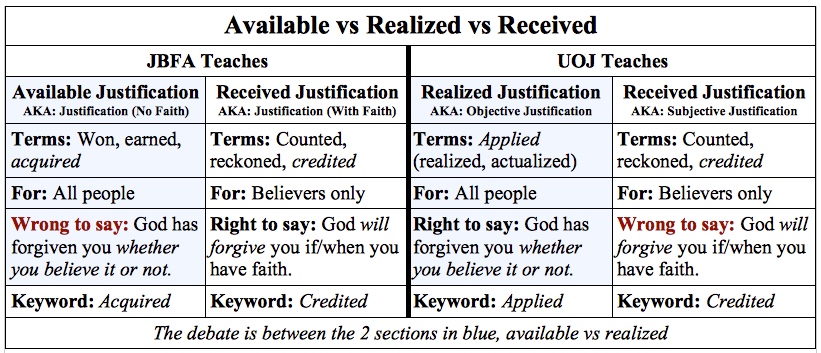
Let’s unpack each of these three terms – available vs realized vs received. (By the way, this could get a bit confusing – such is the nature of UOJ – but, I have included a visual representation at the end of this discussion for clarity…stick with me.)
Available (Acquired) Let’s start with the JBFA view of what happened at the cross. Available justification has to do with the idea that, at the cross, Christ won, earned or acquired (whatever you’d like to call it) justification for all, yet it has NOT been realized for anyone apart from faith. In other words, though it is available, it does not specifically (individually) apply to (is not applicable for) the unbeliever in any way, shape or form due to his unbelief.
Put still another way, according to this view, it would be correct to say, “Throughfaith your sins are forgiven.” but would be wrong to say, “You are forgiven whether you believe it or not.”
The takeaway from this point of view is that justification is only available for the unbeliever because it has only been acquired (not realized) for him on his behalf until faith should come along and apprehend it. The keyword as we move forward on this site is acquired.
Realized (Applied) By contrast, realized justification (what I also refer to as applied justification, in that it is applicable, though not fully received by each individual…more on this in a bit) is simply a way of describing what is taught regarding the objective aspect of UOJ. According to UOJ, all people (including each and every unbeliever) have been actually justified, meaning justification is a real, genuine, literal (whatever you’d like to call it) aspect (reality) of their personal existence. In other words, justification has been fully real-ized (actualized or made real) in regard to each person’s individual life, yet, though this reality (according to UOJ) is said to be true, it is not a reality to the same extent that received justification is.
In keeping with this view, it would be correct to say, “You are forgiven whether you believe it or not.” as well as saying, “But, you don’t receive the benefits of this forgiveness except through faith. Without faith, though you are forgiven (through a legal declaration), you ALSO still stand condemned in your sins.” Yet, it would be wrong to say, “God will forgive you, if/when you have faith.”
The takeaway from this point of view is that justification has been fully realized for the unbeliever. It already applies to him in his life (is applicable to him), yet has not become his received possession until faith should come along and lay hold of it. The keyword as we move forward on this site is applied.
Now, it is worth noting that some proponents of UOJ may take exception with my use of the word applied, here. They might argue that the word applied can be used to mean the same thing as credited. Agreed. It can mean that. And some have used it in this way. But, on this site, I have used it (and will continue to use it) in a different way (to mean real-ized) just as others have done so elsewhere. If you find you take exception to this (no offense), but I encourage you to get over it. On this site, it simply means applicable or real-ized…just run with it.😉 When I mean to say credited, I will use the word credited (or Scripture quotations may use counted or reckoned).
Received (Credited) Finally, there is received (or credited) justification. Both sides (UOJ and JBFA) effectively agree on received justification. Namely, that God has fully credited justification, forgiveness, righteousness to the believer’s account which has, as a result, been received through his faith.
This is what those on the side of UOJ would call the subjective aspect of UOJ, while those in the JBFA camp would say it is the only form (if you will) of justification.
The takeaway from this point of view is that justification has been fully credited and received. The keyword as we move forward on this site is credited.
Clear as mud?
If so, maybe this can add some clarity:
Table 1
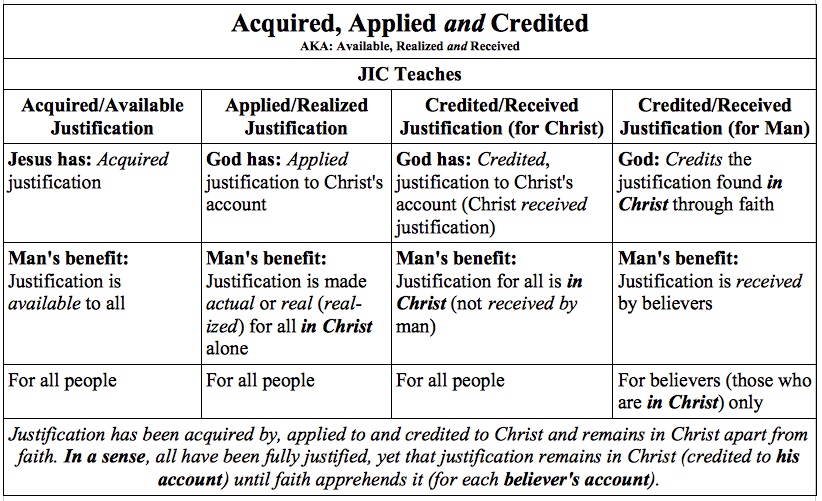
For Further Clarity In an attempt to simplify the complicated (convoluted) nature of the topic of UOJ, what I have attempted to do next is to show both sides of the equation (both God’s and Man’s) as it pertains to both JBFA and UOJ. In other words, I have essentially demonstrated both the cause and the effect of justification.
For example, according to JBFA, what God has done through Jesus at the cross is that he has acquired justification. The resulting benefit for man, therefore, is that his justification has been made available to him through faith in Christ.
The whole situation looks something like this:
Table 2
Clarity or Confusion? So, where do you find yourself at this point? Is everything becoming clear or is it still muddled? Do you understand completely or are things still rather confusing? UOJ and the whole UOJ/JBFA debate can certainly be a lot to grasp. Hopefully, the real clarity will come when we dig into the text of Scripture itself to see what God has to say about justification.
Get ready? This is, by far, my favorite part of the site. Let’s feed on some good old bread from heaven, shall we?
God Says
What God Says About Justification Before looking at God’s Word, we must first lay a little ground work.
Under My Skin I once came upon an online debate of UOJ. Strong views were coming from both sides – views from those for and from those against. Part of the discussion centered around the key concept of acquired vs applied (meaning realized, not credited) justification and forgiveness, apart from saving faith.
This discussion of acquired vs applied justification really stuck with me…it got under my skin, so to speak. Then, the light bulb went on and it struck me that, “This is it!” This is what the whole debate comes down to.
Did Christ only acquire justification for all (to be credited through saving faith) or did God apply (realize) justification for each and every individual, even for those still in unbelief?
Various arguments were made for each side of the acquired/applied debate, yet as I recall, most (if not all) were arguments from reason and logic rather than from Scripture.
But, what if it’s all right there in God’s word? Further, what if it’s not an either/or equation, but a both/and equation?
What do I mean?
Pause… UOJ is effectively a Lutheran doctrine (at least as it is spoken of on this site). As such, I recognize that I am writing primarily to Lutherans – Lutherans who are often accustomed to quoting Luther, the Confessions and/or other “Lutheran Fathers” nearly as often as (if not more often than) Scripture when it comes to a discussion of UOJ. On this site, little attention is given to these extra-biblical sources (the words of men), while heavy emphasis is given to Scripture (the Word of God)…gasp. 😮
Having said that, I would like to introduce our investigation of Scripture by utilizing one single quote from Luther to set up a biblical discussion.
Luther on Acquired vs Applied
“It is a faithful saying that Christ has accomplished everything, has removed sin and overcome every enemy, so that through Him we are lords over all things. But the treasure lies yet in one pile; it is not yet distributed nor invested. Consequently, ifwe are to possess it, the Holy Spirit must come and teach our hearts to believe and say: I, too, am one of those who are to have this treasure. When we feel that God has thus helped us and given the treasure to us, everything goes well…” Sermons of Martin Luther, 8 vols., ed., John Nicholas Lenker, Grand Rapids: Baker Book House, 1983, III, p. 279. Pentecost Sunday. John 14:23-31.J-528 (Emphasis is mine)
Note that Luther states that this treasure lies in one pile and has not yet been distributed nor invested. In other words, it seems he is saying this treasure has been acquired, yet seemingly not made a reality (applied) for each and every individual’s personal existence, including the unbeliever….until faith apprehends it. Remember, it’s just “lyin’ around in a pile.”
Ah, ah, ah…I can practically see the expressions on some of your faces as you’re already conjuring up your refutation of what I’ve just said. You have no idea where I’m going with this, so just hold your horses and keep following along.
Where was I?
Ah, yes, it sounds like Luther disagrees with UOJ, but wait, there’s more.
Luther goes on to tell us how we come to possess this treasure (through faith/believing). He does this even though he began his statement by also recognizing and acknowledging that Christ has accomplished everything, which includes removing sin. What’s this? Everything accomplished? The removal of sin? This sounds similar to arguments made by proponents of UOJ.
So, which is it? Does Luther agree or disagree with UOJ?
Here we have Luther acknowledging that Christ’s work is both fully accomplished (including the removal of sin), yet this treasure still needs to be distributed from the pile it is just lyin’ around in.
Consider this…although Luther seems to recognize that this treasure is acquired and not yet applied for each and every person, he states that this treasure is to be found (so to speak) in a pile. I would suggest, however, that Scripture speaks of a much better “place” to find this treasure rather than in Luther’s “pile.” Let’s take a look.
Turning To God’s Word First things first. What happened at the cross?
~ God made him who had no sinto be sinfor us. 2 Co 5:21a
Here we learn…that 1) Christ was, in-and-of-himself, without sin and 2) he became sin for us.
Therefore, we can say that according to his own life under the law, Jesus was without sin. He was sinless. Yet, we can also legitimately say that at the cross Jesus became sin. He became actually guilty of all sin. In fact, he became every sinner’s sin. Jesus did not go to the cross merely carrying our sin as though he put our sins in a bag and slung them over his shoulder. No! He became sin.
At the cross, Jesus became actually and fully guilty of all sin of all time. It was as though he had become a murderer, a blasphemer, a thief and a liar. Not because he was guilty of sin in-and-of-himself, but because he became so totally and completely intertwined with all of humanity that he became full guilty – fully sinful – in your place and mine. Therefore, God the Father could rightly and justly pour out the full force of his wrath on Jesus in our place. More than this, God could now legitimately justify and forgive each of us because of what had happened to Christ. Christ became sin.
Now, if we have that squared away in our thinking, let’s see what happened next. Note that these first two verses are agreed upon by many theologians (Lutheran or otherwise) as referring to Christ (“me” = Christ).
~ He who vindicatesmeis near. Isaiah 50:8a
~ Without controversy, the mystery of godliness is great: God was revealed in the flesh, justified [vindicated] in the spirit, seen by angels, preached among the nations, believed on in the world, and received up in glory. 1 Tim 3:16 (WEB) Bracketed note is mine.
A number of Lutheran scholars have concluded (and I agree) that the gist of these verses is that after Christ died guilty of our sin, he, himself, needed to be justified (vindicated) on our behalf. Christ, himself, needed to be declared “right with God,” having paid the full penalty for sin.
Where Is Justification Found? This being the case, the question becomes, “Where is our justification to be found?”
Sadly, proponents of UOJ would emphatically state (numerous people have been disfellowshipped for disagreeing) that this justification has been made a reality (applied though, not fully credited) for all people, including the unbeliever. From a UOJ perspective, it is assumed that Christ’s own justification (vindication) automatically equates to the justification (vindication) of all people.
“In other words, what if God has not applied justification, forgiveness and righteous to each unbeliever’s personal account, but instead has applied AND credited each unbeliever’s personal justification, forgiveness and righteousness to…
I’m going to pause and repeat that in a different way so as to encourage you to truly ponder what I’ve just said. UOJ A-S-S-U-M-E-S (it does not prove) the justification of Christ automatically equates to the justification of all. That is an enormous assumption!
Here are, quite possibly two of the most important questions you will ever hear regarding the topic of justification.
Does Christ’s justification = the justification of all, or does it simply mean Christ, himself, has been justified on behalf of all?
Does forgiven sin automatically = forgiven sinners?
In other words, in answer to our previous question (Where is our justification to be found?), proponents of UOJ conclude our justification is found in each and every individual – having been applied to the believer and the unbeliever alike. Though somehow not fully credited apart from faith.
But is this true? Or, is it over-reaching as a flawed interpretation of Scripture? Is it being read into the text, rather than drawn from the text?
Is Justification Found In A Pile? What about Luther?
Is justification like a treasure “lying in a pile” as Luther suggests? Or, does Scripture offer us a better/fuller solution?
Soooo…does this treasure (our justification) lie in a pile? Hmmm. What if it is to be found stored up (so to speak) not in a place, but in a person? And, what if it were not only our justification, but also our forgiveness, our redemption, our acquittal, our righteousness, our life, our salvation and on and on…? What if all are to be found, not in a pile, but in Christ ? Now, there’s a radical thought. 😮
Further, what if one could argue that justification, forgiveness and righteousness have not only been acquired but fully applied and credited?
Oh, but let’s be careful….
I am not suggesting that these have been applied and credited to each and every individual, rather that they have been applied and credited to one account and one account only…until, through faith, each is distributed to each individual believer’s account.
Is Justification Found In A Person?
Think of it this way (here it comes…this is my favorite part 😁), what if God has not applied justification, forgiveness and righteous to each unbeliever’s personal account, but instead has applied AND credited each unbeliever’s personal justification, forgiveness and righteousness to Christ’s account?
Stop…let that sink in.
What if this were essentially what so many proponents of JBFA have been trying to suggest for years, but without fully gasping all of the details in their own theology? What if we were to give these details a name and call them “Justification In Christ” (JIC)? And, what if this justification were both applied AND credited to each individual’s account exclusively by or through faith A-L-O-N-E?
What if the truth of Scripture actually brings both sides of the debate together? What if, in a very real sense, JBFA and UOJ are both true?
Don’t Take My Word For It Is this a viable possibility? Maybe you don’t believe me? Good! You shouldn’t take my word for it. How about looking to God’s word instead?
Please pay careful attention! The following is what God has to say about justification, forgiveness, righteousness, etc…like it or not…believe it or not. This is what we might call God’s objective truth on the matter…will you subjectively believe it?
Where is our justification and redemption to be found? God’s, answer…in Christ.
~ For all have sinned and fall short of the glory of God, being justified freely by His grace through the redemption that is in ChristJesus.Ro 3:23-24 (NKJV)
Where is our reconciliation to be found? Again…in Christ.
~ All this is from God, who reconciled usto himself through Christ and gave us the ministry of reconciliation: that God was reconciling the worldto himself in Christ, not counting men’s sins against them. 2 Co 5:18-19
Where is our forgiveness? In Christ.
~ Be kind and compassionate to one another, forgiving each other, just as in ChristGod forgaveyou. Eph 4:32
Where is our salvation? In Christ.
~ Therefore I endure everything for the sake of the elect, that they too may obtain the salvationthat is in ChristJesus, with eternal glory. 2 Tim 2:10
Where is our righteousness? In Christ.
~ We proclaim him, admonishing and teaching everyone with all wisdom, so that we may present everyone perfect in Christ. Col 1:28
~ God made him who had no sin to be sin for us, so that in him[in Christ] we might becomethe righteousness of God.2 Co 5:21
→ How do we come to be in Christ ? Well, you must decide for yourself in light of Scripture, but I would argue it comes by way of the means of grace through faith. (See next verse, as well as, “How do we come to be in Christ?” below.)
~ For all of you who were baptized into Christhave clothed yourselves with Christ. Gal 3:27-28
Where is our new life/eternal life? In Christ.
~ In the same way, count yourselves dead to sin but alive to Godin ChristJesus. Ro 6:11
~ Therefore, if anyone is in Christ, he is a new creation; the old has gone, the new has come! 2 Co 5:17
~ Paul, an apostle of Christ Jesus by the will of God, according to the promise of life that isin ChristJesus. 2 Tim 1:1
Where are our spiritual wisdom, righteousness, sanctification, redemption, forgiveness and grace to be found? You guessed it…in Christ.
~ And because of him you are in ChristJesus, who became to uswisdom from God, righteousnessand sanctificationand redemption.1 Co 1:30
~ To the church of God in Corinth, to those sanctified in ChristJesus. 1 Co 1:2
~ In himwe have redemptionthrough his blood, the forgivenessof sins, in accordance with the riches of God’s grace. Eph 1:7
In fact, where are all of the incomparable riches of God’s grace to be found? In Christ, of course.
~ You then, my son, be strong in the gracethat is in ChristJesus. 2 Tim 2:1
~ I always thank God for you because of his gracegiven you in ChristJesus. 1 Co 1:4
~ In order that in the coming ages he might show the incomparable riches of his grace, expressed in his kindness to us in ChristJesus. Eph 2:7
What is the real object of our faith? Our own faith? Our justification? Our forgiveness? UOJ? No. Let me ask it another way. Where are all of the promises of God found and fulfilled? In Christ.
~ For no matter how many promisesGod has made, they are “Yes” in Christ. 2 Co 1:20
In Christ, we are seated in the heavenly realms. Pause and allow that one to sink in. This, quite possibly, best demonstrates the point I am attempting to make with all of this.Every spiritual blessing anyone could ever hope to have or imagine is so wrapped up in, hidden in, and encapsulated in Christ, that we (as believers) are even in heaven right this very minute…in Christ (go wrap your head around that one).If this is true, how much more is our forgiveness, righteousness, acquittal, justification, etc. all wrapped up in, hidden in, and encapsulated in Christ?
~ And God raised usup with Christand seated us with himin the heavenly realms in ChristJesus. Eph 2:6
Though it be a mystery, the mystery is solved in Christ.
~ And he made known to us the mystery of his willaccording to his good pleasure, which he purposed in Christ. Eph 1:9
In Christ, every spiritual blessing is found and accomplished.
~ Praise be to the God and Father of our Lord Jesus Christ, who has blessed us in the heavenly realms with every spiritual blessing in Christ. Eph 1:3
~ According to his eternal purpose which he accomplishedin ChristJesus our Lord. Eph 3:11
How do we come to be in Christ?
~ And you also were included in Christwhen you heard the word of truth, the gospel of your salvation. Eph 1:13
And, in Christ, we find our peace.
~ And the peace of God, which transcends all understanding, will guard your hearts and your mindsin ChristJesus. Phil 4:7
~ Peace to allof you who are in Christ. 1 Peter 5:14
Whew! That was a lot. Wasn’t it so cool, though? Isn’t it awesome when we just allow God to do all of the talking on the subject of justification (or anything else)? Did I mention, that this is my favorite part of this site?
But wait…there’s still more.
Outside of Christ What about those who are not in Christ? Do they stand acquitted, forgiven, righteous and justified?
~ The Lord knows how to rescue godly men from trials and to hold the unrighteousfor the day of judgment. 2 Pt 2:9
~ Do you not know that the unrighteouswill not inherit the kingdom of God? 1 Co 6:9 (NKJV)
~ Whoever does not believe stands condemnedalreadybecause he has not believedin the name of God’s one and only Son. Jn 3:18
~ Whoever rejects the Son will not see life, for God’s wrath remainson him. Jn 3:36
~ When he [the Spirit] comes, he will convictthe world of guiltin regard to sinand righteousness and judgment: in regard to sin, because men do not believe in me. Jn 16:8-9
~ If you forgive anyone his sins, they are forgiven; if you do not forgive them, they are not forgiven. Jn 20:23
Though proponents of UOJ think they have a valid response to these last 6 passages, there are serious flaws in the proposed solution (see Q & A, Category 1, Questions 4 & 5).
Conclusion Nowhere in Scripture does God inform us that he has justified the whole world (as you’ll see when we get to the UOJ Proof Passages section of the site) other than with a justification that remains exclusively in Christ until distributed by faith. In other words, what God does say is that he has justified Christ and as a result, he justifies those who are in Christ.
~ He who vindicatesme [Christ] is near. Isaiah 50:8a
~ Without controversy, the mystery of godliness is great: God was revealed in the flesh, justified in the spirit…. 1 Tim 3:16 (WEB)
~ [All] being justified freely by his grace through the redemption which [is] in Christ Jesus; whom God has set forth a mercy-seat, through faith in his blood. Romans 3:24-25a (Darby)
~ Therefore, there is now no condemnation for those who are in Christ Jesus.Romans 8:1
~ And you also were included in Christ when you heard the word of truth, the gospel of your salvation. Having believed, you were marked in him with a seal, the promised Holy Spirit. Ephesians 1:13
~ For it is with your heart that you believe and are justified. Romans 10:10
Maybe it’s just me, but I can’t help but to conclude that the testimony of Scripture is clear. As Christians, every blessing we have, everything we hope for, indeed, everything we are, is all wrapped up and encapsulated (I love that word in this context) only in Christ.
It looks something like this:
Table 3
In keeping with JIC, one could legitimately argue that it would be correct to tell the unbeliever that God has fully and freely forgiven him in Christ.
On the other hand, one could also legitimately argue that it would be just as valid to tell the unbeliever, God will forgive him if/when he is granted the gift of faith in Christ.
For the record (just in case you were keeping a record), I didn’t come up with this stuff on my own. I did not come up with this just to create some theoretically viable way of bringing opponents from both sides together. (In fact, truth be told, I am loath to think of this as a possible form – though a very different form – of UOJ even though it would also serve as a form of JBFA. For years, I resisted presenting this truth in this way, because I became so opposed to UOJ.) Having said that, the reality is this…this is what the text of Scripture teaches. Go read the passages for yourself in context and see if they don’t still hold the same meaning compared to that which I have suggested.
Our justification, forgiveness and righteousness are found in Christ…A-L-O-N-E!
I don’t see any way around it. (Though I’m sure many will cling to their previously held beliefs, over clinging to Scripture.)
Moreover, our good, gracious and just God has not granted these things to those who are not in Christ. Instead unbelievers remain separated, outside of this treasure which God has undeservedly bestowed upon those whom he has brought to himself…brought to himself, in Christ. The treasure is there for all. It is ready and waiting. It is a real (realized, actualized, not potential – more on this later) treasure. It is a treasure that lies, not in a pile, but in a person. It is distributed (credited) to individuals, freely by his grace through faith and through faith alone.
But again, maybe that’s just me. As a Christian, you’ll have to decide for yourself how man comes to be forgiven, justified, acquitted, made righteous and the like. But as for me and my household, we’re going to cling to Christ as the object of our faith…not to faith itself…not to the false misleading doctrine of UOJ, not even to JBFA…not to anything else, but to Christ and to Christ alone.
Here we stand. We can do no other.
What about you?
– Think About It –
Q & A
Category Listings
This section addresses objections surrounding UOJ and is divided into tabs according to 3 categories below:
Category 3 (UOJ Proof Passages) could have easily fallen under either of the first two categories. For this reason and due to the fact that each proof passage contains a fairly detailed explanation, UOJ Proof Passages became its own category.
Instructions Each individual objection is presented as a question, a statement (in response to a question), or a proof passage…all in keeping with the each of the 3 categories, in a closed accordion style entry (to save space). Once opened, each listed entry contains the answer or analysis for each objection. To see each answer/analysis, simply click the large orange “+” symbol next to each question/statement. When finished with each answer/response, you can either close the response (click on the big orange “-” symbol) and open the next one or simply click on the next “+” symbol and the previous response will close automatically.
While it may be helpful to read each category tab, with each of its listed objections, all the way through one-at-a-time, you may also find it useful to skip around a bit.
Category Tabs
1) Direct Objections to UOJ2) Analyzing the Defense of UOJ3) UOJ Proof Passages
What is UOC? Universal Objective Condemnation (or UOC, as I have come to call it), by itself, disproves UOJ.
According to UOC, the whole world, according to their normal, natural sinful condition (apart from saving faith), stands separated from God and under his condemnation and wrath. This is universally and objectively true for all people whether they believe this or not.
UOJ & UOC Cannot Both Be True In short, if UOC is true, then UOJ cannot be true, and if UOJ is true then UOC cannot be true.
This is the reality of the situation, no matter how much the proponent of UOJ tries to confuse the issue by attempting to separate the two into a law/gospel distinction – declaring that since condemnation is a matter of law and forgiveness is a matter of the gospel, both can be true of the same person, namely, each unbeliever. (See “Does the unpardonable sin disprove UOJ?” and “Does the gospel withheld disprove UOJ?” for a demonstration that this supposed law/gospel distinction is nonsensical according to Scripture.)
For, the unbeliever cannot rightly be declared, by God, to be condemned, unrighteous and lacking in the removal of (and the forgiveness of) sins as well as being declared justified, righteous and forgiven at the same time.
Elsewhere (in the tabs above), I’ve taken a somewhat detailed look at those “proof” passages which supposedly teach UOJ. At best, they are very questionable – normally due to having been yanked out of proper context (though not always). But what about UOC? Is the Bible also so sketchy on the subject of the universal condemnation of sinful man?
What God Says About UOC Let’s take a look.
~ 2 Pt 2:9 – The Lord knows how to rescue godly men from trials and to hold the unrighteous for the day of judgment.
~ 1 Co 6:9 (NKJV) – Do you not know that the unrighteous will not inherit the kingdom of God?
~ 1 Pt 3:18 – For Christ died for sins once for all, the righteous for the unrighteous [unjust in NKJV], to bring you to God.
~ Jn 3:18 – Whoever does not believe stands condemned already because he has not believed in the name of God’s one and only Son.
~ Jn 3:36 – Whoever rejects the Son will not see life, for God’s wrath remains on him.
~ Jn 16:8-9 – When he [the Spirit] comes, he will convict the world of guilt in regard to sin and righteousness and judgment: in regard to sin, because men do not believe in me.
~ Acts 3:19 Repent, then, and turn to God, so that your sins may be wiped out, that times of refreshing may come from the Lord.
UOC Verses Explained
While we could include a number of additional passages to the list above, those listed are more than sufficient to prove the point. The unrighteous (the unjust) stand condemned already with God’s wrath remaining on them, while they are also convicted (by the Holy Spirit) of their guilt for their unbelief.
Does this sound like objective justification (UOJ) or universal condemnation (UOC)? The Reality is that each of these passages speaks volumes against UOJ.
UOJ expressly teaches that all people, including the unbeliever, have been declared to be both just and righteous. Yet, the first 3 passages above specifically declare the unbeliever to be unjust or unrighteous.
Next, Jn 3:18 speaks specifically of the unbeliever standing condemned already. This does not say, he will be condemned (after death or on the last day), but that he has already been declared to be condemned (as he stands in his condemnation) as a direct result of his unbelief. The fact that he stands condemned is a statement of his being declared condemned. UOJ would have us believe he has been formally and legallydeclared both condemned and forgiven at the same time.
Moving on, Jn 3:36 tells us that God’s wrath remains on the unbeliever. Again, this does not say that in the end, he will receive God’s wrath, but that God’s wrath is already there, remaining on him. To be clear, this is not man’s guilt and condemnation (judgement) remaining on him, this is God’s wrath (anger, fury) which remains on him. Why would God’s wrath, anger and fury remain on him if God, himself, has declared him to be forgiven in his own sight?
Further, Jn 16:8-9 tells us that the Holy Spirit is at work in the world, among the unbelievers convicting them of their guilt resulting from their unbelief. Yet, UOJ expressly teaches that even the unbeliever’s guilt for sin has been removed (he has been formally declared “not guilty”), he is guilt free. (Note that when I refer to “guilt” here, I am not referring specifically to guilty feelings, I am referring to actual legal guilt vs. innocence.)
Finally, Acts 3:19 gives us the flip-side of the equation. Not only are unbelievers still guilty and condemned before God, but this verse expressly tells us that they still need to have their sins removed as well…they are still lacking in forgiveness as a result of the removal of sin.
In other words, though proponents of UOJ proclaim that there is a supposed law/gospel distinction to be made regarding universal condemnation (law) and supposed universal justification (gospel), this verse negates that possibility (see also Mt 12:31-32 and theunforgivable sin as well as “Does the gospel withheld disprove UOJ?“).
UOC, by itself, disproves UOJ.
Which is more consistent with the entire testimony of Scripture when we allow Scripture to interpret itself, UOJ or JIC?
Another Possibility According to UOJ, God has forgiven all sinners (including unbelievers) whether they believe it (or are even aware of it) or not.
According to UOJ, it is ASSUMED that justification, forgiveness and righteousness (among other things) are all effectively synonymous.
Further, according to UOJ, it is ASSUMED that forgiven sin = forgiven sinner. Moreover, forgiven sinner = all sinners forgiven (believer and unbeliever alike).
Yet, is there another possibility?
In keeping with JIC, forgiven sin ≠ forgiven sinner, except through faith (note, that I used a “does not equal” symbol, there…you caught that, right?).
The questions from proponents of UOJ then become, “How can sin be actually forgiven if each individual has not been forgiven? In other words, how can sins be actually forgiven apart from sinners being actually forgiven, as well?
Simple. As explained earlier in the “God Says” section of this site, this forgiveness for each person’s sins has been forgiven in Christ’s account and is then distributed to individuals (each person’s own account) exclusively through faith.
Why Does This Matter? Okay, so what if it’s true that sins forgiven, may not equate to each and every sinner forgiven? What’s the point?
I address this subject for a couple of reasons:
1) To illustrate the point that there are numerous assumptions inherent in UOJ theology, which have not been proven.
2) To hopefully emphasize the need for each of us as Christians to think critically and to be willing to question that which we are being taught. And, to do such thinking and questioning in light of Scripture and sound, biblical reasoning.
Let’s use Jn 1:29 to help illustrate my point.
Who Takes Away…
~ John 1:29 The next day John saw Jesus coming toward him and said, “Look, the Lamb of God, who takes away the sin of the world!”
Here, the proponent of UOJ may say, “See, there you have it! Scripture is clear. Christ, the lamb of God, has taken away the sins of the whole world.”
Well, aside from the obvious problems associated with the reality that this verse says nothing of the whole world’s sins having been already taken away. There’s still another issue…but, we’ll look at that in a moment.
First, lets address the obvious.
1) The verse does not say “has taken away” (as in the past) it says “takes away” (as in ongoing).
2) John’s having said, “has taken away” would make no sense, before Jesus went to the cross, in the first place.
3) Who else’s sins, but those of the world’s would Christ be taking away? In other words, just because the verse mentions the sin of the world, doesn’t necessarily mean that the whole world’s sin (all at once) is taken away, at least not in the way UOJ teaches. It can simply mean “…the lamb of God, who takes away sin from those of the world.”
Now, let’s address the less obvious. First, it is important to note that UOJ theologians have said, referring to this verse, that “takes away” means “already forgiven.” Actually, to be more specific, I just read a portion of one paper which said this:
“John 1:29 teaches objective justification. Jesus has takenaway the sin of the world. This passage alone should settle the issue. What does take away mean, if not forgive?” (Objective Jusitification by Rolf Preus, http://www.christforus.org/objectivejustification.htm) Emphasis is mine.
Notice the phrase “takes away” in Jn 1:29 is changed by Mr. Preus to both “taken away” and “take away.” While both of these changes help to support UOJ, they are not the same as the biblical text, nor do they hold the same meaning.
Yes, I too put the meaning of the text of Scripture into my own words on this site and elsewhere, but here the meaning of the text is drastically altered to fit a teaching which is being imposed upon the text rather than pulled from it.
But, that’s not really the point. Though sadly, the reality is that I have found this kind of deception as fairly typical in UOJ circles (by the way, when I say “deception,” I am not stating emphatically that Mr. Preus is intentionally being deceptive, I am saying that the deception is there, whether intentionally from Mr. Preus or from the influence of sin and Satan in his own life). The real reason I use this example is to simply make the point that UOJ theologians suggest that “takes away” = already forgiven.
So, let’s run with that.
If “takes away” means already forgiven, then proponents of UOJ would have us understand Jn 29:1 to mean, “The next day John saw Jesus coming toward him and said, “Look, the Lamb of God, who has already forgiven the sin of the world!”
Again, for the sake of argument, let’s say this verse actually means, “…has already forgiven all of the sins of the whole world.” The reality is this: sins, already forgiven, would still do nothing to prove UOJ.
Why?
Because forgiven sins ≠ forgiven sinners, in the way that UOJ promotes.
Do I think God has forgiven all of the sin of the whole world? Yes! Do I think God has applied that forgiveness to each and every individual – believer and unbeliever alike? No! I think and believe that God has applied that forgiveness to Christ’s account and distributes that forgiveness to individuals exclusively through faith.
But, in the end, it doesn’t matter what I think and believe. You have to determine what the bible really teaches for yourself.
I encourage you to think critically and to be willing to question the status quo, in light of Scripture.
What do you think? Does forgiven sin = forgiven sinner, in the UOJ sense? Which makes more sense in light of Scripture, UOJ, JIC, or something else?
(For more on Jn 29:1, see Category Tab #3, “UOJ Proof Passages” above.)
Attempts at Defending UOJ How does the proponent of UOJ go about defending UOJ when legitimate questions or objections are raised? Is the UOJ defense valid? Is the defense biblical? Is it based upon sound logic and reasoning, in light of Scripture?
Here, in Category 2 (Analyzing the Defense of UOJ), I have attempted to put forth a number of common defenses given by proponents of UOJ when a legitimated question or an objection is raised, followed by my own analysis of those defenses.
In Category 1, everything was listed in a strictly Q & A format. Here, each listing is in a question/objection, defense, then analysis format (sometimes with multiple defenses and analyses following the same question/objection).
Upon opening each listing you will find 1) the original question/objection restated, 2) additional details about the defense from proponents of UOJ and 3) my analysis of that defense. I encourage you to determine for yourself whether or not each defense of UOJ is a valid one, in light of Scripture and plain reasoning.
Category 3 – UOJ Proof Passages
Reasonable Doubt Below are a number of commonly used “proof” passages used to support UOJ. With each of these passages of Scripture, much could be said in an effort to disprove or at least raise a reasonable doubt regarding the validity of UOJ. Instead of getting into great detail with each passage, however, I will simply offer here a very brief (as brief as possible, while still giving sufficient detail) analysis regarding the use of each passage as a proof for UOJ.
The Burden of Proof Bear in mind (and this is important), the burden of proof falls on the proponent of UOJ to prove his case from Scripture, not on the one questioning the use of a passage, to disprove it’s use. This is particularly true when the proponent of UOJ is so adamant in his theology, to the point of disfellowshipping those who would question the validity of UOJ, seemingly without serious questioning, analysis, discussion or debate.
UOJ or JIC or…? On this site, I have attempted to share (for a PDF download of the full text of this site that you too can share…or keep for yourself, click here) the teaching of UOJ, along with various problems associated with it .
Additionally, I have attempted to offer a more biblical view of justification (which I have come to call Justification in Christ or JIC – not a new teaching, just a new identifier for the original biblical teaching…in my view) which is consistent with all of Scripture, including those biblical teachings which I have suggested serve to disprove UOJ.
Further, the foundation behind JIC was borrowed from Lutheran theologians who, themselves, were proponents of UOJ. What is that foundation? It is that Christ, himself, had to be vindicated/justified after having become sin for us.
Am I 100% convinced that JIC is the correct way to understand justification? No. But, I do lean heavily in that direction (about 99.9% convinced…I always leave some wiggle room to be corrected on any of my beliefs, but I also know what I believe and why I believe it…and, it’s not just “because my pastor said so.”) based on the biblical witness.
Am I 100% convinced that UOJ is NOT the correct way to understand justification? At this point in time, again I would say 99.9% convinced. And again, I am always willing to consider legitimate arguments from Scripture to the contrary (arguments FROM SCRIPTURE…you caught that, right?) At this point, I have read, researched and prayerfully considered much on the subject of UOJ and have been left thoroughly under-impressed with any supposed biblical arguments.
And, honestly, I don’t really care what other pastors, professors or Lutheran Fathers have to say on the issue unless it is directly taken from God’s word.
My Hope… I hope that this site serves to spark critical thinking on the subject of justification.
I further hope that this site prompts further discussion among Lutherans (theologians and non-theologians), truly willing to openly listen and discuss.
One observation I have made regarding the proponents of UOJ is that most seem over-confident (I’ll refrain from saying arrogant – oh, I guess I just did 😲) in their stance on UOJ. It is assumed that UOJ is the be-all, end-all position on justification. There often seems to be no legitimate consideration given to the possibility that UOJ could be wrong…only that the poor, yet-to-be-convinced, persistent errorist (the one who rejects UOJ) must be wrong.
I would suggest that this is not because the evidence from Scripture compels them to hold so tightly to UOJ (as we have seen some real problems with supposed “proof” passages for UOJ). Rather, I would suggest that these proponents of UOJ are more inclined to hold tightly to UOJ due to pride, tradition, fear of disagreeing with UOJ (and being disfellowshipped), or the like, more than based on the supposed evidence itself (though maybe they have been thoroughly deceived by the enemy).
In this sense, they are akin to the secular scientist who rules out the possibility of a creator before ever looking at the evidence in creation. Just as this is not good science (leading the evidence where you want it to go, rather than following the evidence wherever it leads), so every Christian ought to be readily willing to admit he could be wrong in one way or another and ought to humbly consider another possibility while thoroughly examining all of the biblical witness on the subject.
Should we allow ourselves to be blown back and forth by every wind of teaching? Of course not! But we ought not (dare not) stubbornly refuse to consider real truth, in light of the full testimony of Scripture, either.
Sadly, in regard to UOJ, proponents seem to have closed their eyes and ears to any possibility of being corrected. Zech 7:11 comes to mind:
~ Zech 7:11 But they refused to pay attention and turned a stubborn shoulder; they closed their ears so they could not hear. (CSB)
But, I am fairly confident that not all “proponents” emphatically agree with UOJ (or each other). I hope this site serves to embolden those who quietly disagree with UOJ to come out from hiding and to take a stand for truth…or at least take a stand for legitimate questioning and debate.
Finally, I hope this site serves to glorify God and to bring light to his truth, found in our Lord and Savior, Jesus Christ.
If I Have Failed… If I have, at times spoken too harshly, I apologize. It was not my intention. Though it was my intention to put forth the truth and to put down error plainly and boldly (and hopefully with a bit of levity). I currently stand vehemently opposed to UOJ, but I have done my very best to present information here as honestly and objectively as possible. I have made every effort to avoid name-calling or other derogatory language and the like, while at the same time openly “telling it like it is.” I hope I have successfully shared the truth (as I understand it) in true Christian love and humility. I again, apologize if I have failed at some point.
Blessings God’s blessings to you on your journey of discovery regarding God’s justifying work through Christ. May he lead you to a knowledge of the truth.
~ If any of you lacks wisdom, he should ask God, who gives generously to all without finding fault, and it will be given to him. James 1:5 (BSB)
X
Due to certain features used, this site is best viewed on computer or tablet (horizontally). Phone? Not so much...just sayin'.

 When we put all three of these terms together, what we end up with is this: All people for all time have been legally declared, “not guilty,” not because each one is without sin (or because their sin does not matter), but because Christ’s sacrifice on the cross was fully sufficient and therefore no one during his lifetime (this side of eternity) is legally held accountable for his wrongdoings in the eyes of God (more on this in a moment).

 Many Lutherans (though certainly not all) believe in UOJ (pretty obvious, right?). Many others, however, reject UOJ in favor of (what has become known as) Justification By Faith Alone (JBFA – because, after all, Lutheranism needs more initials and/or acronyms…ya know, we’ve got ELCA, LCMS, WELS, ELS, UOJ, etc. Why not JBFA too? And, just for fun, I’ll add another to the mix in just a bit.) 😉

 Received (Credited)