
Justification For All
Here’s a statement for you. “Justification for the whole world, both believer and unbeliever alike!”
Yay! Sounds great, doesn’t it? 
Did you know there is a sense in which both proponents and opponents of UOJ could agree on the above statement? It’s true. Yet, it is true only because each side would cling to one of two very different meanings for the statement.
And, I would suggest this is the key concept for a correct understanding of UOJ and the debate associated with it. This is what it all boils down to. Everything hinges on this. (Are you getting the hint? This really matters!) When it comes to the subject of UOJ, the importance of what I am about to share cannot be overstated.
Here it is:
Available or Realized (Acquired or Applied)?
Is justification “merely” available on behalf of the whole world or has it been fully realized for the whole world?
What’s the difference?
 Many Lutherans (though certainly not all) believe in UOJ (pretty obvious, right?). Many others, however, reject UOJ in favor of (what has become known as) Justification By Faith Alone (JBFA – because, after all, Lutheranism needs more initials and/or acronyms…ya know, we’ve got ELCA, LCMS, WELS, ELS, UOJ, etc. Why not JBFA too? And, just for fun, I’ll add another to the mix in just a bit.) 😉
As I stated, each side (proponents of UOJ as well as proponents of JBFA) could agree on my carefully worded statement from above, “Justification for the whole world, both believer and unbeliever alike!”
Yet, each side would cling to a different meaning behind this statement. And, it all comes down to (what I have come to call) the distinction between available vs realized justification.
Please hear me correctly. I suspect many have concluded that the debate is all about whether or not the objective aspect of UOJ is true or not. And, in a sense, that would be an accurate assessment. But, the whole thing goes even deeper than this. More than just whether or not objective justification is true, is the question of exactly how the objective aspect of justification is defined.
You see, I personally believed in UOJ for quite some time…or, so I thought.
But after years of digging into it deeper, trying to figure out why (on the one hand) I believed UOJ, even while (on the other hand) I found that it didn’t quite sit well with me either, I finally came to understand there was a subtle (or not so subtle) distinction to be made in my belief system. I had come to recognize that all along, I had been effectively believing that objective justification meant that justification, forgiveness, righteousness, etc. were all fully available on behalf of each and every individual person, but not realized for all. Christ had (in my view) won each person’s forgiveness and so in a sense, there was real-deal, viable, tangible (if you will) forgiveness for all, yet this forgiveness was not fully realized (again, in my view) for each person (including the unbeliever). In other words, what I had finally come to understand for myself is that for many years I had been trying to force “realized justification for all” into my “available justification for all” understanding of Scripture. One might even say that all along I had been believing all were forgiven (in Christ), yet through available, not realized justification.
That last sentence is soooo important, I’m going to repeat it (but, I’ll wait to fully explain it in the next section). Here it is…”One might even say that all along I had been believing all were forgiven (in Christ), yet through available, not realized justification.”
In the end, an online debate led me to more fully recognize the details of this conflict within my own understanding of justification. Moreover, I suspect there could be a similar conflict (or misunderstanding) for many others as well. Therefore, I have become compelled to not only understand the matter better for myself, but also to share my findings with others.
The long and the short of it is this…as it turned out, I discovered that my understanding (my belief in UOJ) was not really UOJ (as it is actually defined) after all!

Objective justification (as it is officially defined) means that forgiveness is more than “merely” available, yet it is less than fully received…it’s realized justification.
What?
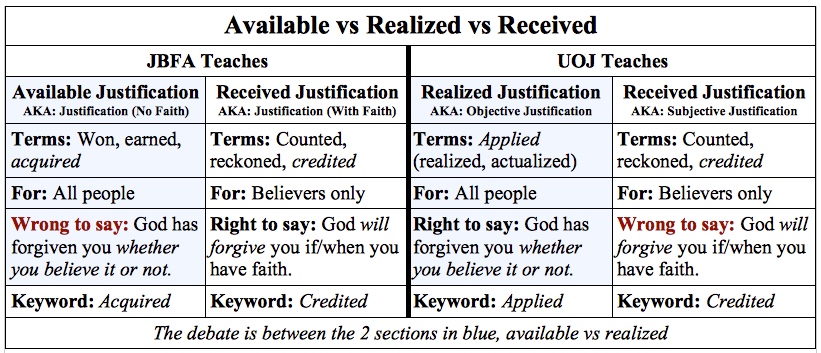
Let’s unpack each of these three terms – available vs realized vs received. (By the way, this could get a bit confusing – such is the nature of UOJ – but, I have included a visual representation at the end of this discussion for clarity…stick with me.)
Available (Acquired)
Let’s start with the JBFA view of what happened at the cross. Available justification has to do with the idea that, at the cross, Christ won, earned or acquired (whatever you’d like to call it) justification for all, yet it has NOT been realized for anyone apart from faith. In other words, though it is available, it does not specifically (individually) apply to (is not applicable for) the unbeliever in any way, shape or form due to his unbelief.
Put still another way, according to this view, it would be correct to say, “Through faith your sins are forgiven.” but would be wrong to say, “You are forgiven whether you believe it or not.”
The takeaway from this point of view is that justification is only available for the unbeliever  because it has only been acquired (not realized) for him on his behalf until faith should come along and apprehend it. The keyword as we move forward on this site is acquired.
Realized (Applied)
By contrast, realized justification (what I also refer to as applied justification, in that it is applicable, though not fully received by each individual…more on this in a bit) is simply a way of describing what is taught regarding the objective aspect of UOJ. According to UOJ, all people (including each and every unbeliever) have been actually justified, meaning justification is a real, genuine, literal (whatever you’d like to call it) aspect (reality) of their personal existence. In other words, justification has been fully real-ized (actualized or made real) in regard to each person’s individual life, yet, though this reality (according to UOJ) is said to be true, it is not a reality to the same extent that received justification is.
In keeping with this view, it would be correct to say, “You are forgiven whether you believe it or not.” as well as saying, “But, you don’t receive the benefits of this forgiveness except through faith. Without faith, though you are forgiven (through a legal declaration), you ALSO still stand condemned in your sins.” Yet, it would be wrong to say, “God will forgive you, if/when you have faith.”
The takeaway from this point of view is that justification has been fully realized for the unbeliever. It already applies to him in his life (is applicable to him), yet has not become his received possession until faith should come along and lay hold of it. The keyword as we move forward on this site is applied.
 Received (Credited)
Finally, there is received (or credited) justification. Both sides (UOJ and JBFA) effectively agree on received justification. Namely, that God has fully credited justification, forgiveness, righteousness to the believer’s account which has, as a result, been received through his faith.
This is what those on the side of UOJ would call the subjective aspect of UOJ, while those in the JBFA camp would say it is the only form (if you will) of justification.
The takeaway from this point of view is that justification has been fully credited and received. The keyword as we move forward on this site is credited.
Clear as mud?
If so, maybe this can add some clarity:
For Further Clarity
In an attempt to simplify the complicated (convoluted) nature of the topic of UOJ, what I have attempted to do next is to show both sides of the equation (both God’s and Man’s) as it pertains to both JBFA and UOJ. In other words, I have essentially demonstrated both the cause and the effect of justification.
For example, according to JBFA, what God has done through Jesus at the cross is that he has acquired justification. The resulting benefit for man, therefore, is that his justification has been made available to him through faith in Christ.
The whole situation looks something like this:

Clarity or Confusion?
So, where do you find yourself at this point? Is everything becoming clear or is it still muddled? Do you understand completely or are things still rather confusing? UOJ and the whole UOJ/JBFA debate can certainly be a lot to grasp. Hopefully, the real clarity will come when we dig into the text of Scripture itself to see what God has to say about justification.
Get ready? This is, by far, my favorite part of the site. Let’s feed on some good old bread from heaven, shall we?