What God Says About Justification
Before looking at God’s Word, we must first lay a little ground work.
Under My Skin
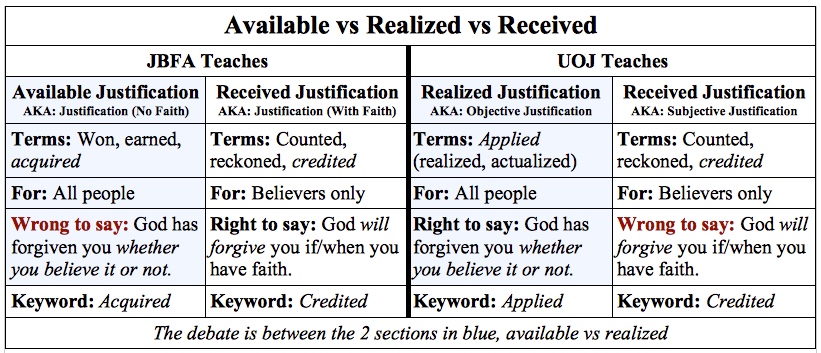
I once came upon an online debate of UOJ. Strong views were coming from both sides – views from those for and from those against. Part of the discussion centered around the key concept of acquired vs applied (meaning realized, not credited) justification and forgiveness, apart from saving faith.
This discussion of acquired vs applied justification really stuck with me…it got under my skin, so to speak. Then, the light bulb went on and it struck me that, “This is it!” This is what the whole debate comes down to.
Did Christ only acquire justification for all (to be credited through saving faith) or did God apply (realize) justification for each and every individual, even for those still in unbelief?
Various arguments were made for each side of the acquired/applied debate, yet as I recall, most (if not all) were arguments from reason and logic rather than from Scripture.
But, what if it’s all right there in God’s word? Further, what if it’s not an either/or equation, but a both/and equation?
What do I mean?
Having said that, I would like to introduce our investigation of Scripture by utilizing one single quote from Luther to set up a biblical discussion.
Luther on Acquired vs Applied
“It is a faithful saying that Christ has accomplished everything, has removed sin and overcome every enemy, so that through Him we are lords over all things. But the treasure lies yet in one pile; it is not yet distributed nor invested. Consequently, if we are to possess it, the Holy Spirit must come and teach our hearts to believe and say: I, too, am one of those who are to have this treasure. When we feel that God has thus helped us and given the treasure to us, everything goes well…” Sermons of Martin Luther, 8 vols., ed., John Nicholas Lenker, Grand Rapids: Baker Book House, 1983, III, p. 279. Pentecost Sunday. John 14:23-31.J-528 (Emphasis is mine)
Note that Luther states that this treasure lies in one pile and has not yet been distributed nor invested. In other words, it seems he is saying this treasure has been acquired, yet seemingly not made a reality (applied) for each and every individual’s personal existence, including the unbeliever….until faith apprehends it. Remember, it’s just “lyin’ around in a pile.”
Ah, ah, ah…I can practically see the expressions on some of your faces as you’re already conjuring up your refutation of what I’ve just said. You have no idea where I’m going with this, so just hold your horses and keep following along.
Where was I?
Ah, yes, it sounds like Luther disagrees with UOJ, but wait, there’s more.
Luther goes on to tell us how we come to possess this treasure (through faith/believing). He does this even though he began his statement by also recognizing and acknowledging that Christ has accomplished everything, which includes removing sin. What’s this? Everything accomplished? The removal of sin? This sounds similar to arguments made by proponents of UOJ.
So, which is it? Does Luther agree or disagree with UOJ?
Here we have Luther acknowledging that Christ’s work is both fully accomplished (including the removal of sin), yet this treasure still needs to be distributed from the pile it is just lyin’ around in.
Consider this…although Luther seems to recognize that this treasure is acquired and not yet applied for each and every person, he states that this treasure is to be found (so to speak) in a pile. I would suggest, however, that Scripture speaks of a much better “place” to find this treasure rather than in Luther’s “pile.” Let’s take a look.
Turning To God’s Word 
First things first. What happened at the cross?
~ God made him who had no sin to be sin for us. 2 Co 5:21a
Here we learn…that 1) Christ was, in-and-of-himself, without sin and 2) he became sin for us.
Therefore, we can say that according to his own life under the law, Jesus was without sin. He was sinless. Yet, we can also legitimately say that at the cross Jesus became sin. He became actually guilty of all sin. In fact, he became every sinner’s sin. Jesus did not go to the cross merely carrying our sin as though he put our sins in a bag and slung them over his shoulder. No! He became sin.
At the cross, Jesus became actually and fully guilty of all sin of all time. It was as though he had become a murderer, a blasphemer, a thief and a liar. Not because he was guilty of sin in-and-of-himself, but because he became so totally and completely intertwined with all of humanity that he became full guilty – fully sinful – in your place and mine. Therefore, God the Father could rightly and justly pour out the full force of his wrath on Jesus in our place. More than this, God could now legitimately justify and forgive each of us because of what had happened to Christ. Christ became sin.
Now, if we have that squared away in our thinking, let’s see what happened next. Note that these first two verses are agreed upon by many theologians (Lutheran or otherwise) as referring to Christ (“me” = Christ).
~ He who vindicates me is near. Isaiah 50:8a
~ Without controversy, the mystery of godliness is great: God was revealed in the flesh, justified [vindicated] in the spirit, seen by angels, preached among the nations, believed on in the world, and received up in glory. 1 Tim 3:16 (WEB) Bracketed note is mine.
A number of Lutheran scholars have concluded (and I agree) that the gist of these verses is that after Christ died guilty of our sin, he, himself, needed to be justified (vindicated) on our behalf. Christ, himself, needed to be declared “right with God,” having paid the full penalty for sin.
Where Is Justification Found?
This being the case, the question becomes, “Where is our justification to be found?”
Sadly, proponents of UOJ would emphatically state (numerous people have been disfellowshipped for disagreeing) that this justification has been made a reality (applied though, not fully credited) for all people, including the unbeliever. From a UOJ perspective, it is assumed that Christ’s own justification (vindication) automatically equates to the justification (vindication) of all people.
I’m going to pause and repeat that in a different way so as to encourage you to truly ponder what I’ve just said. UOJ A-S-S-U-M-E-S (it does not prove) the justification of Christ automatically equates to the justification of all. That is an enormous assumption!
Here are, quite possibly two of the most important questions you will ever hear regarding the topic of justification.
- Does Christ’s justification = the justification of all, or does it simply mean Christ, himself, has been justified on behalf of all?
- Does forgiven sin automatically = forgiven sinners?
In other words, in answer to our previous question (Where is our justification to be found?), proponents of UOJ conclude our justification is found in each and every individual – having been applied to the believer and the unbeliever alike. Though somehow not fully credited apart from faith.
But is this true? Or, is it over-reaching as a flawed interpretation of Scripture? Is it being read into the text, rather than drawn from the text?
Is Justification Found In A Pile?
What about Luther?
Is justification like a treasure “lying in a pile” as Luther suggests? Or, does Scripture offer us a better/fuller solution?
Soooo…does this treasure (our justification) lie in a pile? Hmmm. What if it is to be found stored up (so to speak) not in a place, but in a person? And, what if it were not only our justification, but also our forgiveness, our redemption, our acquittal, our righteousness, our life, our salvation and on and on…? What if all are to be found, not in a pile, but in Christ ? Now, there’s a radical thought. 😮
Further, what if one could argue that justification, forgiveness and righteousness have not only been acquired but fully applied and credited?
Oh, but let’s be careful….
I am not suggesting that these have been applied and credited to each and every individual, rather that they have been applied and credited to one account and one account only…until, through faith, each is distributed to each individual believer’s account.
Is Justification Found In A Person?
 Think of it this way (here it comes…this is my favorite part 😁), what if God has not applied justification, forgiveness and righteous to each unbeliever’s personal account, but instead has applied AND credited each unbeliever’s personal justification, forgiveness and righteousness to Christ’s account?
Stop…let that sink in.
What if this were essentially what so many proponents of JBFA have been trying to suggest for years, but without fully gasping all of the details in their own theology? What if we were to give these details a name and call them “Justification In Christ” (JIC)? And, what if this justification were both applied AND credited to each individual’s account exclusively by or through faith A-L-O-N-E?
What if the truth of Scripture actually brings both sides of the debate together? What if, in a very real sense, JBFA and UOJ are both true?
Don’t Take My Word For It
Is this a viable possibility? Maybe you don’t believe me? Good! You shouldn’t take my word for it. How about looking to God’s word instead?
Please pay careful attention! The following is what God has to say about justification, forgiveness, righteousness, etc…like it or not…believe it or not. This is what we might call God’s objective truth on the matter…will you subjectively believe it?
Where is our justification and redemption to be found? God’s, answer…in Christ.
~ For all have sinned and fall short of the glory of God, being justified freely by His grace through the redemption that is in Christ Jesus. Ro 3:23-24 (NKJV)
Where is our reconciliation to be found? Again…in Christ.
~ All this is from God, who reconciled us to himself through Christ and gave us the ministry of reconciliation: that God was reconciling the world to himself in Christ, not counting men’s sins against them. 2 Co 5:18-19
Where is our forgiveness? In Christ.
~ Be kind and compassionate to one another, forgiving each other, just as in Christ God forgave you. Eph 4:32
Where is our salvation? In Christ.
~ Therefore I endure everything for the sake of the elect, that they too may obtain the salvation that is in Christ Jesus, with eternal glory. 2 Tim 2:10
Where is our righteousness? In Christ.
~ We proclaim him, admonishing and teaching everyone with all wisdom, so that we may present everyone perfect in Christ. Col 1:28
~ God made him who had no sin to be sin for us, so that in him [in Christ] we might become the righteousness of God. 2 Co 5:21
→ How do we come to be in Christ ? Well, you must decide for yourself in light of Scripture, but I would argue it comes by way of the means of grace through faith. (See next verse, as well as, “How do we come to be in Christ?” below.)
~ For all of you who were baptized into Christ have clothed yourselves with Christ. Gal 3:27-28
Where is our new life/eternal life? In Christ.
~ In the same way, count yourselves dead to sin but alive to God in Christ Jesus. Ro 6:11
~ Therefore, if anyone is in Christ, he is a new creation; the old has gone, the new has come! 2 Co 5:17
~ Paul, an apostle of Christ Jesus by the will of God, according to the promise of life that is in Christ Jesus. 2 Tim 1:1
Where are our spiritual wisdom, righteousness, sanctification, redemption, forgiveness and grace to be found? You guessed it…in Christ.
~ And because of him you are in Christ Jesus, who became to us wisdom from God, righteousness and sanctification and redemption. 1 Co 1:30
~ To the church of God in Corinth, to those sanctified in Christ Jesus. 1 Co 1:2
~ In him we have redemption through his blood, the forgiveness of sins, in accordance with the riches of God’s grace. Eph 1:7
In fact, where are all of the incomparable riches of God’s grace to be found? In Christ, of course.
~ You then, my son, be strong in the grace that is in Christ Jesus. 2 Tim 2:1
~ I always thank God for you because of his grace given you in Christ Jesus. 1 Co 1:4
~ In order that in the coming ages he might show the incomparable riches of his grace, expressed in his kindness to us in Christ Jesus. Eph 2:7
What is the real object of our faith? Our own faith? Our justification? Our forgiveness? UOJ? No. Let me ask it another way. Where are all of the promises of God found and fulfilled? In Christ.
~ For no matter how many promises God has made, they are “Yes” in Christ. 2 Co 1:20
In Christ, we are seated in the heavenly realms. Pause and allow that one to sink in. This, quite possibly, best demonstrates the point I am attempting to make with all of this. Every spiritual blessing anyone could ever hope to have or imagine is so wrapped up in, hidden in, and encapsulated in Christ, that we (as believers) are even in heaven right this very minute…in Christ (go wrap your head around that one). If this is true, how much more is our forgiveness, righteousness, acquittal, justification, etc. all wrapped up in, hidden in, and encapsulated in Christ?
~ And God raised us up with Christ and seated us with him in the heavenly realms in Christ Jesus. Eph 2:6
Though it be a mystery, the mystery is solved in Christ.
~ And he made known to us the mystery of his will according to his good pleasure, which he purposed in Christ. Eph 1:9
In Christ, every spiritual blessing is found and accomplished.
~ Praise be to the God and Father of our Lord Jesus Christ, who has blessed us in the heavenly realms with every spiritual blessing in Christ. Eph 1:3
~ According to his eternal purpose which he accomplished in Christ Jesus our Lord. Eph 3:11
How do we come to be in Christ?
~ And you also were included in Christ when you heard the word of truth, the gospel of your salvation. Eph 1:13
And, in Christ, we find our peace.
~ And the peace of God, which transcends all understanding, will guard your hearts and your minds in Christ Jesus. Phil 4:7
~ Peace to all of you who are in Christ. 1 Peter 5:14
Whew! That was a lot. Wasn’t it so cool, though? Isn’t it awesome when we just allow God to do all of the talking on the subject of justification (or anything else)? Did I mention, that this is my favorite part of this site?
But wait…there’s still more.

Outside of Christ
What about those who are not in Christ? Do they stand acquitted, forgiven, righteous and justified?
~ The Lord knows how to rescue godly men from trials and to hold the unrighteous for the day of judgment. 2 Pt 2:9
~ Do you not know that the unrighteous will not inherit the kingdom of God? 1 Co 6:9 (NKJV)
~ Whoever does not believe stands condemned already because he has not believed in the name of God’s one and only Son. Jn 3:18
~ Whoever rejects the Son will not see life, for God’s wrath remains on him. Jn 3:36
~ When he [the Spirit] comes, he will convict the world of guilt in regard to sin and righteousness and judgment: in regard to sin, because men do not believe in me. Jn 16:8-9
~ If you forgive anyone his sins, they are forgiven; if you do not forgive them, they are not forgiven. Jn 20:23
Though proponents of UOJ think they have a valid response to these last 6 passages, there are serious flaws in the proposed solution (see Q & A, Category 1, Questions 4 & 5).
 Conclusion
Nowhere in Scripture does God inform us that he has justified the whole world (as you’ll see when we get to the UOJ Proof Passages section of the site) other than with a justification that remains exclusively in Christ until distributed by faith. In other words, what God does say is that he has justified Christ and as a result, he justifies those who are in Christ.
~ He who vindicates me [Christ] is near. Isaiah 50:8a
~ Without controversy, the mystery of godliness is great: God was revealed in the flesh, justified in the spirit…. 1 Tim 3:16 (WEB)
~ [All] being justified freely by his grace through the redemption which [is] in Christ Jesus; whom God has set forth a mercy-seat, through faith in his blood. Romans 3:24-25a (Darby)
~ Therefore, there is now no condemnation for those who are in Christ Jesus. Romans 8:1
~ And you also were included in Christ when you heard the word of truth, the gospel of your salvation. Having believed, you were marked in him with a seal, the promised Holy Spirit. Ephesians 1:13
~ For it is with your heart that you believe and are justified. Romans 10:10
Maybe it’s just me, but I can’t help but to conclude that the testimony of Scripture is clear. As Christians, every blessing we have, everything we hope for, indeed, everything we are, is all wrapped up and encapsulated (I love that word in this context) only in Christ.
It looks something like this:
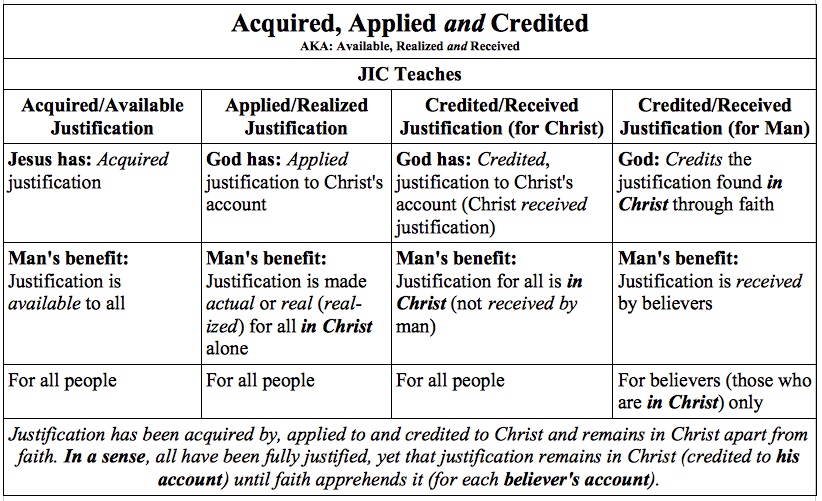
In keeping with JIC, one could legitimately argue that it would be correct to tell the unbeliever that God has fully and freely forgiven him in Christ.
On the other hand, one could also legitimately argue that it would be just as valid to tell the unbeliever, God will forgive him if/when he is granted the gift of faith in Christ.
For the record (just in case you were keeping a record), I didn’t come up with this stuff on my own. I did not come up with this just to create some theoretically viable way of bringing opponents from both sides together. (In fact, truth be told, I am loath to think of this as a possible form – though a very different form – of UOJ even though it would also serve as a form of JBFA. For years, I resisted presenting this truth in this way, because I became so opposed to UOJ.) Having said that, the reality is this…this is what the text of Scripture teaches. Go read the passages for yourself in context and see if they don’t still hold the same meaning compared to that which I have suggested.
Our justification, forgiveness and righteousness are found in Christ…A-L-O-N-E!
I don’t see any way around it. (Though I’m sure many will cling to their previously held beliefs, over clinging to Scripture.)
Moreover, our good, gracious and just God has not granted these things to those who are not in Christ. Instead unbelievers remain separated, outside of this treasure which God has undeservedly bestowed upon those whom he has brought to himself…brought to himself, in Christ. The treasure is there for all. It is ready and waiting. It is a real (realized, actualized, not potential – more on this later) treasure. It is a treasure that lies, not in a pile, but in a person. It is distributed (credited) to individuals, freely by his grace through faith and through faith alone.
But again, maybe that’s just me. As a Christian, you’ll have to decide for yourself how man comes to be forgiven, justified, acquitted, made righteous and the like. But as for me and my household, we’re going to cling to Christ as the object of our faith…not to faith itself…not to the false misleading doctrine of UOJ, not even to JBFA…not to anything else, but to Christ and to Christ alone.
Here we stand. We can do no other.
What about you?

 Many Lutherans (though certainly not all) believe in UOJ (pretty obvious, right?). Many others, however, reject UOJ in favor of (what has become known as) Justification By Faith Alone (JBFA – because, after all, Lutheranism needs more initials and/or acronyms…ya know, we’ve got ELCA, LCMS, WELS, ELS, UOJ, etc. Why not JBFA too? And, just for fun, I’ll add another to the mix in just a bit.) 😉

 Received (Credited)