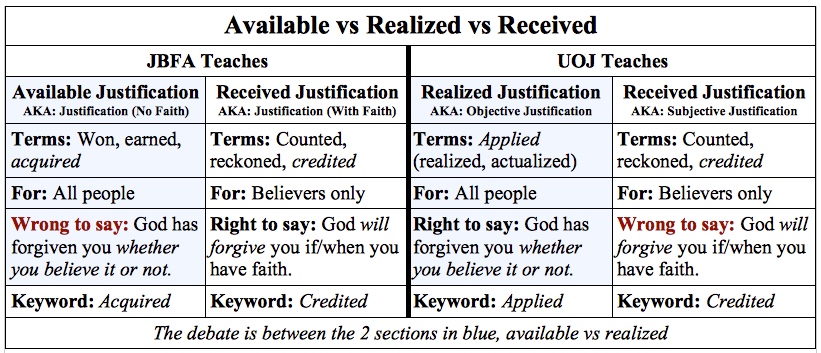
UOJ or JIC or…? On this site, I have attempted to share (for a PDF download of the full text of this site that you too can share…or keep for yourself, click here) the teaching of UOJ, along with various problems associated with it .
Additionally, I have attempted to offer a more biblical view of justification (which I have come to call Justification in Christ or JIC – not a new teaching, just a new identifier for the original biblical teaching…in my view) which is consistent with all of Scripture, including those biblical teachings which I have suggested serve to disprove UOJ.
Further, the foundation behind JIC was borrowed from Lutheran theologians who, themselves, were proponents of UOJ. What is that foundation? It is that Christ, himself, had to be vindicated/justified after having become sin for us.
Am I 100% convinced that JIC is the correct way to understand justification? No. But, I do lean heavily in that direction (about 99.9% convinced…I always leave some wiggle room to be corrected on any of my beliefs, but I also know what I believe and why I believe it…and, it’s not just “because my pastor said so.”) based on the biblical witness.
Am I 100% convinced that UOJ is NOT the correct way to understand justification? At this point in time, again I would say 99.9% convinced. And again, I am always willing to consider legitimate arguments from Scripture to the contrary (arguments FROM SCRIPTURE…you caught that, right?) At this point, I have read, researched and prayerfully considered much on the subject of UOJ and have been left thoroughly under-impressed with any supposed biblical arguments.
And, honestly, I don’t really care what other pastors, professors or Lutheran Fathers have to say on the issue unless it is directly taken from God’s word.
My Hope… I hope that this site serves to spark critical thinking on the subject of justification.
I further hope that this site prompts further discussion among Lutherans (theologians and non-theologians), truly willing to openly listen and discuss.
One observation I have made regarding the proponents of UOJ is that most seem over-confident (I’ll refrain from saying arrogant – oh, I guess I just did 😲) in their stance on UOJ. It is assumed that UOJ is the be-all, end-all position on justification. There often seems to be no legitimate consideration given to the possibility that UOJ could be wrong…only that the poor, yet-to-be-convinced, persistent errorist (the one who rejects UOJ) must be wrong.
I would suggest that this is not because the evidence from Scripture compels them to hold so tightly to UOJ (as we have seen some real problems with supposed “proof” passages for UOJ). Rather, I would suggest that these proponents of UOJ are more inclined to hold tightly to UOJ due to pride, tradition, fear of disagreeing with UOJ (and being disfellowshipped), or the like, more than based on the supposed evidence itself (though maybe they have been thoroughly deceived by the enemy).
In this sense, they are akin to the secular scientist who rules out the possibility of a creator before ever looking at the evidence in creation. Just as this is not good science (leading the evidence where you want it to go, rather than following the evidence wherever it leads), so every Christian ought to be readily willing to admit he could be wrong in one way or another and ought to humbly consider another possibility while thoroughly examining all of the biblical witness on the subject.
Should we allow ourselves to be blown back and forth by every wind of teaching? Of course not! But we ought not (dare not) stubbornly refuse to consider real truth, in light of the full testimony of Scripture, either.
Sadly, in regard to UOJ, proponents seem to have closed their eyes and ears to any possibility of being corrected. Zech 7:11 comes to mind:
~ Zech 7:11 But they refused to pay attention and turned a stubborn shoulder; they closed their ears so they could not hear. (CSB)
But, I am fairly confident that not all “proponents” emphatically agree with UOJ (or each other). I hope this site serves to embolden those who quietly disagree with UOJ to come out from hiding and to take a stand for truth…or at least take a stand for legitimate questioning and debate.
Finally, I hope this site serves to glorify God and to bring light to his truth, found in our Lord and Savior, Jesus Christ.
If I Have Failed… If I have, at times spoken too harshly, I apologize. It was not my intention. Though it was my intention to put forth the truth and to put down error plainly and boldly (and hopefully with a bit of levity). I currently stand vehemently opposed to UOJ, but I have done my very best to present information here as honestly and objectively as possible. I have made every effort to avoid name-calling or other derogatory language and the like, while at the same time openly “telling it like it is.” I hope I have successfully shared the truth (as I understand it) in true Christian love and humility. I again, apologize if I have failed at some point.
Blessings God’s blessings to you on your journey of discovery regarding God’s justifying work through Christ. May he lead you to a knowledge of the truth.
~ If any of you lacks wisdom, he should ask God, who gives generously to all without finding fault, and it will be given to him. James 1:5 (BSB)
Category Listings
This section addresses objections surrounding UOJ and is divided into tabs according to 3 categories below:
Category 3 (UOJ Proof Passages) could have easily fallen under either of the first two categories. For this reason and due to the fact that each proof passage contains a fairly detailed explanation, UOJ Proof Passages became its own category.
Instructions Each individual objection is presented as a question, a statement (in response to a question), or a proof passage…all in keeping with the each of the 3 categories, in a closed accordion style entry (to save space). Once opened, each listed entry contains the answer or analysis for each objection. To see each answer/analysis, simply click the large orange “+” symbol next to each question/statement. When finished with each answer/response, you can either close the response (click on the big orange “-” symbol) and open the next one or simply click on the next “+” symbol and the previous response will close automatically.
While it may be helpful to read each category tab, with each of its listed objections, all the way through one-at-a-time, you may also find it useful to skip around a bit.
Category Tabs
1) Direct Objections to UOJ2) Analyzing the Defense of UOJ3) UOJ Proof Passages
How Will You Know?
In the end, Scripture teaches what it teaches. It’s up to each individual Christian to determine for himself how to interpret what God has revealed to us in his word and what he has not. And, I would urge each Christian to think and seek to understand for himself, rather than simply “buying into” whatever his church body teaches. We are each to be sheep of the Good Shepherd, not sheep to our denomination.
Personally, I would argue that the biblical evidence seems overwhelmingly against God having declared all (including the unbeliever) to be justified in any way, shape or form other than by way of that which remains in Christ and becomes ours exclusively through saving faith…alone.
I’ve given UOJ Proof Passages their own category listing in the tabs above. Click below to go back to the top of this listing if you’d like to go to that tab now.
What is UOC? Universal Objective Condemnation (or UOC, as I have come to call it), by itself, disproves UOJ.
According to UOC, the whole world, according to their normal, natural sinful condition (apart from saving faith), stands separated from God and under his condemnation and wrath. This is universally and objectively true for all people whether they believe this or not.
UOJ & UOC Cannot Both Be True In short, if UOC is true, then UOJ cannot be true, and if UOJ is true then UOC cannot be true.
This is the reality of the situation, no matter how much the proponent of UOJ tries to confuse the issue by attempting to separate the two into a law/gospel distinction – declaring that since condemnation is a matter of law and forgiveness is a matter of the gospel, both can be true of the same person, namely, each unbeliever. (See “Does the unpardonable sin disprove UOJ?” and “Does the gospel withheld disprove UOJ?” for a demonstration that this supposed law/gospel distinction is nonsensical according to Scripture.)
For, the unbeliever cannot rightly be declared, by God, to be condemned, unrighteous and lacking in the removal of (and the forgiveness of) sins as well as being declared justified, righteous and forgiven at the same time.
Elsewhere (in the tabs above), I’ve taken a somewhat detailed look at those “proof” passages which supposedly teach UOJ. At best, they are very questionable – normally due to having been yanked out of proper context (though not always). But what about UOC? Is the Bible also so sketchy on the subject of the universal condemnation of sinful man?
What God Says About UOC Let’s take a look.
~ 2 Pt 2:9 – The Lord knows how to rescue godly men from trials and to hold the unrighteous for the day of judgment.
~ 1 Co 6:9 (NKJV) – Do you not know that the unrighteous will not inherit the kingdom of God?
~ 1 Pt 3:18 – For Christ died for sins once for all, the righteous for the unrighteous [unjust in NKJV], to bring you to God.
~ Jn 3:18 – Whoever does not believe stands condemned already because he has not believed in the name of God’s one and only Son.
~ Jn 3:36 – Whoever rejects the Son will not see life, for God’s wrath remains on him.
~ Jn 16:8-9 – When he [the Spirit] comes, he will convict the world of guilt in regard to sin and righteousness and judgment: in regard to sin, because men do not believe in me.
~ Acts 3:19 Repent, then, and turn to God, so that your sins may be wiped out, that times of refreshing may come from the Lord.
UOC Verses Explained
While we could include a number of additional passages to the list above, those listed are more than sufficient to prove the point. The unrighteous (the unjust) stand condemned already with God’s wrath remaining on them, while they are also convicted (by the Holy Spirit) of their guilt for their unbelief.
Does this sound like objective justification (UOJ) or universal condemnation (UOC)? The Reality is that each of these passages speaks volumes against UOJ.
UOJ expressly teaches that all people, including the unbeliever, have been declared to be both just and righteous. Yet, the first 3 passages above specifically declare the unbeliever to be unjust or unrighteous.
Next, Jn 3:18 speaks specifically of the unbeliever standing condemned already. This does not say, he will be condemned (after death or on the last day), but that he has already been declared to be condemned (as he stands in his condemnation) as a direct result of his unbelief. The fact that he stands condemned is a statement of his being declared condemned. UOJ would have us believe he has been formally and legallydeclared both condemned and forgiven at the same time.
Moving on, Jn 3:36 tells us that God’s wrath remains on the unbeliever. Again, this does not say that in the end, he will receive God’s wrath, but that God’s wrath is already there, remaining on him. To be clear, this is not man’s guilt and condemnation (judgement) remaining on him, this is God’s wrath (anger, fury) which remains on him. Why would God’s wrath, anger and fury remain on him if God, himself, has declared him to be forgiven in his own sight?
Further, Jn 16:8-9 tells us that the Holy Spirit is at work in the world, among the unbelievers convicting them of their guilt resulting from their unbelief. Yet, UOJ expressly teaches that even the unbeliever’s guilt for sin has been removed (he has been formally declared “not guilty”), he is guilt free. (Note that when I refer to “guilt” here, I am not referring specifically to guilty feelings, I am referring to actual legal guilt vs. innocence.)
Finally, Acts 3:19 gives us the flip-side of the equation. Not only are unbelievers still guilty and condemned before God, but this verse expressly tells us that they still need to have their sins removed as well…they are still lacking in forgiveness as a result of the removal of sin.
In other words, though proponents of UOJ proclaim that there is a supposed law/gospel distinction to be made regarding universal condemnation (law) and supposed universal justification (gospel), this verse negates that possibility (see also Mt 12:31-32 and theunforgivable sin as well as “Does the gospel withheld disprove UOJ?“).
UOC, by itself, disproves UOJ.
Which is more consistent with the entire testimony of Scripture when we allow Scripture to interpret itself, UOJ or JIC?
What is the Unforgivable Sin/Blasphemy of the Spirit? Good Lutherans understand that the gift of saving faith is just that…a gift, worked in us through the Holy Spirit by way of the means of grace (the gospel in word and sacrament).
Based upon this firm foundation, when an unbeliever (in their unbelief) rejects this work of the Holy Spirit to bring about saving faith, we can rightly understand this to be blasphemy against that which the Holy Spirit is doing to produce faith – blasphemy against the Holy Spirit, himself.
In other words, blasphemy against the Holy Spirit is effectively to exert one’s persistent unbelief. Or, put still another way, to blaspheme the Spirit is to choose to remain in unbelief, while resisting the Holy Spirit’s work to prompt one toward faith.
Having said this, let’s look at what Scripture calls the unforgiven sin. The fist two passages (from Hebrews and Acts) help to set the stage for the additional three passages below.
Setting the Stage
~ Hebrews 10:29 How much more severely do you think a man [who has fallen away from the faith] deserves to be punished who has trampled the Son of God under foot, who has treated as an unholy thing the blood of the covenant that sanctified him, and who has insulted the Spirit of grace?
~ Acts 7:51 “You stiff-necked people, with uncircumcised hearts and ears! You are just like your fathers: You always resist the Holy Spirit!
In Hebrews, we see that the one who was formerly a believer (but has fallen away from the faith) has, in reality, insulted the Holy Spirit (Spirit of grace). Further, in Acts, we see that Steven, who is speaking to the Jews just before his stoning, states that to reject the gospel message is to “resist the Holy Spirit.”
This brings us to the words of our Lord who states clearly that blasphemy against the Holy Spirit will not be forgiven.
The Unforgivable Sin
~ Mark 3:28-29 I tell you the truth, all the sins and blasphemies of men will be forgiven them. But whoever blasphemes against the Holy Spirit will never be forgiven; he is guilty of an eternal sin.”
~ Luke 12:10 And everyone who speaks a word against the Son of Man will be forgiven, but anyone who blasphemes against the Holy Spirit will not be forgiven.
~ Matthew 12:31-32 And so I tell you, every sin and blasphemy will be forgiven men, but the blasphemy against the Spirit will not be forgiven. Anyone who speaks a word against the Son of Man will be forgiven, but anyone who speaks against the Holy Spirit will not be forgiven, either in this ageor in the age to come.
In Mark, we learn that all other sins and blasphemies will be forgiven, but blasphemy against the Spirit will not be forgiven.
In Luke, we learn that 1) anyone who speaks a word against the son will be forgiven, but that 2) anyone who speaks against the Holy Spirit will not be forgiven.
Finally, in Matthew, we learn that 1) every sin and blasphemy (including speaking against the son) will be forgiven, but that 2) anyone who speaks against the Holy Spirit will not be forgiven. Moreover, we also learn that 3) this lack of forgiveness will be the reality for both this age and the age to come.
UOJ Disproved This last part is the “nail in the coffin” to disproving UOJ. Jesus makes it very clear that blasphemy against the spirit will NOT be declared forgiven, not only in the age to come, but in this age as well. In other words, the proponent of UOJ would suggest that all people (believer and unbeliever alike) are forgiven, even though the unbeliever will not receive the full benefit of this forgiveness, ultimately in the age to come. But, Matthew not only states that forgiveness will not be realized for the unbeliever in the age to come, but forgiveness will not be granted to him in this age either.
It is as though Jesus is effectively saying that the unbeliever is doubly unforgiven. Maybe Jesus, looking ahead to UOJ, just wanted to make sure everyone was clear on the matter. (Ya, think?)
Law/Gospel Distinction is Misapplied Moreover, proponents of UOJ like to confuse the debate further by suggesting that according to the law, unbelievers are still condemned, while at the very same time, according the gospel, all (including the unbeliever) have been forgiven. But notice that this passage from Matthew does nothing to suggest that the unbeliever is only condemned according to the law. Rather, in direct refutation of UOJ logic, this passage is expressly stating that the gospel of forgiveness is withheld.
In other words, UOJ would have us believe that the law and the gospel are essentially two sides of the same coin. On one side of the coin the unbeliever is condemned by the law, but on the other side he is forgiven by the gospel….supposedly.
The reality of Scripture, however, is that on one side of the coin the unbeliever is condemned while on the other side he is also not forgiven (see also Acts 3:19).
This passage from Matthew, by itself, emphatically disproves UOJ.
Otherwise, according to the proponent of UOJ, what we are supposed to conclude from this passage in Matthew, is that the reality of what Jesus is saying is, “All sins and blasphemies for all people of all time will be forgiven, even the sin of blasphemy against the Spirit. This forgiveness will be applied to each and every individual, even to the unbeliever. Yet, I tell you, even though this sin of blasphemy against the Holy Spirit is forgiven, it will also never be forgiven in this age or in the age to come.”
Now, I ask you, does this sound like our God of order and justice?
But, What About…? Some might object, “Ah, but…what about the first half of the above passages, which states that ‘all other blasphemies will be forgiven’? Doesn’t this demonstrate the truth of UOJ?” “In each of the gospel accounts mentioned above…” The proponent of UOJ might continue to say, “Jesus is doing the talking. Historically speaking, he spoke these words before he went to the cross, so isn’t Jesus saying that once he dies on the cross to pay for all sin, then, at that time, all men will be forgiven for all of their blasphemies?”
Absolutely not!
How do I know?
Because the second half of each passage won’t allow me to come to a typical UOJ conclusion, as I have already explained.
In fact, what both halves of each passage really suggest is the reality of JIC. If all sin is forgiven in Christ, then while the sin is forgiven, the sinner is not…that forgiveness remains in Christ. Only the one who is in Christ receives that forgiveness. The one outside of Christ (due to his persistent resistance of the work of the Holy Spirit – his blasphemy against the Holy Spirit) remains unforgiven.
The unforgivable sin, by itself, disproves UOJ.
But, you’ll have to decide for yourself, seeking the wisdom and guidance of the Holy Spirit, which makes more sense UOJ or JIC?
You may be wondering why I’ve included questions about both the unforgivable sin and the gospel withheld, when both seem so similar.
Well, there is certainly overlap between these two questions as well as the question regarding the Ministry of the Keys. Scripture speaks against UOJ in a number of similar, yet distinct, ways. Essentially, the unforgivable sin is, indeed, an example of the gospel withheld, but it is an extreme example where Jesus emphatically declares that those who commit this sin, will not only be unforgiven in the age to come, but are already unforgiven in this age as well.
Moreover, though proponents of UOJ have sometimes heard (and responded to) the objection that the unforgivable sin disproves UOJ by claiming a law/gospel distinction, to the best of my knowledge, no one has made the argument that the unforgivable sin specifically stands as an example of the gospel withheld (lack of gospel), not just an example of the sinner’s condemnation (law).
In other words, the unforgivable sin not only speaks of the unbeliever’s condemnation, but more specifically of his lack of forgiveness. He cannot be forgiven and expressly unforgiven at the same time. The unforgivable sin expressly speaks of the sinner as being without forgiveness (without the gospel) rather than his being condemned (under the law).
Therefore, 1) due to the fact that the unforgivable sin is a somewhat common objection to UOJ (and a strong objection at that) as well as 2) the fact that the gospel withheld is a seemingly new slant on the unforgivable sin (in addition to other Bible passages which speak of the unbeliever’s lack of forgiveness – rather than his condemnation), I felt both subjects deserved their own Q & A.
So, what is the difference between the unforgivable sin and the gospel withheld? Well, the gospel withheld does not necessarily refer to the unforgivable sin, but the unforgivable sin is one example of the gospel withheld.
Truth or Fine Sounding Argumentation? One way in which proponents of UOJ attempt to overcome the objections associated with the fact that Scripture clearly states that unbelievers stand condemned under God’s wrath is by making the claim that there is a law/gospel distinction being made between God’s condemnation and God’s forgiveness as explained by UOJ.
According to this line of thinking, it is simply a matter of the law when we understand that unbelievers stand condemned by God. By contrast, it is a matter of the gospel (so it is taught) to understand that these same unbelievers have God’s forgiveness applied to their lives. The two teachings, though seemingly contradictory (according to the proponent of UOJ) can still coexist nicely, once we understand this law/gospel distinction.
~ Col 2:4 I tell you this so that no one may deceive you by fine-sounding arguments.
While this may be a fine-sounding argument, I would suggest that it is a hollow and deceptive philosophy which has been imposed upon the text of Scripture rather than pulled from the text.
~ Col 2:8 See to it that no one takes you captive through hollow and deceptive philosophy, which depends on human tradition and the basic principles of this world rather than on Christ.
Why do I think this is just a fine sounding argument? What about those times when Scripture fails to speak in terms of the unbeliever’s condemnation under the law, but instead, speaks of the gospel being withheld?
More of The Same? I’ve touched on the concept of “the gospel withheld” in a couple of other Q & A’s, but I believe this deserves its own Q & A, so we can dig into it in more detail.
Quite simply, the gospel withheld, by itself, disproves UOJ.
To be clear, those passages which speak of wrath and condemnation before a holy God, can indeed, rightly be considered law passages, while those passages which speak of justification, forgiveness and righteousness can also rightly be considered gospel passages.
If what I have just said is true, then what’s the problem?
Here it is. The law and the gospel do not…cannot…apply equally to the same person at the same time.
Under Law or Grace? When we look at the whole of Scripture and allow Scripture to interpret Scripture, we come to realize that the believer is no longer under the law, but under grace. The law no longer applies to him in the same way that it did when he was an unbeliever.
~ Ro 6:14 [Speaking to those who have been brought from death to life – i.e. believers] For sin shall not be your master, because you are not under law, but under grace.
The flip side is also true – the unbeliever is not under grace (in a legal sense), rather he is exclusively under the law. Yes, God bestows some measure of grace on all of creation, but we are not speaking of that, here. We are speaking of God’s grace in a forensic (legal) sense in regards to God’s eternal judgement, specifically in regard to justification, forgiveness and righteousness. In this sense, the unbeliever is not under God’s grace, he is exclusively under the law.
~ Ro 3:19 Now we know that whatever the law says, it says to those who are under the law, so that every mouth may be silenced and the whole world held accountable to God.
The long and the short of it is that those passages which speak of the unbeliever’s condemnation and wrath are specifically statements of condemnation and wrath, under the law.
Moreover, those passages which speak of the believer as having received God’s justification, forgiveness and righteousness are specifically statements of gospel, to those under God’s grace.
Distinction or Blending? To say that the unbeliever is both condemned and forgiven at the same time is not a distinction between law and gospel, but a blendingof law and gospel. It is equivalent to saying that the unbeliever is both under the law and under grace at the same time.
If we are going to use a law/gospel argument, let’s use the law and the gospel correctly (and fully) without blending the two together. Any good Lutheran knows that we should always be careful to use the law and the gospel correctly, including the fact that we should never mix the two together.
But wait…there’s more! Scripture not only speaks of the unbeliever as standing under God’s wrath and condemnation, but it also speaks specifically of the gospel being withheld from him. In other words, Scripture not only speaks of the law condemning the unbeliever, but at the other end of the spectrum (or on the other side of the coin, if you will) of his NOT being forgiving by the gospel.
I’m no rocket scientist, but it doesn’t take a genius to figure out that the gospel cannot rightly be said to be fully applied (though not credited) and to be fully withheld at the same time.
Again, to be clear, I am not speaking of wrath and condemnation passages, here. I am speaking of gospel withheld passages. There is an important distinction to be made between the two.
Proofs of Gospel Withheld Let’s take a look at a few passages which specifically speak of the gospel being withheld.
We’ll begin in the Old Testament. An argument could be made that these OT passages do not apply to those in the NT era. I would encourage you to look them up for yourself in their broader context to see if any of these are exclusively for the people of the OT or whether some (or all) are intended to be understood in an ongoing sense.
Moreover, UOJ teaches that God’s forgiveness is essentially retroactive, meaning it not only applies from the cross (or empty tomb, as the case may be) forward, but goes all the way back to creation. So, if you want to argue that these OT passages do not apply, you’ll have to factor this retroactive application into your thinking as you try to wrap your head around the problems with UOJ.
OT Passages:
~ Deut 29:19-20 When such a person hears the words of this oath, he invokes a blessing on himself and therefore thinks, “I will be safe, even though I persist in going my own way.” This will bring disaster on the watered land as well as the dry. The LORD will never be willing to forgive him; his wrath and zeal will burnagainst that man. All the curses written in this book will fall upon him, and the LORD will blot out his name from under heaven.
This chapter ends with these words from verse 29 (see, I’ve done some of the context homework for you…you’re welcome 😜):
~“The secret things belong to the LORD our God, but the things revealed belong to us and to our children forever, that we may follow all the words of this law.”
So, what do you think? Could this entire OT passage (verses 19-29) include those of us in the NT era?
Next…
~ Ex 23:20-21 “See, I am sending an angel [Many would say this angel (messenger) is Christ] ahead of you to guard you along the way and to bring you to the place I have prepared. Pay attention to him and listen to what he says. Do not rebel against him; he will not forgive your rebellion, since my Name is in him.
~ Num 14:18 The LORD is slow to anger and abounding in steadfast love, forgiving iniquity and transgression, but he will by no means clear the guilty…
Notice this last verse (Num 14:18) is clearly speaking of God’s slowness to anger and of his abounding and steadfast love as expressed in forgiveness. Yet, even though it speaks of the wonders of God’s love and forgiveness, his abounding love is not bound-less love. His love has boundaries which coincide with his justice and holiness. God will not clear (gospel) the guilty (law).
Did you catch the significance of this verse. If any verse in all of Scripture has potential for being a perfect UOJ proof, the first part of this verse would lead us to believe that this is it!
UOJ assumes God’s love, as expressed through forgiveness, is boundless. Yet, though this verse speaks of God’s abounding love, expressed through forgiveness, it also does that which the rest of Scripture consistently does, it refuses to result in UOJ. The second portion of the verse goes out of its way to explain the whole truth of the matter. Namely, that God’s love, expressed through forgiveness, though abounding is not boundless.
For God’s wrath and judgement remain for the guilty. The guilty have no part in the forgiveness of the first part of the verse. The guilty are not cleared of their guilt as the second part of the verse states. Finally, the guilty are not the guilt free, but remain theguilty as the second part also states.
In short, the gospel is withheld from them.
Let’s move on the the New Testament.
NT Passages:
~ Mt 6:14-15 For if you forgive men when they sin against you, your heavenly Father will also forgive you. But if you do not forgive men their sins, your Father will not forgive your sins.
~ Jn 20:23 If you forgive anyone his sins, they are forgiven; if you do not forgive them, they are not forgiven.”
~ Acts 3:19 Repent, then, and turn to God, so that your sins may be wiped out, that times of refreshing may come from the Lord.
~ Mt 12:32 Anyone who speaks a word against the Son of Man will be forgiven, but anyone who speaks against the Holy Spirit will not be forgiven, either in this age or in the age to come.
Conclusion As you can hopefully see from the above passages, the unbeliever’s condemnation before God is more than a matter of a law/gospel distinction. Scripture not only informs us that the unbeliever is condemned under the law, but, in keeping with the testimony of Scripture, he is not forgiven either.
While these two sides of the same truth ought to be self evident, UOJ attempts to confuse the issue by claiming a supposed law/gospel distinction which is ultimately a blending of law and gospel (rather than a distinction between the two) as explained above.
What it comes down to is this: The word of God very clear states that those who do not find themselves among the made-new children of God remain unforgiven, while the words of men claim (contrary to God) that these same unbelievers are forgiven. Bearing in mind that I have attempted to demonstrate (under the 3rd category tab, “UOJ Proof Passages”) UOJ has never legitimately (in context) been proved from Scripture, in the first place.
Either you believe our God of order, has both forgiven and not forgiven the unbeliever at the same time, or you (at the very least) are willing to question the idea…if not forsake it altogether.
If enough people question it, maybe Lutheran theologians will eventually feel compelled to legitimately discuss and debate…including actually listening to and considering an alternative (more biblical) view.
As for me, I have to conclude that God said what he meant and meant what he said…”not forgiven” means not forgiven, rather than meaning not forgiven and also forgiven. Call me crazy.
The gospel withheld, by itself, disproves UOJ.
Which is more consistent with the entire testimony of Scripture (both Old and New Testaments), UOJ or JIC?
You may be wondering why I’ve included questions about both the unforgivable sin and the gospel withheld, when both seem so similar.
Well, there is certainly overlap between these two questions as well as the question regarding the Ministry of the Keys. Scripture speaks against UOJ in a number of similar, yet distinct, ways. Essentially, the unforgivable sin is, indeed, an example of the gospel withheld, but it is an extreme example where Jesus emphatically declares that those who commit this sin, will not only be unforgiven in the age to come, but are already unforgiven in this age as well.
Moreover, though proponents of UOJ have sometimes heard (and responded to) the objection that the unforgivable sin disproves UOJ by claiming a law/gospel distinction, to the best of my knowledge, no one has made the argument that the unforgivable sin specifically stands as an example of the gospel withheld (lack of gospel), not just an example of the sinner’s condemnation (law).
In other words, the unforgivable sin not only speaks of the unbeliever’s condemnation, but more specifically of his lack of forgiveness. He cannot be forgiven and expressly unforgiven at the same time. The unforgivable sin expressly speaks of the sinner as being without forgiveness (without the gospel) rather than his being condemned (under the law).
Therefore, 1) due to the fact that the unforgivable sin is a somewhat common objection to UOJ (and a strong objection at that) as well as 2) the fact that the gospel withheld is a seemingly new slant on the unforgivable sin (in addition to other Bible passages which speak of the unbeliever’s lack of forgiveness – rather than his condemnation), I felt both subjects deserved their own Q & A.
So, what is the difference between the unforgivable sin and the gospel withheld? Well, the gospel withheld does not necessarily refer to the unforgivable sin, but the unforgivable sin is one example of the gospel withheld.
Now, onto our next similar/related subject, the “Ministry of the Keys.”
What is The Ministry of The Keys? On three occasions, Jesus gave his disciples (including you and me) the authority to bind and to loose sins. On one of these occasions, Jesus referred to this authority as using the keys of the kingdom of heaven.
~ Mt 16:19 I will give you the keys of the kingdom of heaven; whatever you bind on earth will be bound in heaven, and whatever you loose on earth will be loosed in heaven.”
~ Mt 18:18 “I tell you the truth, whatever you bind on earth will be bound in heaven, and whatever you loose on earth will be loosed in heaven.
~ John 20:23 If you forgive anyone his sins, they are forgiven; if you do not forgive them, they are not forgiven.”
In the first two passages above, we have similar wording, “whatever you bind…will be bound.” Here, it is worth noting that many would argue that a better translation might be, “what ever you bind…will have been bound.”
In other words, the binding has already been done in heaven and disciples of Jesus are merely recognizing this and pronouncing it to those who persist in their unbelief. Put still another way, the sins are not bound in heaven because of the pronouncement, rather the pronouncement comes due to the fact that sins remain bound in heaven.
Compare to UOJ Now, let’s think this through, in light of UOJ. The pronouncement (on earth, if you will) that the unbeliever remains bound to his sins, is the direct result of the truth of this same reality in heaven…due to unbelief. In other words, this is the reality in the eyes of God. God sees the unbeliever as still bound to his sins, until faith should lay hold of the forgiveness of sins. Apart from faith, God does not see forgiveness, he sees sins held bound.
Want further evidence? Just look at the other half of these same two verses. By contrast, Jesus states that once sins are forgiven, disciples should pronounce the forgiveness of sins (or the loosening of sins). Again, we have a less than stellar translation on this half of the verses…whenever disciples pronounce the loosening of sins, it is due to the fact that faith has become evident (by confession, at least) and that the sins have therefore already been forgiven in heaven by the time a disciple pronounces it.
Now, the proponent of UOJ, may make the claim that the fact that the forgiveness of sins already exists before being pronounced, actually serves to prove the truth of UOJ. He might suggest that sins are already forgiven before forgiveness is pronounced, therefore UOJ must be true. But as I have just explained, there is also another possibility…that due to his new-found faith, forgiveness has become a reality, before the pronouncement of it. So, the simple fact that forgiveness exists before the pronouncement of it, does nothing to prove UOJ.
At this point, Jn 20:23 steps in to further disprove UOJ. In John, Jesus does not say, “whatever you bind…will have been bound,” rather he says (paraphrasing), “whatever you do not forgive, will not have been forgiven.”
Nail in the coffin…case closed!
The Ministry of the Keys disproves UOJ.
Let Scripture Interpret Scripture
While the teaching of UOJ would have us believe that all people of all time have been declared not guilty, free of sin, justified and even righteous, when we allow Scripture to interpret itself, we find that through the Ministry of the Keys we must reject this notion.
Jesus intends for us to go out and to share the good news with others, but what good news would proponents of UOJ have us believe we are to share? We are (according to UOJ) supposed to preach the good news that God has forgiven all people (applied this forgiveness to each individual), believer and unbeliever alike.
In other words, evangelizing to an unbeliever might look something like this:
Christian: “Friend, there is good news! God has forgiven all of your sins…full forgiveness applied to you in the eyes of God. And, this is true even if you don’t believe it!”
Unbeliever: “Great! If what you are saying is true, then why would I need to be a Christian – a believer?”
Christian (using the binding key): “Well, because if you don’t then you are still bound to your sins.”
Unbeliever: “But, you just said all of my sins are forgiven, even if I don’t believe it. How can I possibly be forgiven and bound to my sins at the same time?”
Christian: “Uhhh, that’s a great question. All I know is that, this is what my church says that the Bible says.”
Unbeliever: “Well, then either your church, or your God (or both) make no sense, since what you’ve just said completely contradicts itself. I thought you “Bible believing” Christians were all about absolute truth. How can truth contradict itself? And…explain to me again why would I want to have anything to do with being a Christian..and, for that matter, why would you?”
The Ministry of the Keys, by itself, disproves UOJ.
Which is more consistent with the entire testimony of Scripture, UOJ or JIC?
What is Meant by Spiritual Identity? This is a critically important doctrine which is largely overlooked or misunderstood throughout much of Christianity. Personally, this just blows my mind due to the fact that the testimony of Scripture is so obvious on the matter. When I first discovered this reality for myself, I was sure I was the only big dope who didn’t understand it…due to its being so obvious in the text of Scripture. Since, then I have only become more and more convinced that many (if not most) Christians (did you catch how nice I was being?…notice I did not say, “other dopes” 😉) do not understand it.
I’ll attempt to keep my explanation brief, yet thorough enough to understand.
Unconverted Man Essentially, it comes down to this: According to Scripture, man is made up of two fundamental parts – flesh (or, body) and spirit (Mt 26:41 & 2Co 7:1). According to our normal, natural, fallen condition, we are all sinful in both flesh and spirit from conception forward. It would be true to say of the unbeliever, that he not only commits sin, but that he is sin. He is sinful through-and-through. He can do nothing to please God and can only sin all of the time. God puts it this way:
~ Ps 51:5 Surely I was sinful at birth, sinful from the time my mother conceived me.
~ Isa 64:6 All of us have become like one who is unclean, and all our righteous acts are like filthy rags.
~ Heb 11:6 Without faith it is impossible to please God.
~ Ro 14:23 Everything that does not come from faith is sin.
You might think of it like this…
Imagine I am covered in sloppy, wet mud from head to toe. I am a walking mud-pile, with only two white eyeballs showing through all of the filth.
Though I may desire to do some nice things for you, you would likely prefer I did not. Though I might offer to give you a hug; to make your lunch or to wash your new white shirt, you would likely decline my offers.
Why?
Because everything I would do – everything I would touch – would be covered in filth. Everything I had done would be tainted by the filthy stains I had left behind. In this filthy condition, I could not help but to leave filth’s stains behind, in all I’d do.
So it is with my sin. When sinful through-and-through (in both flesh and spirit), everything I think, say and do is tainted by sin. This is why God cannot see anything other than filthy rags when, even my best attempts to please him, are done apart from saving faith. This is why God must declare:
~ Ro 14:23 Everything that does not come from faith is sin.
And:
~ Heb 11:6 Without faith it is impossible to please God.
Converted Man By contrast, however, when the Holy Spirit produces faith in the heart of man, he also transforms him, he births new life in him and the man becomes a new creation.
I want to be very clear here. Many Christians today are confused by the sinner/saint status of the Christian. Because we still sin, many (in my experience, it is not just many but most) Christians seem to believe that God merely chooses to see us as new and/or righteous. They believe that God has NOT actually made us righteous, but only chooses to see us that way. “After all,” they seem to conclude. “I am obviously still a sinner. How could I possibly be actually, literally perfect or righteous?” They believe there is only a change in status (how God sees us), but not a change in condition (how God has made us to be). Sure, they may realize they have some new, improved desires, but they seem to see this as only the result of a new attitude, not a fully new condition.
But, Scripture doesn’t allow for these faulty conclusions. God has made it very clear that he not only sees us as new (sees us as righteous), but he has actually, literally made us new in spirit. Though our sinful flesh remains, the spirit of the true Christian is entirely new, robed in the righteousness of Christ.
Don’t take my word for it. Here is what God has to say about it:
~ Ezek 36:25-26 I will sprinkle clean water on you, and you will be clean; I will cleanse you from all your impurities… I will give you a new heart and put a new spirit in you.
~ Jn 3:3-6 In reply Jesus declared, “I tell you the truth, no one can see the kingdom of God unless he is born again…I tell you the truth, no one can enter the kingdom of God unless he is born of water and the Spirit. Flesh gives birth to flesh, but the Spirit gives birth to spirit.
~ 2 Co 5:17 Therefore, if anyone is in Christ, he is a new creation; the old has gone, the new has come!
~ Isa 61:10 I delight greatly in the LORD; my soul rejoices in my God. For he has clothed me with garments of salvation and arrayed me in a robe of righteousness
~ 1 Co 6:17 Anyone joined to the Lord is one spirit with him. (CSB)
~ Ro 8:10 But if Christ is in you, your body is dead because of sin, yet your spirit is alive because of righteousness.
This last verse (Ro 8:10) gives us the clearest picture of just what it is that I am referring to. As Christians, we have been given new life in spirit. We are literally perfectly righteous – robed in the righteousness of Christ, one spirit with him. Yet, this new spirit is wrapped up (so to speak) in our remaining sinful flesh. We are literally a saint and a sinner at the same time. Not because God merely chooses to see us as a saint even though we are really only a sinner, but because we have been perfected in Christ (in spirit), even though a sinful flesh remains.
This is key! For God sees us (views us, looks at us) not according to the flesh, but according to our having been made a new creation in spirit.
~ 1 Sam 16:7 The LORD does not look at the things man looks at. Man looks at the outward appearance, but the LORD looks at the heart.”
~ 1 Pt 3:4 Instead, it [a woman’s beauty] should be that of your inner self, the unfading beauty of a gentle and quiet spirit, which is of great worth in God’s sight.
~ Jn 4:23-24 Yet a time is coming and has now come when the true worshipers will worship the Father in spirit and truth, for they are the kind of worshipers the Father seeks. God is spirit, and his worshipers must worship in spirit and in truth.”
~ Ro 12:1 Therefore, I urge you, brothers, in view of God’s mercy, to offer your bodies as living sacrifices, holy and pleasing to God–this is your spiritual act of worship.
Summary & Conclusion Therefore, the unbeliever, who is sinful through-and-through in both flesh and spirit can do nothing good in God’s sight. While the Christian, on the other hand, is viewed only according to his righteousness in Christ. Yes, God is aware of the sins of his flesh and may even discipline him in order to keep him in the true faith and from falling away (once again dying in spirit). But he is seen (and judged, if you will) by God according to his made-new spiritual identity.
Now, that we (hopefully) have this clear in our minds, what does this have to do with UOJ?
Proponents of UOJ state that God has declared all (even the unbeliever) to be justified, forgiven andrighteous in his sight…that all (including the unbeliever) have had a change in their status (how God views them), though not a change in their nature (how God has made them to be).
UOJ, therefore, assumes justification (the declaration of a change in status) comes before sanctification (a change in nature). This, however, is never proven by the proponent of UOJ.
I would argue that justification and sanctification essentially happen simultaneously and that God only declares the sinner to be righteous as a result of his having been made righteous by way of a new spirit (see: Related Question below). In other words, God only declares to be true that which is actually true, not that which is untrue.
Otherwise, according to UOJ, God is declaring the man who is still sinful through-and-through (in both flesh and spirit); the man who cannot possibly please God (Heb 11:6); the one whose best efforts at righteous acts are nothing but filthy rags (Isa 64:6); the one whose every action (in fact, he himself) is only sin apart from faith (Ro 14:23), as not only justified, but righteous. Effectively, UOJ states that God declares a lie to be true.
By contrast, according to JIC, God remains true to himself and only declares those who have been made new (those who have been made righteous), to be righteous.
Therefore, spiritual identity, by itself, disproves UOJ.
Which is more consistent with the entire testimony of Scripture, UOJ or JIC?
Completed or Ongoing Sanctification? Above I spoke of justification (being declared righteous) and sanctification (having been made righteous) essentially happening simultaneously. In so doing, I explained that the believer has been fully sanctified by way of receiving a new spirit. But, doesn’t Scripture teach that the believer is still being sanctified?
Actually, Scripture teaches both…that the believer is fully sanctified and is continuing to be sanctified. Moreover, there is a perfectly simple and reasonable explanation as to why this is so.
Let’s look at a couple of quick examples.
The believer’s sanctification is already completed:
~ 1 Corinthians 6:11 And that is what some of you were [sinners, of the kinds Paul listed in verses 9-10]. But you were washed, you were sanctified, you were justified in the name of the Lord Jesus Christ and by the Spirit of our God.
The believer’s sanctification is incomplete and ongoing:
~ 1 Thessalonians 4:1-4Finally, brothers, we instructed you how to live in order to please God, as in fact you are living…It is God’s will that you should be sanctified: that you should avoid sexual immorality; that each of you should learn to control his own body in a way that is holy and honorable…
In context, both passages are obviously speaking to believers (as indicated in the second passage by Paul’s use of the word “brothers”). Note the distinction between these two passages, however. The first seems to speak of the time of our conversion, while the second speaks of the ongoing life of sanctification. Note too, the controlling of the body (the flesh) in the second passage.
The long and the short of it is this…the believer has been fully sanctified in spirit, while at the same time he continues to be sanctified in flesh.
Scripture Interprets Scripture One thing I have gratefully learned from my Lutheran heritage is that we must always allow Scripture to interpret Scripture.
In other words, as it applies to UOJ, we cannot forsake one portion of Scripture for the sake of upholding a flawed belief loosely based upon (or read into) other portions of Scripture.
Is the biblical evidence overwhelmingly against the validity of UOJ?
Well, you will have to decide for yourself, hopefully you’ll do so by being honest with all of the text of Scripture, in its proper context. Personally, I would suggest that individually, each of the previous five arguments, 1) the unforgivable sin, 2) universal condemnation, 3) the gospel withheld, 4) the keys, and 5) spiritual identity, each by itself, disproves UOJ. But when combined together, the biblical witness is overwhelmingly against the validity of UOJ, in my view.
Again, you will have to decide for yourself with or without the help of the Holy Spirit as your guide. The choice is yours.
What say you? Which is more consistent with the entire testimony of Scripture, UOJ or JIC?
Now, let’s briefly consider some additional problems with UOJ.
For Now Technically, according to the current “official” teachings of UOJ, proponents are quick to reject universalism (the belief that all people are saved) as being an unbiblical, heretical, teaching.
Associated with this, proponents of UOJ also reject any notion of new life or eternal life having been granted to all people apart from saving faith…for now.
Example 1 For example, here is a quote from a pro-UOJ resource:
“Objective justification is not the teaching that everyone, regardless of faith or unbelief, will be saved.” (Justification – Am I good enough for God?, Rolf Preus, page 3, Northwestern Publishing House).
Yet, in the very same booklet, it says this:
“Objective justification guarantees that the means of grace really are means of grace.
‘Friend, are you saved?’
‘Yes, I am saved.’
‘Praise the Lord! When were you saved?’
‘When Jesus took away my sins on the cross. It was then that God saved me and justified me by Jesus’ blood.’” (Justification – Am I good enough for God?, Rolf Preus, pages 18-19, Northwestern Publishing House).
Universalism in Disguise? Do you see the problem? Though UOJ proponents technically reject universalism (when the subject of universalism is brought up), they also effectively promote it (when not making the connection to universalism). In other words, they do not always seem to be putting two and two together, in the whole of their teaching.
Fact, God’s People Are Prone to Wandering If there is one thing I have learned over the past 20+ years since my Christian conversion, it is this…our own sinful natures, coupled with the influence of Satan, combine to make an often underestimated, yet powerful force which is bound and determined to lead us astray. In all of human history, it’s a fact, many (if not most) of God’s people have been prone to wander to one extent or another.
Here’s what I mean. Today, UOJ proponents openly reject universalism, while subtly they are also being lead astray (by sin and Satan) to promote it at the very same time. Tomorrow (which could be 10, 25 or 50 years from now), UOJ proponents may no longer be rejecting universalism, but instead, may have been led astray, little-by-little, until they have come to openly embrace it.
Today, those who reject UOJ, while members of a UOJ promoting church body, are disfellowshipped for their rejection of UOJ. Tomorrow, those who reject universalism may be disfellowshipped by those same church bodies who will have, at that time, accepted universalism as sound doctrine.
Far more important than remaining in fellowship or being disfellowshipped, however, will be the multitudes who will have been led astray by this false theology to the point of being separated (or remaining separated) from God for eternity. And, all in the name of sound doctrine.
Example 2 As I wrap up the answer to this Q & A question, I will leave you with one more example of UOJ leading to universalism. This too is from a pro-UOJ resource.
“…God has, as a gift of his grace, justified all men, that is, he has declared them righteous and just. As a result, they [what else can “they” refer to but the previous “all men” and “them”?] are awarded life.
Since this is something that has taken place through Jesus’ life death and resurrection and is an objective reality, it may be spoken of as objective justification. It is also called universal atonement.” (Basic Doctrines of the Bible, Armin W. Schuetze, page 42, Northwestern Publishing House). Emphasis and bracketed text are mine.
In addition to calling it “objective justification” and “universal atonement,” I think there is another term for it – “universalism” (in a not-so-subtle disguise).
No Surprise My hope and prayer is that many will begin to see UOJ for what it really is; that they will see that the biblical evidence is overwhelmingly against UOJ and stop proclaiming it to the multitudes. If not, we should not be surprised when many are led astray into universalism in the future.
Every false doctrine, carried to its logical conclusion, ends in spiritual death.
Think about it.
Which is more consistent with the truth of Scripture and therefore less likely to lead people away from the Savior, UOJ or JIC?
Another Possibility According to UOJ, God has forgiven all sinners (including unbelievers) whether they believe it (or are even aware of it) or not.
According to UOJ, it is ASSUMED that justification, forgiveness and righteousness (among other things) are all effectively synonymous.
Further, according to UOJ, it is ASSUMED that forgiven sin = forgiven sinner. Moreover, forgiven sinner = all sinners forgiven (believer and unbeliever alike).
Yet, is there another possibility?
In keeping with JIC, forgiven sin ≠ forgiven sinner, except through faith (note, that I used a “does not equal” symbol, there…you caught that, right?).
The questions from proponents of UOJ then become, “How can sin be actually forgiven if each individual has not been forgiven? In other words, how can sins be actually forgiven apart from sinners being actually forgiven, as well?
Simple. As explained earlier in the “God Says” section of this site, this forgiveness for each person’s sins has been forgiven in Christ’s account and is then distributed to individuals (each person’s own account) exclusively through faith.
Why Does This Matter? Okay, so what if it’s true that sins forgiven, may not equate to each and every sinner forgiven? What’s the point?
I address this subject for a couple of reasons:
1) To illustrate the point that there are numerous assumptions inherent in UOJ theology, which have not been proven.
2) To hopefully emphasize the need for each of us as Christians to think critically and to be willing to question that which we are being taught. And, to do such thinking and questioning in light of Scripture and sound, biblical reasoning.
Let’s use Jn 1:29 to help illustrate my point.
Who Takes Away…
~ John 1:29 The next day John saw Jesus coming toward him and said, “Look, the Lamb of God, who takes away the sin of the world!”
Here, the proponent of UOJ may say, “See, there you have it! Scripture is clear. Christ, the lamb of God, has taken away the sins of the whole world.”
Well, aside from the obvious problems associated with the reality that this verse says nothing of the whole world’s sins having been already taken away. There’s still another issue…but, we’ll look at that in a moment.
First, lets address the obvious.
1) The verse does not say “has taken away” (as in the past) it says “takes away” (as in ongoing).
2) John’s having said, “has taken away” would make no sense, before Jesus went to the cross, in the first place.
3) Who else’s sins, but those of the world’s would Christ be taking away? In other words, just because the verse mentions the sin of the world, doesn’t necessarily mean that the whole world’s sin (all at once) is taken away, at least not in the way UOJ teaches. It can simply mean “…the lamb of God, who takes away sin from those of the world.”
Now, let’s address the less obvious. First, it is important to note that UOJ theologians have said, referring to this verse, that “takes away” means “already forgiven.” Actually, to be more specific, I just read a portion of one paper which said this:
“John 1:29 teaches objective justification. Jesus has takenaway the sin of the world. This passage alone should settle the issue. What does take away mean, if not forgive?” (Objective Jusitification by Rolf Preus, http://www.christforus.org/objectivejustification.htm) Emphasis is mine.
Notice the phrase “takes away” in Jn 1:29 is changed by Mr. Preus to both “taken away” and “take away.” While both of these changes help to support UOJ, they are not the same as the biblical text, nor do they hold the same meaning.
Yes, I too put the meaning of the text of Scripture into my own words on this site and elsewhere, but here the meaning of the text is drastically altered to fit a teaching which is being imposed upon the text rather than pulled from it.
But, that’s not really the point. Though sadly, the reality is that I have found this kind of deception as fairly typical in UOJ circles (by the way, when I say “deception,” I am not stating emphatically that Mr. Preus is intentionally being deceptive, I am saying that the deception is there, whether intentionally from Mr. Preus or from the influence of sin and Satan in his own life). The real reason I use this example is to simply make the point that UOJ theologians suggest that “takes away” = already forgiven.
So, let’s run with that.
If “takes away” means already forgiven, then proponents of UOJ would have us understand Jn 29:1 to mean, “The next day John saw Jesus coming toward him and said, “Look, the Lamb of God, who has already forgiven the sin of the world!”
Again, for the sake of argument, let’s say this verse actually means, “…has already forgiven all of the sins of the whole world.” The reality is this: sins, already forgiven, would still do nothing to prove UOJ.
Why?
Because forgiven sins ≠ forgiven sinners, in the way that UOJ promotes.
Do I think God has forgiven all of the sin of the whole world? Yes! Do I think God has applied that forgiveness to each and every individual – believer and unbeliever alike? No! I think and believe that God has applied that forgiveness to Christ’s account and distributes that forgiveness to individuals exclusively through faith.
But, in the end, it doesn’t matter what I think and believe. You have to determine what the bible really teaches for yourself.
I encourage you to think critically and to be willing to question the status quo, in light of Scripture.
What do you think? Does forgiven sin = forgiven sinner, in the UOJ sense? Which makes more sense in light of Scripture, UOJ, JIC, or something else?
(For more on Jn 29:1, see Category Tab #3, “UOJ Proof Passages” above.)
At what point do we determine we have legitimately rung-out every last drop of biblical truth from any given doctrine before we find we have gone just a little too far in defining the details?
And, if someone does over-step…just a little…what does it take for someone else (with some level of authority) to come along and recognize this over-stepping for what it is and to make an authoritative change?
Further, what if that slight over-stepping becomes formally documented “truth,” an official church doctrine, part of the seminary curriculum, and the like?
What if, over time, little-by-little, one more nugget of “truth” or one more “proof” passage gets added to the original slight over-stepping?
What if these new “truths” also get added to formal documents, official church doctrine, seminary curriculum, and the like?
What would it take for these supposed truths to be corrected rather than vehemently held onto, no matter what?
Pulling From or Reading Into? Exegesis vs eisegesis.
Those are the fancy theological terms which simply refer to pulling meaning from the text vs. reading meaning into the text.
Exegesis is to pull meaning from the text of Scripture – allowing Scripture to speak to you.
Eisegesis, on the other hand, is to read meaning into the text of Scripture – imposing meaning upon the text. Put another way, eisegesis is seeing meaning in the text, which just isn’t there.
It can certainly be an easy thing to do, especially in this digital age, when we can so easily “search” for a particular word, phrase or topic and dozens of results pop up…all, out of context.
Context Read out of context, a number of “proof” passages for UOJ, for example, could easily seem to suggest (on the surface) UOJ could actually be true.
Ahh, but context…context is always king.
Or…should be.
In context, any given passage can take on an entirely different meaning than that which may appear to be the case, when taken out of context. Only in context, can we legitimately expect to find and correctly comprehend the original (the true) meaning of the passage in question.
Any False Doctrine… The topic of how man comes to be justified before a holy God is arguably the central, most important doctrine in all of Scripture.
When errors arise regarding any doctrine of Scripture, by-and-large, we do well to address them one-by-one. We do well to “put down” error with the light of God’s truth. We do well to quickly extinguish the flaming arrows of the evil one before his lies have the opportunity to take root and grow.
“Any false doctrine, carried to its logical conclusion, ends in spiritual death.”
If you have been around conservative Lutheran circles for any length of time, you may have heard this statement before.
I happen to agree with this statement.
If we need to take every precaution to squash any false teaching, in an attempt to avoid spiritual death (or preserve spiritual life, as the case may be) how much more important is it to pay particularly close attention to those teachings which have to do with justification.
Too Much of a Good Thing? I don’t know exactly how the teaching of UOJ came to be, but if I had to guess, I would think it had something to do with addressing some sort of real or perceived doctrinal error. Or, maybe it was simply an attempt to find an answer to some previously unanswered question.
Either way, is it possible that somewhere along the way someone (or more than one someone) stepped into error, while trying to define things too precisely?
Possible…is it just possible?
If so, what would it take to correct it?
At what point do we determine we have legitimately rung-out every last drop of biblical truth from any given doctrine before we find we have gone just a little too far in defining the details?
Have proponents of UOJ attempted to define things a little too precisely?
How will you handle the word of God?
Which is more consistent with the entire testimony of Scripture, UOJ or JIC or something else?
Attempts at Defending UOJ How does the proponent of UOJ go about defending UOJ when legitimate questions or objections are raised? Is the UOJ defense valid? Is the defense biblical? Is it based upon sound logic and reasoning, in light of Scripture?
Here, in Category 2 (Analyzing the Defense of UOJ), I have attempted to put forth a number of common defenses given by proponents of UOJ when a legitimated question or an objection is raised, followed by my own analysis of those defenses.
In Category 1, everything was listed in a strictly Q & A format. Here, each listing is in a question/objection, defense, then analysis format (sometimes with multiple defenses and analyses following the same question/objection).
Upon opening each listing you will find 1) the original question/objection restated, 2) additional details about the defense from proponents of UOJ and 3) my analysis of that defense. I encourage you to determine for yourself whether or not each defense of UOJ is a valid one, in light of Scripture and plain reasoning.
Question/Objection (A) | But, I still don't understand _________ (fill in the blank), can you help me?
Question/Objection to UOJ: But, I still don’t understand_____(fill in the blank)
(As in, “But, I still don’t understand how someone can be declared righteous and condemned at the same time?”)
Defense for UOJ: Let me explain it, again…and again…and again…
“I could be wrong, but in my experience, it seems the number one question/ objection regarding UOJ, simply involves a general lack of understanding…
I once attended a series of Bible studies on the book of Romans as part of my former Lutheran congregation. On one particular Sunday morning, early in the class, we turned our attention to the subject of UOJ. The pastor spent the entire class that day discussing UOJ, going back and forth and back and forth, effectively giving the same responses over and over as people wrestled with the subject. In a congregation known for its well attended and discussion-filled Bible studies, this was the liveliest discussion I had ever witnessed in several years of attendance there.
But it didn’t end there. The following Sunday, I’d swear we had a nearly identical discussion to the week before. The pastor was intent on taking time with this topic due to the importance of justification. As I recall, I did not attend the next two Sundays for one reason or another (I believe I was out of town at least one of the two Sundays). Following the two week break, I returned to the class, only to discover, we were still having the same discussion that we had been having during the first two weeks on UOJ.
Let me be clear, 1) when you do the math, we were now on week five of UOJ, and 2) I am not merely saying we spent five weeks digging into every nitty-gritty detail of UOJ in depth. I am saying (what seemed to be the case, since I was absent for two of the five weeks) that the same few things were repeated over and over for five weeks, before the pastor finally gave up on this most important topic and decided to move on with the rest of Romans. In other words, for 5 weeks he essentially said, “Let me explain it, again…and again…and again. If I just keep repeating the same few things over and over, maybe something will eventually stick.”
Analysis: On the surface, it may sound like I am suggesting this pastor did a fine job (for 5 weeks straight) of patiently addressing confusion and concerns from his flock. I do believe this was his intention. But, the point I am really getting at is this. The pastor assumed the accuracy of UOJ despite many concerns, and objections and rather than digging into Scripture to clarify or to even question the validity of UOJ, he simply spoke (mostly) off-the-top-of-his-head, essentially stating the same things over and over again, hoping that if he just repeated himself one more time, or one more time in a slightly different way, then finally this convoluted teaching on UOJ would resonate and all of the concerns/objections would go away.
I’ve seen this phenomenon over and over again in UOJ circles. I’ve come to call it, arguing from the argument, rather than from Scripture. While the original argument may indeed stem from a particular passage of Scripture (often yanked out of context), the argument as a whole tends to center solely around man’s reason and logic, rather than (ironically) objective truths of Scripture (allowing the whole of Scripture to interpret itself). When the hearer raises objections from different passages of Scripture (rather than the UOJ “proof” passage), the proponent of UOJ often sidesteps those passages and simply returns to his arguing from his original argument.
I would suggest the possibility that the only reason this happens, in the first place, is because proponents of UOJ cannot honestly defend their beliefs from Scripture and therefore, find themselves backed into a corner and have to rely on their own faulty, traditional, UOJ argumentation strategies…and, no matter how much these strategies fail to stand up to the rest of Scripture, the proponent of UOJ just keeps repeating them over and over again, in hopes that this will eventually silence those who are questioning the validity of UOJ.
Or, at the other end of the spectrum, proponents of UOJ will only repeat themselves a couple of times, and when the one questioning UOJ fails to readily give up and admit defeat due to the supposed overwhelming evidence for the “truth” of UOJ, then the proponent of UOJ writes off this questioner as a persistent errorist who refuses to listen to supposedly sound doctrine and the discussion is over…end of story. Could it be that the proponent of UOJ has nowhere else to go in his own argumentation, so he just gives up, blaming it on the questioner who dares to question UOJ?
Sadly, in a number of situations, rather than simply giving up and moving on to complete a Bible study on the book of Romans (such as my pastor did), or even dismissing the discussion as being the result of persistent error, church members, pastors, or even whole congregations have been disfellowshiped instead.
Don’t get me wrong, I am not suggesting that disfellowshiping is never a legitimate response to doctrinal error. I am, instead, suggesting that no matter how much a person objects to UOJ on biblical grounds, proponents of UOJ often refuse to tolerate it, or even discuss it in any real detail…FROM SCRIPTURE. They simply cling to their long-standing UOJ arguments from (supposedly sound) reasoning and/or the supposed position of the Lutheran Confessions or other Lutherans and expect others to blindly and obediently comply…or else. (Did you ever notice this same sort of thing comes from evolutionists when the subject of creation/design comes up…questioning evolution, in evolutionary circles is simply not allowed. One must comply…or else. What are the evolutionists and the UOJ’ers so afraid of, if their views are so accurate? Why not welcome discussion…if their “truth” is so obviously true? Could it be that proponents of either position (evolution or UOJ) ultimately recognize, somewhere inside, that their version of “truth” is actually flawed and therefore they don’t want to unpack it any more than they have to? But, I digress).
Did I Mention…? Have I mentioned yet, that UOJ is a confusing, convoluted, and controversial doctrine. Oh, and one which just so happens (in my view) to be so, due to its falsehood, in light of Scripture? Did I also mention that proponents of UOJ don’t seem to lessen the problematic nature of the topic with their flawed argumentation strategies?
Oh, wait…maybe that’s just what we should expect from a false, misleading doctrine which can never really add up in the hearts and minds of even its adherents, since falsehood can never add up to truth. Maybe there is a reason why even the proponents of UOJ themselves seem to be confused and to disagree (on some level) with each other (a subject I’ll not get into in any detail on this site – differing views from the proponents of UOJ, that is).
Maybe this is at least part of the reason they are often so quick to disfellowship, rather than to legitimately discuss, debate, consider, and prayerfully discern in light of Scripture. And instead, effectively say, “let me explain it (using the same faulty UOJ arguments) again…and again…and again.”
Truth be told, maybe they don’t legitimately know how to respond beyond the usual defenses of UOJ (which we’ll look at next), which themselves fail to stand up to close scrutiny. Maybe it’s easier to simply dismiss (literally, through disfellowshipping) your opposition, than it is to engage in thoughtful, loving discussion.
But, then again, I could be wrong. You’ll have to decide for yourself whether or not there could be anything of value to my own understanding of Scripture or the problems surrounding UOJ.
What About You? What do you think? Which is more consistent with the entire testimony of Scripture, UOJ or JIC…or something else?
Question/Objection to UOJ: Aren’t all people justified/forgiven through faith alone?
Defense for UOJ (Parts 1 & 2 of 5):
1) Justification cannot be dependent upon man’s faith. 2) Otherwise, faith would then complete justification.
Analysis:
This defense has two distinct aspects I’d like to address, but each goes hand-in-hand with the other, so I’d like to address them together. We’ll look at them one-at-a-time.
1. Re: Forgiveness depends upon man’s faith – One thing I have noticed in my UOJ research is just how much proponents of UOJ will use very obscure arguments when defending their position, even to the point of seemingly denying their own theology (temporarily) to make their point. This UOJ defense is a prime example.
How so?
Right off the bat, this defense is a hoot.🤣 Any decent conservative Lutheran pastor, professor, etc. (in any other circumstance), would be quick to emphasize that the faith which a man has is a God-given gift, granted to him by the grace of God. Yet, with this defense, the proponent of UOJ is not-so-subtly implying that if forgiveness is dependent upon faith, then this equates to its being dependent upon man’s faith (emphasis on faith being man’s).
Further, by making this implication, the proponent of UOJ would seem to be further implying that since we, as good Lutherans, know that our forgiveness can never be dependent upon man, then UOJ must be true.
I’ve seen this sort of wording (referring to man’s faith) numerous times. The proponent of UOJ does not normally say, “…forgiveness would be dependent upon faith.” Rather, as already stated, it is most often stated as something like, “…forgiveness would be dependent upon man’s faith.”
Moreover, I have never once read or heard a proponent of UOJ say something like, “If UOJ were not true, then forgiveness would become dependent upon God’s gift of saving faith, and that would be very bad because…”
Hmmm. I wonder why? (You caught the sarcasm in that question, right?) This brings us to the second problem I have with this argument.
2. Re: Faith completes justification – What’s so bad about faith “completing” justification?
In one sense or another, both those who agree with UOJ as well as those who disagree with it, must admit (if they are honest) that there is a sense in which justification or forgiveness becomes completed, or more complete or more fulfilled (or, however you want to look at it) once faith has been granted. After all, even the proponent of UOJ insists upon a distinction between the objective and the subjective aspects of UOJ. Let’s face it, something more (dare I say, “more complete”) happens with subjective justification which goes beyond the objective aspect of justification. Objective justification is, in a sense, missing something that subjective justification has in abundance…objective justification is less “complete” by comparison.
The proponent of UOJ may object, saying, “The only thing ‘missing’ from objective justification is faith…nothing more. And, faith does nothing more than simply receive that which is already offered in objective justification.” they might further conclude.
Really? Then, how does this applied (realized) justification (including forgiveness and righteousness) become a credited justification (forgiveness and righteousness) which then makes all of the difference in the world…er, umm…for eternity for the one receiving it, without “adding” something to the equation. Something, in some way, shape or form becomes more completed…or, maybe that’s just me.
If this were not so; if something in some way were not becoming more complete, wouldn’t we ultimately be finding ourselves promoting universalism (all are saved, believer and unbeliever, alike)?
But even when we recognize that faith, in one way or another, completes forgiveness, the reality is that since God grants faith, this completion of forgiveness through faith is still all about the work of God through the grace of God. In other words, it is all fully dependent upon God, not man. So…what’s the problem?
The underlying suggestion or implication by the proponent of UOJ seems to be that if faith completes justification and forgiveness, it therefore becomes a meritorious work…faith does, rather than faith receives. Lutherans are big on understanding faith as (warning: fancy terminology coming…) the organon leptikon – the “receiving instrument.” To be clear, this means that faith only receives that which is offered in the gospel. It lays hold of the promises of God rather than doing anything.
In keeping with JIC, however, if justification has been fully applied to the account of Christ, then justification is complete already (according to a UOJ definition of what it means to be complete) and faith does not complete anything any more than the subjective aspect of UOJ does.
I don’t know about you, but whether or not we think of faith as completing justification, I am personally of the view that I will allow God to complete things as he will, rather than trying to tell him how he must go about completing things; or telling him how he must define completion of those things.
Maybe I’m just weird that way.
Which is more consistent with the testimony of Scripture, UOJ or JIC?
Question/Objection to UOJ: Aren’t all people justified/forgiven through faith alone?
Defense for UOJ (Part 3 of 5): If faith completes justification, then the object of a person’s faith becomes his own faith.
The argument goes something like this: if UOJ is not true, each “believer” must always question whether or not he is truly forgiven. Why? Because his forgiveness was not already true (real, genuine, realized) before his faith, therefore, he must question whether or not his faith actually “produced” the forgiveness he sought, or if his faith is a false faith? In other words, forgiveness becomes potential rather than actual.
As a result, this “believer” must always look to his own faith as the object of his faith (the thing in which he is putting his trust) in order to have the assurance of forgiveness he is looking for…or, so the argument goes.
Analysis: First, let’s be clear. Sin and Satan, can lead any believer (possibly every believer) to doubt God; to doubt God’s promises; to doubt God’s word as a whole; and/or to doubt his own forgiveness at one time or another.
This reality has nothing to do with whether or not UOJ is true!
In fact, for the proponent of UOJ, this argument accomplishes nothing more than to push doubt back a step. How so? Even if forgiveness has been applied to every individual person (including the unbeliever), most people, will still die separated from God and held accountable for their sin as a result of their unbelief.
This being the case, even the proponent of UOJ, has to wonder if he is one of those who is forgiven and saved or is he forgiven and still condemned? Is he a true believer, or does he have a false faith? Has forgiveness actually been credited to his account or does it merely apply to (it has been realized for) him without being credited to him? All of this would still result in a supposed objectively true forgiveness which still does him no good, in regard to his doubts/certainty of forgiveness.
Sin and Satan will always find a way to create doubt.
To overcome doubt, the proponent of UOJ, will be just as likely to find himself trusting in his own faith (or trusting in UOJ, itself), as will the one who rejects UOJ – all in an effort to find assurance of forgiveness.
This being the case, however, many doubting Christians (proponents of UOJ or not) still do not find themselves trusting in their own faith or in UOJ, but instead turning to the promises of God, found in Christ.
You see, though sin and Satan are hard at work leading the Christian to doubt, sin and Satan are not the only forces at work…the Holy Spirit coupled with the believer’s new spirit within him are also at work, leading him to trust in God through Christ.
So, while it may certainly be true that some could find themselves looking to their own faith (or UOJ) as the object of their faith, some will not. There is more than one possible result.
Therefore, this defense from proponents of UOJ is based upon flawed reasoning. Moreover, as already pointed out, UOJ does nothing to solve the problem of doubt anyway. It just moves it back a step.
By contrast, JIC puts the Christian’s faith squarely in Christ from the get-go. Further, JIC overcomes any notion that forgiveness is potential rather than actual.
If someone believes JIC, could sin and Satan still lead him to doubt? Absolutely! Let’s be real. This is what sin and Satan do.
But, unlike UOJ, I would suggest that JIC leads a person toward a greater likelihood of looking to Christ himself, as the object of his faith, when he finds himself in the midst of wrestling with his doubts.
I would further suggest that this is more likely, 1) due to having a firmer foundation planted directly in Christ in the first place, over against UOJ and, 2) due to the Holy Spirit (combined with the believer’s new spirit) having this same firmer foundation to work with in bringing assurance to him, when he doubts.
By contrast, I would also suggest that UOJ has a greater likelihood of pointing the doubter, either to his faith, or to the doctrine of UOJ itself vs pointing him to Christ specifically.
Will all who believe in UOJ fall back on their own faith or on the justification proposed by UOJ when they doubt? Certainly not! But, I would suspect, there would be a greater likelihood of it, over those who trust directly in Christ in the first place as JIC teaches. This is part of the reason, I lean heavily in the direction of JIC as being the more biblically accurate understanding of justification – its greater focus on Christ in all things.
Proponents of UOJ, will likely take exception to the idea that JIC focuses on Christ more than UOJ does. Yet, I have read numerous times from proponents of UOJ, that (and, I am paraphrasing) UOJ solves this problem of doubt, because the doubter can trust in their objectively true forgiveness/justification (for an example of this see the link below, One Example of UOJ as Object of Faith) rather than the doubter being pointed directly to Christ.
Reread that last sentence…I’ll leave it for you to decide whether or not this is ultimately an admission that UOJ promotes forgiveness/justification as the object of faith, rather than Christ. To me, the answer is clear.
Which is more consistent with the testimony of Scripture, UOJ or JIC?
Consider This, From One Proponent of UOJ:
“If forgiveness were dependent on faith in the sense that God does not forgive until we believe, we would always have to be sure that we are believers before we could be sure that we are forgiven. We may not see how dangerous that is, until one of those moments of temptation and doubt comes to us in which we no longer know that we are believers. In such a time we will have no place to go unless we can say, “God has told me that in Christ He has forgiven the sins of the world. (sic) My faith or my unbelief, will neither make God’s Word true or untrue. He does not lie. He justifies the ungodly (Ro 4:5). Even if I am the most ungodly, the most wicked man on earth, I know that He has justified and forgiven me.To that promise I will cling, even if my heart tells me that I am without faith, without love, without hope. I know that God is greater than my heart and knows all things (1 Jn 3:20).” (Universal Justification [Delivered at the convention of the Southeast Wisconsin District of the WELS on June 12, 1984 at Wisconsin Lutheran High School in Milwaukee, Wisconsin], By Siegbert W. Becker) Emboldened and underlined emphasis above are mine. “Sic” refers to the fact that there should be an end quote after “world”.
Mr. Becker mentions the danger of rejecting UOJ. Let’s examine his words more closely to discover the real danger of UOJ.
1. As I’ve already stated JIC, eliminates any notion that forgiveness is dependent on faith in the sense that Mr. Becker suggests. In all fairness, I realize that Mr. Becker is not responding to JIC, he is responding to the supposed default belief that opponents of UOJ must have, namely, that faith completes justification/forgiveness.
2. Next, Mr. Becker states that one would have to be sure he is a believer, before he could be sure he is forgiven. Well, in the way that it is laid out in the above quote, if UOJ were true everyone could theoretically know they are forgiven, even without being a believer. However, what comfort is this to the one who has NOT been (according to UOJ) subjectively justified and still has no relationship with God and, therefore, has no credited forgiveness and no eternal life (i.e. the false convert)? Answer: A false comfort.
3. Sadly, the real danger is not for the true Christian who has times of doubt and goes to heaven anyway because he has been made new in Christ and is a true child of God. No. The real danger is in the unbeliever, who remains separated from God, yet finds full assurance in his state of “forgiven” unbelief and who spends eternity in hell, while supposedly fully forgiven. I come from a Catholic background and most, if not all of my family members (on both my and my wife’s side of the family) either consider themselves Catholic or believe (similarly to Catholics – influenced by Catholicism) that their works will get them to heaven. They have a certain level of comfort (mixed with uncertainty) that they will be forgiven by God when they stand before him. They don’t need extra false assurance they are already forgiven in their works-oriented faith. On two separate occasions, I have had two separate family members tell me they would rather go to hell, than to hear what I have to say about the biblical version (rather than Catholic version) of the gospel. Why? Is it because they are convinced they are going to hell anyway? No! Instead, it is because they believe they are good enough to go to heaven on their own! In my view, false assurance of forgiveness is far more dangerous than doubts from the true believer. Which is not to suggest that doubts are not dangerous or are unimportant.
4. Notice that Mr. Becker, somehow seems to know with something inside of him (maybe his own spirit as well as the Holy Spirit) that full forgiveness (objective forgiveness) is found “in Christ” (applied to Christ’s account, not to all people’s account). Notice he says, “…unless we can say, “God has told me that in Christ He has forgiven the sins of the world.” Could it be that Mr. Becker is really a proponent of JIC at heart, even if he, himself, doesn’t realize it?
5. Notice also, that Mr. Becker states that the promise which a person is to cling to is the promise of justification and forgiveness, meaning objective justification and therefore objective forgiveness (i.e. UOJ). And, there you have it, the object of faith is the doctrine of UOJ, not specifically Christ himself. Sadly, things get worse.
6. Unfortunately, Mr. Becker says, “Even if I am the most ungodly, the most wicked man on earth, I know that He has justified and forgiven me. To that promise I will cling, even if my heart tells me that I am without faith, without love, without hope.”Let’s be really clear, either Mr. Becker is actually referring to himself or to a hypothetical “I” (which could refer to either a believer or an unbeliever). Either way, let’s examine each possibility more closely. If Mr. Becker is referring to an unbeliever, the notion that this unbeliever would “cling to the promise of justification and forgiveness” can only refer to a false assurance based upon a false faith due to his remaining unbelief. Which, as stated above, is not a good thing, as it results in eternal separation from God. Further, if there is some notion of this “clinging” as still being a good thing for the unbeliever, then we find ourselves dancing dangerously close to universalism. On the other hand, if Mr. Becker is referring to a believer (himself or otherwise), we must take notice that he consistently speaks in the present tense. In other words, he is suggesting that this person is a believer as well as being the most ungodly, wicked man on earth at the same time. Yes, it is true that the sinful flesh remains, but the spirit (which is what God is looking at and is concerned primarily about) has been made new, clothed in the righteousness of Christ (see Category Tab 1 – Direct Objections to UOJ / #7- Does spiritual identity disprove UOJ?). Therefore, it is impossible for a man to be a believer and the most ungodly, wicked man on earth at the same time. A critically important distinction is to be made between the man himself and his behavior (his sinful acts). While a believer may commit ungodly, wicked acts he, himself is not ungodly or wicked as a believer. The reality (which is objectively true whether anyone believes it or not, by the way) is that there is only the godly and the ungodly (the believer and the unbeliever, respectively), not ungodly believers as Mr Becker would have us believe (if he is referring to a believer in his statement). Yes, the believer can do some ungodly things (according to the remaining sinful flesh), but he, himself, is not ungodly. He is righteous…made new (a new condition) by the Holy Spirit and therefore a saint in God’s eyes (a new status), though he still commits sin, as well. Whether Mr. Becker is referring to a believer or an unbeliever, his theology (regarding this quote) is awful, either way. One then ought to ask himself, is Mr. Becker’s theology always so poor, or his belief in UOJ (coupled with his attempts to try to force it into the bible) just bringing out the worst in his overall thinking and his theology? If UOJ is indeed false, should it be any surprise that otherwise good theologians will falter considerably when trying to make it fit with Scripture, even though it does not? Put another way, is there any legitimate way to take something false and try to wrangle it into truth, without having to do some pretty significant theological gymnastics?
7. This is precisely what a false doctrine does. It blinds us to reality. All false doctrine carried to it’s logical conclusion, ends in spiritual death. Fortunately, it seems the Holy Spirit often keeps many of us blissfully ignorant by preventing us from carrying wrong ideas to their logical conclusions.
Question/Objection to UOJ: Aren’t all people justified/forgiven through faith alone?
Defense for UOJ (Part 4 of 5): If faith completes justification then forgiveness becomes potential rather than actual.
Analysis: Elsewhere I asked, “What’s so bad about faith completing justification?” as a rhetorical question. Proponents of UOJ, however, do see a problem with faith completing justification. This is, of course, in light of their definition of what it means for faith to complete justification. Proponents of UOJ often argue that if justification is not already objectively true for all people, then forgiveness is not actual, but only potential forgiveness.
To that I have to say, what? Really? How does the forgiveness of God automatically become only potential rather than actual due to its being completed through faith? This is flawed logic from the get-go.
I mean, is there really no other option? Has God somehow become unfaithful or a liar? Can I somehow not rely on God, because he chooses to both apply and credit forgiveness to each person through faith and not before? I’m I really supposed to believe that forgiveness won (forgivenesswhich is acquired and available, but withheld) is somehow not valid or actual and that only forgiveness which has already been applied (realized) equates to actual forgiveness?
Besides, I’ve already demonstrated that JIC solves this supposed problem anyway. According to JIC, forgiveness is indeed actual and fully applied to Christ’s account, then distributed (applied and credited, if you will) to each individual account through faith. This, by itself, disproves the flawed logic which leads to the conclusion that UOJ has to be true, otherwise forgiveness must become only potential rather than actual.
I suspect the point that the UOJ proponent could ineffectively be trying to make, is this…if UOJ is not true, then how can anyone ever know for sure if he or she is actually forgiven? (Proponents of UOJ often speak of the comfort one can have from UOJ.) “How can anyone know that he has truly been forgiven if he was not already forgiven even before he believed it?” the proponent of UOJ might say.
But, this again, is flawed reasoning. Even if UOJ were true, it does nothing to solve this “uncertainty.” Why? Because according to UOJ, all are forgiven, yet not all receive the benefit of this forgiveness due to their unbelief. So, even when someone agrees with UOJ, he must still ultimately question whether or not he is one of those who is forgiven and yet still condemned (UOJ teaches someone can be both) or is he one who is forgiven and actually has eternal life. (See also: UOJ Defense B-3 The object of faith becomes faith.)
Which is more consistent with the entire testimony of Scripture, UOJ or JIC?
Question/Objection to UOJ: Aren’t all people justified/forgiven through faith alone?
Defense for UOJ (Part 5 of 5): If faith completes justification, Jesus’ words, “It is finished.” become invalidated.
The argument suggests that since, Jesus could not have lied or been mistaken when he said, “It if finished” then, UOJ must be true.
Analysis: Here again, we have an obviously faulty conclusion built upon flawed reasoning.
Again, I have to say, “Really? There’s no other possible conclusion?” Think about this carefully.
What is finished? What exactly did Christ mean when he said, “It is finished.” and how does anyone know for certain?
Did Jesus mean he had paid the full redemption price? Did he mean that the Father had poured out the fullness of his wrath against all sin – enough to exact a full payment for sin? Even if Christ meant that God had poured out the fullness of his wrath, does this mean no one could possibly experience the wrath of God, after the time of the cross? Did he mean that the Father had objectively justified the whole world and not even faith was necessary for salvation? Did he mean that the Father had objectively justified the whole world, but that faith was still necessary for salvation? Did Jesus mean that everything was completely accomplished and that everyone since the time of his death on the cross is in heaven…that this is it…the end has come and we’re all experiencing it? Did Jesus simply mean that it had been a long and brutal day and now his day (and his life) was coming to an end?
While some of these examples may be easily ruled out based on the context of the rest of Scripture, you hopefully get the point.
What exactly encompasses Jesus’ statement of completion. Did Jesus spell it out for us before he gave up his spirit and died? No. Did the apostles specifically comment on these words from the cross? No. How does anyone know precisely what exactly was included in the “completed” work of Christ, particularly since Christ is still at work in the world?
Proponents of UOJ would have us believe that “It is finished” very specifically refers to the whole work of the objective (yet, not the subjective) aspect of UOJ. Moreover, they would have us believe there is no other possibility, otherwise Christ’s words become invalid.
But, isn’t it ultimately completely arbitrary to try to attach a specific meaning to these words from the cross, and then conclude everything else falls outside of the realm of possibility and is therefore wrong?
Think about it.
That’s like my saying, “Universalism must be true because Jesus said ‘It is finished.’ To suggest that all people only come to have salvation and eternal life through faith, would mean that faith completes salvation and eternal life, which would invalidate Jesus’ words. Therefore, universalism must be true.” Of course, I don’t actually believe this, but by using the same logic as the proponent of UOJ, I could make this argument and declare it to be true.
How about a couple of other examples?
“If subjective justification were needed in order to lay hold of the benefits of objective justification, then subjective justification could not be true. Why? Because Jesus said, ‘It is finished.’”
Or, “If Christ said, ‘It is finished.’ then how could anyone come to have justification, forgiveness, eternal life, or…(fill in the blank) after his death on the cross, since he already said everything was completed?”
The point being, anyone could arbitrarily pick anything he wants in regard to matters of the Christian faith and say, if something comes after, then Christ’s words from the cross are invalid.
Did I mention arbitrary?
Scripture does not expressly define the exact details of the meaning behind Jesus’ words, “it if finished.” and therefore neither should we.
For me, it is enough to know that what Jesus meant was that everything necessary (whatever that may include) to please and to satisfy the Father, in regard to his incarnation as Savior, is complete.
He and the Father know all the ins and outs and the inner workings of all of the intimate, nitty-gritty details of the whole kit-and-caboodle…and have not shared it all with me.
Then…
Then, Jesus rose from the grave to prove it was so. And, I’m good with that!
I don’t need to know anything else, or to pretend that I do. And, anyone who proclaims to know more…well…I’ll let you complete that thought for yourself.
As for me, I am finished.
…well, with this particular analysis, not with the whole website or with the whole of my life. Oh, look…my “I am finished.” statement is still valid, even though it could have had any number of possible meanings. 😉
Which is more consistent with the entire testimony of Scripture, UOJ or JIC?
Question/Objection to UOJ: How can an unbeliever be forgiven, if the Bible says he’s condemned?
Defense for UOJ: It comes down to a law/gospel distinction.
The argument suggests that passages which speak of the unbeliever’s condemnation are law passages, while those that teach UOJ are gospel passages. Understanding the distinction between law and gospel solves this apparent contradiction (according to UOJ).
But, is this true? Let’s investigate further to find out.
Analysis: I’ve covered this in some detail in Category 1 (questions 4 & 5). I really don’t have anything more to add here, but have copied the text from question 5 here (Ensure updated copy is place below once proof-reading has been done), for your convenience:
[ 5 ] Does the gospel withheld disprove UOJ?
Truth or Fine Sounding Argumentation? One way in which proponents of UOJ attempt to overcome the objections associated with the fact that Scripture clearly states that unbelievers stand condemned under God’s wrath is by making the claim that there is a law/gospel distinction being made between God’s condemnation and God’s forgiveness as explained by UOJ.
According to this line of thinking, it is simply a matter of the law when we understand that unbelievers stand condemned by God. By contrast, it is a matter of the gospel (so it is taught) to understand that these same unbelievers have God’s forgiveness applied to their lives. The two teachings, though seemingly contradictory (according to the proponent of UOJ) can still coexist nicely, once we understand this law/gospel distinction.
~ Col 2:4 I tell you this so that no one may deceive you by fine-sounding arguments.
While this may be a fine-sounding argument, I would suggest that it is a hollow and deceptive philosophy which has been imposed upon the text of Scripture rather than pulled from the text.
~ Col 2:8 See to it that no one takes you captive through hollow and deceptive philosophy, which depends on human tradition and the basic principles of this world rather than on Christ.
Why do I think this is just a fine sounding argument? What about those times when Scripture fails to speak in terms of the unbeliever’s condemnation under the law, but instead, speaks of the gospel being withheld?
More of The Same? I’ve touched on the concept of “the gospel withheld” in a couple of other Q & A’s, but I believe this deserves its own Q & A, so we can dig into it in more detail.
Quite simply, the gospel withheld, by itself, disproves UOJ.
To be clear, those passages which speak of wrath and condemnation before a holy God, can indeed, rightly be considered law passages, while those passages which speak of justification, forgiveness and righteousnesscan also rightly be considered gospel passages.
If what I have just said is true, then what’s the problem?
Here it is. The law and the gospel do not…cannot…apply equally to the same person at the same time.
Under Law or Grace? When we look at the whole of Scripture and allow Scripture to interpret Scripture, we come to realize that the believer is no longer under the law, but under grace. The law no longer applies to him in the same way that it did when he was an unbeliever.
~ Ro 6:14 [Speaking to those who have been brought from death to life – i.e. believers] For sin shall not be your master, because you are not under law, but under grace.
The flip side is also true – the unbeliever is not under grace (in a legal sense), rather he is exclusively under the law. Yes, God bestows some measure of grace on all of creation, but we are not speaking of that, here. We are speaking of God’s grace in a forensic (legal) sense in regards to God’s eternal judgement, specifically in regard to justification, forgiveness and righteousness. In this sense, the unbeliever is not under God’s grace, he is exclusively under the law.
~ Ro 3:19 Now we know that whatever the law says, it says to those who are under the law, so that every mouth may be silenced and the whole world held accountable to God.
The long and the short of it is that those passages which speak of the unbeliever’s condemnation and wrath are specifically statements of condemnation and wrath, under the law.
Moreover, those passages which speak of the believer as having received God’s justification, forgiveness and righteousness are specifically statements of gospel, to those under God’s grace.
Distinction or Blending? To say that the unbeliever is both condemned and forgiven at the same time is not a distinction between law and gospel, but a blendingof law and gospel. It is equivalent to saying that the unbeliever is both under the law and under grace at the same time.
If we are going to use a law/gospel argument, let’s use the law and the gospel correctly (and fully) without blending the two together. Any good Lutheran knows that we should always be careful to use the law and the gospel correctly, including the fact that we should never mix the two together.
But wait…there’s more! Scripture not only speaks of the unbeliever as standing under God’s wrath and condemnation, but it also speaks specifically of the gospel being withheld from him. In other words, Scripture not only speaks of the law condemning the unbeliever, but at the other end of the spectrum (or on the other side of the coin, if you will) of his NOT being forgiving by the gospel.
I’m no rocket scientist, but it doesn’t take a genius to figure out that the gospel cannot rightly be said to be fully applied (though not credited) and to be fully withheld at the same time.
Again, to be clear, I am not speaking of wrath and condemnation passages, here. I am speaking of gospel withheld passages. There is an important distinction to be made between the two.
Proofs of Gospel Withheld Let’s take a look at a few passages which specifically speak of the gospel being withheld.
We’ll begin in the Old Testament. An argument could be made that these OT passages do not apply to those in the NT era. I would encourage you to look them up for yourself in their broader context to see if any of these are exclusively for the people of the OT or whether some (or all) are intended to be understood in an ongoing sense.
Moreover, UOJ teaches that God’s forgiveness is essentially retroactive, meaning it not only applies from the cross (or empty tomb, as the case may be) forward, but goes all the way back to creation. So, if you want to argue that these OT passages do not apply, you’ll have to factor this retroactive application into your thinking as you try to wrap your head around the problems with UOJ.
OT Passages:
~ Deut 29:19-20 When such a person hears the words of this oath, he invokes a blessing on himself and therefore thinks, “I will be safe, even though I persist in going my own way.” This will bring disaster on the watered land as well as the dry. The LORD will never be willing to forgive him; his wrath and zeal will burnagainst that man. All the curses written in this book will fall upon him, and the LORD will blot out his name from under heaven.
This chapter ends with these words from verse 29 (see, I’ve done some of the context homework for you…you’re welcome :-):
~“The secret things belong to the LORD our God, but the things revealed belong to us and to our children forever, that we may follow all the words of this law.”
So, what do you think? Could this entire OT passage (verses 19-29) include those of us in the NT era?
Next…
~ Ex 23:20-21 “See, I am sending an angel [Many would say this angel (messenger) is Christ] ahead of you to guard you along the way and to bring you to the place I have prepared. Pay attention to him and listen to what he says. Do not rebel against him; he will not forgive your rebellion, since my Name is in him.
~ Num 14:18 The LORD is slow to anger and abounding in steadfast love, forgiving iniquity and transgression, but he will by no means clear the guilty…
Notice this last verse (Num 14:18) is clearly speaking of God’s slowness to anger and of his abounding and steadfast love as expressed in forgiveness. Yet, even though it speaks of the wonders of God’s love and forgiveness, his abounding love is not bound-less love. His love has boundaries which coincide with his justice and holiness. God will not clear (gospel) the guilty (law).
Did you catch the significance of this verse. If any verse in all of Scripture has potential for being a perfect UOJ proof, the first part of this verse would lead us to believe that this is it!
UOJ assumes God’s love, as expressed through forgiveness, is boundless. Yet, though this verse speaks of God’s abounding love, expressed through forgiveness, it also does that which the rest of Scripture consistently does, it refuses to result in UOJ. The second portion of the verse goes out of its way to explain the whole truth of the matter. Namely, that God’s love, expressed through forgiveness, though abounding is not boundless.
For God’s wrath and judgement remain for the guilty. The guilty have no part in the forgiveness of the first part of the verse. The guilty are not cleared of their guilt as the second part of the verse states. Finally, the guilty are not the guilt free, but remain theguilty as the second part also states.
In short, the gospel is withheld from them.
Let’s move on the the New Testament.
NT Passages:
~ Mt 6:14-15 For if you forgive men when they sin against you, your heavenly Father will also forgive you. But if you do not forgive men their sins, your Father will not forgive your sins.
~ Jn 20:23 If you forgive anyone his sins, they are forgiven; if you do not forgive them, they are not forgiven.”
~ Acts 3:19 Repent, then, and turn to God, so that your sins may be wiped out, that times of refreshing may come from the Lord.
~ Mt 12:32 Anyone who speaks a word against the Son of Man will be forgiven, but anyone who speaks against the Holy Spirit will not be forgiven, either in this age or in the age to come.
Conclusion As you can hopefully see from the above passages, the unbeliever’s condemnation before God is more than a matter of a law/gospel distinction. Scripture not only informs us that the unbeliever is condemned under the law, but, in keeping with the testimony of Scripture, he is not forgiven either.
While these two sides of the same truth ought to be self evident, UOJ attempts to confuse the issue by claiming a supposed law/gospel distinction which is ultimately a blending of law and gospel (rather than a distinction between the two) as explained above.
What it comes down to is this: The word of God very clear states that those who do not find themselves among the made-new children of God remain unforgiven, while the words of men claim (contrary to God) that these same unbelievers are forgiven. Bearing in mind that I have attempted to demonstrate (under the 3rd category tab, “UOJ Proof Passages”) UOJ has never legitimately (in context) been proved from Scripture, in the first place.
Either you believe our God of order, has both forgiven and not forgiven the unbeliever at the same time, or you (at the very least) are willing to question the idea…if not forsake it altogether.
If enough people question it, maybe Lutheran theologians will eventually feel compelled to legitimately discuss and debate…including actually listening to and considering an alternative (more biblical) view.
As for me, I have to conclude that God said what he meant and meant what he said…”not forgiven” means not forgiven, rather than meaning not forgiven and also forgiven. Call me crazy.
The gospel withheld, by itself, disproves UOJ.
Which is more consistent with the entire testimony of Scripture (both Old and New Testaments), UOJ or JIC?
You may be wondering why I’ve included questions about both the unforgivable sin and the gospel withheld, when both seem so similar.
Well, there is certainly overlap between these two questions as well as the question regarding the Ministry of the Keys. Scripture speaks against UOJ in a number of similar, yet distinct, ways. Essentially, the unforgivable sin is, indeed, an example of the gospel withheld, but it is an extreme example where Jesus emphatically declares that those who commit this sin, will not only be unforgiven in the age to come, but are already unforgiven in this age as well.
Moreover, though proponents of UOJ have sometimes heard (and responded to) the objection that the unforgivable sin disproves UOJ by claiming a law/gospel distinction, to the best of my knowledge, no one has made the argument that the unforgivable sin specifically stands as an example of the gospel withheld (lack of gospel), not just an example of the sinner’s condemnation (law).
In other words, the unforgivable sin not only speaks of the unbeliever’s condemnation, but more specifically of his lack of forgiveness. He cannot be forgiven and expressly unforgiven at the same time. The unforgivable sin expressly speaks of the sinner as being without forgiveness (without the gospel) rather than his being condemned (under the law).
Therefore, 1) due to the fact that the unforgivable sin is a somewhat common objection to UOJ (and a strong objection at that) as well as 2) the fact that the gospel withheld is a seemingly new slant on the unforgivable sin (in addition to other Bible passages which speak of the unbeliever’s lack of forgiveness – rather than his condemnation), I felt both subjects deserved their own Q & A.
So, what is the difference between the unforgivable sin and the gospel withheld? Well, the gospel withheld does not necessarily refer to the unforgivable sin, but the unforgivable sin is one example of the gospel withheld.
Now, onto our next similar/related subject, the “Ministry of the Keys.”
Reasonable Doubt Below are a number of commonly used “proof” passages used to support UOJ. With each of these passages of Scripture, much could be said in an effort to disprove or at least raise a reasonable doubt regarding the validity of UOJ. Instead of getting into great detail with each passage, however, I will simply offer here a very brief (as brief as possible, while still giving sufficient detail) analysis regarding the use of each passage as a proof for UOJ.
The Burden of Proof Bear in mind (and this is important), the burden of proof falls on the proponent of UOJ to prove his case from Scripture, not on the one questioning the use of a passage, to disprove it’s use. This is particularly true when the proponent of UOJ is so adamant in his theology, to the point of disfellowshipping those who would question the validity of UOJ, seemingly without serious questioning, analysis, discussion or debate.
Colossians 2:13-14 When you were dead in your sins and in the uncircumcision of your sinful nature, God made you alive with Christ. He forgave us all our sins, having canceled the written code, with its regulations, that was against us and that stood opposed to us; he took it away, nailing it to the cross.
The Subjective Justification Card Here, the proponent of UOJ will plainly state that the first half of the passage is referring to the subjective aspect of UOJ, while the second half is referring to the objective aspect.
Mmmm, is it just me or is that a pretty convenient way of reading Scripture in…it’s…context…sort of?
Think about it. If you were not already viewing this passage through the lens of UOJ, would you ever come up with UOJ by pulling meaning from the text?
This passage serves as a classic example of 2 serious problems with poor UOJ interpretation, 1) imposing meaning upon the text, rather than pulling meaning from the text and 2) whipping out the subjective justification card when Scripture does not fit with UOJ.
Repeatedly, I have seen instances when the Scriptures (or the Lutheran Confessions) do not support or otherwise openly deny UOJ, where the proponent of UOJ will simply say, “Well, that’s just talking about the subjective aspect of UOJ.”
Rather than clearly seeing the truth for what it is, the proponent of UOJ insists upon covering his eyes and falling back on subjective justification. This is part of the reason, it is so incredibly difficult to help the proponent of UOJ to see this false doctrine for what it is. Often times, so many who reject UOJ, point to a number of biblical passages and/or confessional quotes and say, “See, it’s obvious. Scripture and/or the Confessions teach justification by faith.” To which the proponent of UOJ simply replies, “Well, of course! That’s just referring to the subjective aspect of UOJ.” This is part of the reason why I have attempted to take a different approach on this site, but I digress.
It’s All About Pronouns “Ahh, but look at the change in pronouns.” The proponent of UOJ might say.
Okay, let’s do that. Let’s look at the passage again.
~ Colossians 2:13-14 When you were dead in your sins and in the uncircumcision of your sinful nature, God made you alive with Christ. He forgave us all our sins, having canceled the written code, with its regulations, that was against us and that stood opposed to us; he took it away, nailing it to the cross.
Yes, there is a change in pronouns. Paul goes from speaking about you and your to speaking of us and our.
Decide for yourself which makes more sense.
Paul is speaking to the Colossians about the Colossians, then adds other believers into the discussion, whether it be 1) Paul simply adding himself to the discussion or 2) adding himself and anyone else with him as he writes this letter to the Colossians or 3) adding himself and all believers to the discussion. Any way you look at it, everyone Paul is referring to is a believer.
Or…
Should we understand Paul’s words to mean (as proponents of UOJ would have us believe) he is speaking to the Colossians about the Colossians, then switches gears entirely and starts speaking of the whole world, believers and unbelievers alike.
Now, on the surface you might conclude it could go either way. And, it could. So, let’s run with that. If this is the case (it could go either way), then UOJ is not proved here, at best, it is speculated instead. Remember the burden of proof falls on the proponent of UOJ.
A MUCH BIGGER Problem! If we conclude that Paul switches to speaking of the whole world (including the unbeliever), it’s not enough to hear Paul speaking of UOJ, we have to take seriously all that Paul says about the unbeliever. Here is the passage once again.
~ Colossians 2:13-14 When you were dead in your sins and in the uncircumcision of your sinful nature, God made you alive with Christ. He forgave us all our sins, having canceled the written code, with its regulations, that was against us and that stood opposed to us; he took it away, nailing it to the cross.
Let this sink in.
If there is no longer a written code with any regulations; if there is nothing against or standing opposed; if all has been fully taken away from the unbeliever, then what is left to condemn him by the law?
Keep thinking. Keep letting this sink in.
If there is nothing left to condemn him by the law, then here are some logical conclusions we could come to regarding each and every unbeliever:
1. He cannot be condemned by the law, though in theory he could be condemned by his unbelief without the condemnation of the law per-se.
2. Though, if the unbeliever is condemned by his unbelief, rather than by the law, then this disproves the law/gospel distinction argument (Category 1 – Questions 4 & 5) put forth by proponents of UOJ. One cannot be (according to the argument) forgiven by the gospel, yet stand condemned by the law (when the law has been taken away). UOJ logic is then proved faulty.
3. Further, if the unbeliever is somehow not condemned by his unbelief, yet there is also no law against him (through universalism, for example), then this too disproves the law/gospel distinction argument. UOJ logic is still proved faulty.
4. Let’s go the other direction. If the proponent of UOJ insists on clinging to his law/gospel argument, then (to be consistent) he must let go of this passage as a UOJ proof passage. UOJ logic is proved faulty and the proponent of UOJ is proved to have read UOJ into the text of Scripture rather than drawing it from Scripture.
5. Finally, if there is no law against the unbeliever and if he does not stand condemned by his unbelief (point 3 above) then universalism must be true. UOJ logic is proved exceedingly faulty as well as contradictory since proponents of UOJ openly reject universalism. (Actually, there is one other theoretical possibility I could think of…the unbeliever could theoretically be condemned by his inherent sinful condition, but the believer is made new in spirit/born again – made morally perfect/righteous in Christ – as discussed in Category 1 – Question 7, when faith is granted. This fact ultimately just brings us back to the previously mentioned possibility of the unbeliever being condemned due to his unbelief – as one who has NOT been made new/born again. If this whole parenthetical thought only adds to your confusion :-o, forget everything I just said inside these parentheses).
No matter how you look at it, it seems the proponent of UOJ, just can’t win with this proof passage!
Almost Done, But Not Before It Gets Worse While these possibilities may be a lot to absorb, these are logical conclusions to be drawn, if we read UOJ into the text and assume the second half of the passage refers to the whole word (including the unbeliever).
Ahh, but let’s think about that for a moment. If the proponent of UOJ thinks these things through and is honest about the conclusions, then he must concede that this is not a valid proof passage in support of UOJ.
Yet, if he concedes that he (and every other proponent of UOJ who uses this proof text – which is commonly used) has, indeed, read UOJ into the text, then he is admitting that he has been reading UOJ into the text of Scripture – seeing and proclaiming as truth, that which just isn’t there (is falsehood). He (and/or others in his camp), has also been disfellowshipping others based upon poor interpretation of Scripture.
In other words, this is a major lose – lose proposition for the proponent of UOJ.
Once again, in further context of Colossians, as well as in the included context of the passage, anyone who is honest with the text can plainly see that Paul is referring to believers, those whom God has “made alive” with Christ as Col 2:13 clearly states.
So, what do you think…does UOJ or JIC work best here?
I know I said I would keep these Proof Passage discussions as brief as possible (and this one was originally much shorter), but the end result of drawing logical conclusions, made a lengthy explanation necessary for this “proof.” I’ve tried to keep the others shorter than this one.
1 John 2:2 He is the atoning sacrifice for our sins, and not only for ours but also for the sins of the whole world.
Who Else? Who else but Jesus, is the atoning sacrifice for the sake of all the sins of the whole world?
But, what does this have to do with UOJ? Again, the question must be raised, is UOJ being pulled from the text or inserted into it?
Lost in Translation? The NIV84 renders this text with “atoning sacrifice.” Many translations use “propitiation” instead. Either way, there is a sense of the “turning away” of God’s wrath. In other words, I would argue that this verse is saying more than Jesus is the one who was sacrificed for the whole world. It is saying that Jesus is the one who turns away God’s wrath “for” the whole world. Am I admitting UOJ works well here? Not at all.
The question becomes, what is meant by turning away wrath “for” the whole world…what does “for” mean? Does it mean Jesus is the one who has already turned away the wrath of God toward all (each one) who are in the world? Or, does it mean Jesus is the one who turns away (in an ongoing manner)God’s wrath on behalf of all who are in the world, for each one as he is granted the gift of faith.
Let’s try taking off our UOJ glasses for a moment (if you have yours on, that is) and consider whether or not this verse proves UOJ or is closer to JIC. Consider which works best as I provide my own paraphrase for the verse (I’ll include the original as well for comparison).
~ Jesus is the one who turns away the wrath of God, by way of his sacrifice – wrath which is not only due to us (as believers) because of our sins, but also due to the whole world (including unbelievers) because of the whole world’s sins.
~ 1 John 2:2 He is the atoning sacrifice for our sins, and not only for ours but also for the sins of the whole world.
Is it even remotely possible that my paraphrase serves as a valid way of looking at the passage. If so, just remember that the burden of proof falls on the proponent of UOJ to demonstrate conclusively that 1Jn 2:2 must be understood, in light of UOJ and no other way. Otherwise, this is not a conclusive proof passage. At best, it only leaves UOJ as a possibility…which leaves JIC as a possibility as well.
See for Yourself I encourage you to look up the verse in context as you also take into consideration how much John speaks of those who are in Christ, how to tell if you are in Christ, and so on, in the surrounding verses (1Jn 2:1-6).
Personally, I lean heavily toward the verse saying that propitiation, not only for our sins, but for the sins of the whole world, has been made and is found in Christ as a result of his sacrifice. In other words, in Christ is found the satisfaction for the wrath of God against all (the whole world’s) sin.
~ 1 John 2:2 He is the atoning sacrifice for our sins, and not only for ours but also for the sins of the whole world.
So, what do you think…does UOJ or JIC work best here, in context?
Romans 4:25 He was delivered over to death for our sins and was raised to life for our justification.
For or Because? Here, the proponent of UOJ would argue that the two uses of the the word “for” could be better translated “because” so as to render the verse, “He was delivered over to death because of our sins and was raised to life because of our justification.”
First, though it is true that the word “for” could be translated “because” it is also true that it can rightly be rendered “for” as well. While “because” may give the impression of better support for UOJ, in the end it does not.
Even if the verse is best translated “because” it still does nothing to prove UOJ, since in this verse, Paul is (in context, and context is always king) referring to believers only.
Lutheran or Calvinist? Gasp! But, wait! Did I just say that Christ died (and was raised) for the sins of believers only? Absolutely not! But, in my experience, this is what the proponent of UOJ will normally declare of the one who makes this objection. “You must be a Calvinist who believes in limited atonement.” he might say. But is this sound reasoning?
If Christ died for the sins of the whole world and was raised to life for the sake of the whole world, then the whole world also includes believers, correct?
Imagine I take my family to the local stadium to watch our favorite sports team play. Our team pulls out a come-from-behind victory in the last few seconds of the game. In the car, on the way home, I say to my family, “Wow! Our team gave us a great game today, didn’t they?”
When I use the words “our” and “us” who am I referring to? I am referring exclusively to myself and my family. Does this mean I am indoctrinating my family with the false teaching of limited attendance? Does this mean I believe that the team only played a great game for my family and not for the other fans in attendance at the stadium; those watching on TV; or those listening on the radio? No. It simply means that I am talking to my family about my family.
By Works, By Faith or By Existence? In context, in the book of Romans, leading up to verse 4:25, Paul’s whole point is to help the reader understand that no one can possibly earn God’s favor…no one can become righteous through works of the law. Instead, each and every one of us needs a foreign righteousness which comes by way of faith. Paul is specifically laying out the contrast in man’s attempts to be righteous on his own vs receiving Christ’s righteousness by faith.
In this context, it makes no sense whatsoever for Paul, in the middle of his explanation of righteousness by faith and not by works of the law, to pause and say, “Oh and by the way, justification really comes to all who have ever existed or will ever exist regardless of faith or works of the law. Now, let me get back to explaining this righteousness which comes only by faith and not by works.”
The whole of the context of Romans chapters 4 and 5, screams out to us that Paul is speaking exclusively to believers about believers, not the whole world in verse 4:25.
Even If… But let’s, for the sake of argument, say that Paul is speaking of the whole world in 4:25. It still makes far more sense for Paul to be saying, “He was delivered over to death for the sins of the whole world and was raised to life for the justification of the whole world which has been applied to Christ’s account on our behalf and is found in him and received by faith.” than it does for Paul to be saying that the whole world has had justification applied to each and every personal account, yet righteousness comes by faith and not works. (By the way, don’t forget that the proponent of UOJ says justification and righteousness are synonymous.)
Read Romans for yourself in context and allow the text to speak to you rather than imposing meaning upon the text. If you are honest with the text, I think you will rightly conclude, Paul is speaking to believers about believers in 4:25.
So, what do you think…does UOJ or JIC work best here?
1 Tim 4:10 We have put our hope in the living God, who is the Savior of all men, and especially of those who believe.
Who Else? Who else would be the Savior of all, other than Christ?
This verse does nothing to prove objective justification. Why? Because, the verse does not speak of the justification or even forgiveness or righteousness of all, but at best (in keeping with UOJ reasoning) of the salvation of all.
Salvation For All Moreover, some proponents have stated as much, yet somehow still deny universalism (the universal salvation of all). Consider the following (referring to 1Tim 4:10):
God is not merely the potential Savior of all people; he is the Savior of all people. If God is the Savior of all people, and Christ’s redemptive work is complete, then we can say that God saved all people in Christ. To say that God did not save all people in Christ would be to say that Jesus’ work was incomplete or not for all. (Jesus Canceled Your Debt! By Pastor Jon D. Buchholz) Emphasis is mine.
In Christ In context, Mr. Buchholz goes on to reject universalism. By doing so, he seems to recognize some sense in which God has saved all and yet not saved all. Notice, what he does to resolve this dilemma. He says, “God saved all people in Christ.” In fact he mentions what God has done in Christ twice.
I wonder if Mr. Buchholz actually leans more toward JIC than traditional UOJ, without realizing it. By the way, I’ve seen this sort of thing quite a bit in my UOJ investigations. When the proponent of UOJ sometimes finds himself in a bit of a sticky situation theologically (trying to carry UOJ to its logical conclusion while also avoiding universalism, for example), he sometimes adds the words in Christ to his UOJisms (UOJisms, I just made that up, could you tell?).
Do I believe salvation is found in Christ? Absolutely! But how does anyone receive that which is in Christ? Scripture’s answer is to be in Christ yourself. Those who are NOT in Christ do not have that which is in Christ. Why? Because they are outside of Christ (simple, huh?). In other words, salvation is by faith alone.
UOJ or JIC? You decide.
Cake Anyone? As for the proponent of UOJ, he regularly likes to have his cake and eat it too. He regularly likes to speak of the salvation of all, while also rejecting (for now) universalism (see Category 1 – Question 9). He likes to speak of the justification of all, while also rejecting eternal life for all, even when the “all” of Ro 5:18 refers to both justification and eternal life, for example (which we’ll look at next).
While this may be a very convenient way of interpreting Scripture, I would suggest it is not very honest with the text. Again, is UOJ being pulled from the text or imposed upon it? You’ll have to decide for yourself.
Transition Otherwise, please take notice (in this “proof” passage) of the perfect example we have from Paul as he speaks very clearly when he is transitioning from speaking about unbelievers to speaking about believers only (“the Savior of all men, and especially of those who believe.”), just as John did previously (1Jn 2:2). Yet, proponents of UOJ would have us believe that Paul jumps back and forth between speaking about believers and speaking about the whole world (including unbelievers) in passages like Rom 4:25, while giving us no notice that he is doing so. While it is true that the biblical writers could have chosen to give no transition if they wanted to, maybe verses such as 1Jn 2:2 and 1Tim 4:10 can serves as a reminder that the writers might just have been in the habit of giving us a nice transition (a heads-up), instead.
So, what do you think…does UOJ or JIC work best here?
Romans 5:18 Consequently, just as the result of one trespass was condemnation for all men, so also the result of one act of righteousness was justification that brings life for all men.
Or, 20th Century NT“Just as a single offense resulted for all mankind in condemnation, so, too, a single decree of righteousness resulted for all mankind in that declaration of righteousness which brings Life.”
Here, I have included what one proponent of UOJ has declared to be the best translation of Romans 5:18 which is from the 20th Century NT translation.
Convenience is King? Does anyone else find it completely convenient that the proponent of UOJ will regularly use this verse as a proof passage, while always consistently ignoring the end of the verse?
I guess I shouldn’t say he will ignore it, he will dismiss it instead.
In other words, the proponent of UOJ will teach that this passage effectively says, “Just as all have been condemned as a result of the one sin of Adam, so the one act of righteousness (or the one decree of righteousness) of Christ, has brought about the justification (declaration of righteousness) of all mankind. Oh, and forget about the ‘life’ portion of the verse because we all know God does not give eternal life to the unbeliever, only the justification/righteousness portion of the verse counts for all people. ‘All’ is not referring to those with life, only those with justification/righteousness.”
Lesson in Interpretation Hmmm, mental note for Bible interpretation…life and justification/righteousness always get separated when referring to the objective aspect of UOJ, even when both are included in the same verse of Scripture as the object of “all” or “all mankind.” Got it!
This is what proponents of UOJ would have you believe. But, examine this verse more closely.
Closer Examination & Analysis First, this verse does more to disprove UOJ than it does to prove it. Think about it. If UOJ were true, then it must apply to all people of all time. This includes all people before the time of Christ, going back to the beginning of time with Adam and Eve.
If UOJ were true, what this verse would actually be saying is this, “Consequently, just as the result of one trespass was condemnation for all men (who have been declared righteous whether they believe it or not), so also the result of one act of righteousness was justification for all (even those who are not only justified but also condemned) that brings life for all men (well, not really life, just justification for all…life comes only to those who believe).”
Do you see it? Universal Objective Condemnation (as I have come to call it) disproves UOJ. One cannot legitimately be declared condemned and declared justified and forgiven at the same time.
In Christ What makes far more sense and is most consistent with Scripture (in my view) is to understand this verse to be saying something like this, “Consequently, just as the result of one trespass was condemnation for all men, so also the result of one act of righteousness (or decree of righteousness applied to Christ’s account) was justification for all (hidden in Christ and applied to each personal account by faith) which also brings with it life for all men (life has been acquired for all and remains hidden in Christ and is applied to each personal account by faith…or, life has been applied to Christ’s account and is distributed to each account by faith).”
Or we might think of it this way. Just as Adam confers sin and death to all who are born from him, so Christ confers justification/righteousness and life to those who are born of him (which is available to all).
Did Christ’s justifying work bring about justification for all? Yes. But, where is this justification for all to be found? You will have to decide for yourself in light of the full testimony of Scripture. Has it been applied to each individual’s account? Or… has it been applied to Christ’s account, to be distributed to each individual only through faith?
Did Christ’s justifying work bring about life for all? Yes. But where is this life to be found? Has it been applied to all? If not, what is it about the verse which tells you life should be separated from the justification and/righteousness for all?
Natural Meaning Consider that according to both translations, it is most natural to read and understand the verse as saying, the justification (or righteousness) which has been brought about through Christ, brings life right along with it. Look at each again and see if this isn’t true.
~ Romans 5:18 Consequently, just as the result of one trespass was condemnation for all men, so also the result of one act of righteousness was justification thatbrings life for all men.
~ Or, 20th Century NT“Just as a single offense resulted for all mankind in condemnation, so, too, a single decree of righteousness resulted for all mankind in that declaration of righteousness whichbrings Life.”
To read it and come to the conclusion that justification/righteousness should be separated from life is to read it through the lens of UOJ (or some other faulty lens) and to impose that meaning on the text. Nothing in the text, itself, suggests the two should be separated.
To separate the two is nothing more than a convenient way of supporting one’s own false doctrine.
Context is King! By the way, since proponents of UOJ tell us that life should NOT be applied to all in the same way that justification/righteousness should be, the question becomes, “How do they know?”
“Ahh…” proponents may say, “The evidence lies in the context of the rest of Scripture, which does not allow us to conclude that all people have life.”
To which I would say, “Precisely!”
It is this same “full context of Scripture” which also does not allow us to conclude that all have been justified either. So, once again the UOJ proponent’s own argumentation works against him.
The proponent of UOJ is therefore left with the only conclusion he can come to, in an effort to cling to his false theology, “The broader context of Scripture should be taken at face value when referring to the fact that all do not have life, but it should not be taken at face value when it speaks of the fact that all have not been justified. In the case of justification, it is somehow a law gospel distinction, while in the case of eternal life it is somehow not a law/gospel distinction. In short, in the case of justification, UOJ is still true. Why? Because we say so.”
Do you see it? The real object of faith becomes the doctrine of UOJ, itself. That and a trust in the words of those who teach UOJ, over a trust in the words of Scripture. (See Q & A, Category 1)
So, what do you think…in light of the whole testimony of Scripture, does UOJ or JIC work best here?
2 Corinthians 5:14 For Christ’s love compels us, because we are convinced that one died for all, and therefore all died.
Death Is Not Justification Yes, I agree…with Christ, all died. But death, in-and-of-itself, has nothing to do with being objectively justified. It does nothing to support UOJ.
Instead, there is a distinction being made between those who died with Christ and those who live in Christ (2Co 5:15). With Christ, all have died, yes. But only those who have life in Christ receive the forgiveness, justification and righteousness which is hidden in Christ.
Everyone else, still needs to be reconciled through the message of reconciliation for the whole world (which we’ll look at next).
And, since so many need to hear this message of reconciliation, we should probably get busy helping others to be justified, instead of spending all of our time and effort debating, this all important topic. Though, on the other hand, we should get this topic (justification) right as we go out to reconcile the world.
Well, that’s my conclusion, anyway. What do you think?
2 Corinthians 5:19 God was reconciling the world to himself in Christ, not counting men’s sins against them.
Which Words Are Key? Proponents of UOJ will tell you that the key words in this verse are “world” and “men’s” (which is sometimes translated as “their”). Proponents of UOJ will tell you that men’s is referring back to the word “world” and therefore UOJ is true since all of the world’s sins have not been counted against them.
But, does the verse say that sins have not been counted against the world (past tense). Or, does it say God was and is in the process of not counting sins against those of the world (past, present and future tense)?
You see, I would argue that the key words in the verse are “was” and “reconciling” rather than “world” and “men’s.” In the Greek, the word translated “was” carries with it a past, present and future sense. It was, is and will continue to happen. In other words, in Paul’s day, what Paul was saying is that God was (in the past), is (in the 1st century) and will continue (until the end of time) to be reconciling the world to himself…oh, and here it comes…“in Christ” by way of not counting men’s sins against them.
Here again, the word “reconciling” (not “reconciled”) suggests something ongoing. And how will God continue to go about all of this reconciling? Context once again tells us. The way in which man is to be found having been made new in Christ, is through the message of reconciliation (2Co 5:19-21).
Be Reconciled (Present, Not Past) This is all further evidenced by the fact that Paul goes on to implore the Corinthians to be reconciled to God. He does not say, “Isn’t it great that the whole world has been reconciled to God even apart from faith.” No, he says, “We implore you on Christ’s behalf: Be reconciled to God (2Co 5:20).”
Reality “In Christ” makes all the difference. In keeping with JIC, there is a sense in which we could say that the whole world has indeed been reconciled to God, BUT (and, that’s a great big BUT), that reconciliation remains in Christ. A person has to, himself, be in Christ in order to receive that which is in Christ (namely, reconciliation – in addition to justification, forgiveness righteousness, etc.). Those who remain outside of Christ, also remain outside of the reconciliation, justification, forgiveness and so on, which is found in Christ.
You see, that whole “in Christ” thing, just keeps getting in the way of UOJ being valid for those outside of Christ. And, just as those who are in Christ get all of the blessings and benefits of all that is in Christ, so too, those who are outside of Christ, get all of the “blessings” and “benefits” of that which is outside of Christ – such getting to sin all they want, as well as standing condemned, remaining under God’s wrath, and so on.
That just makes sense, in light of Scripture, doesn’t it? Or, is it just me? And, it makes far more sense than “some are forgiven and forgiven (objective/subjective for believers), while others are forgiven and unforgiven (objective/subjective for unbelievers).” See: Mt 6:14-15; Mt 12:32 & Jn 20:23.
2Co 5:19 does not suggest that the whole world has been reconciled (past tense) to God, but rather that reconciliation of the world comes by way of Christ’s completed work of reconciliation and is found in Christ, received by anyone who is a part of the whole world by way of the reconciliation message which brings about a new creation (the righteousness of God – 2 Co 5:21) in Christ.
Or, at least that’s my view. You’ll have to decide for yourself, in light of Scripture.
So, what do you think…does UOJ or JIC work best here?
Romans 3:23-24 for all have sinned and fall short of the glory of God, and are justified freely by his grace through the redemption that came by Christ Jesus.
Freely Justified All are justified freely…amen.
All have sinned. And, how are all able to be justified? Freely by God’s grace. And, how has this grace been demonstrated/shown itself to the world? Through the redeeming work of Christ…through the redemption which is hidden in Christ and received by faith.
Notice the word “are” (often translated as “being”), “…and are justified freely.” It does not say “have been” as in “have been justified freely.” It is in the present and is ongoing, not objectively in the past.
Now, go back and read these verses in context (context is once again king) and see that everything surrounding these verses is speaking of righteousness and justification by faith. Decide for yourself if these verses speak of UOJ or if UOJ is being imposed upon the text.
So, what do you think…does UOJ or JIC work best here?
John 1:29 The next day John saw Jesus coming toward him and said, “Look, the Lamb of God, who takes away the sin of the world!
Who is it who takes away the world’s sins? Only Christ. Amen.
Each Word Matters Notice again the past, present and future sense of the word “takes.” John does not say, “Look the lamb of God who will take away the whole world’s sins.” Or, “Look the lamb of God who has taken away the whole world’s sins.” (which would make less sense, since Christ had not gone to the cross yet). No. John says, “takes away” as in ongoing.
It seems just about every time I read something from a proponent of UOJ referring to this verse, the word, “takes” is changed to “has taken.” John simply does not say, “has taken.” He says, “takes.”
Nor, does John give any indication that one day Christ’s work (which would have been in the future when John said this) should be understood in keeping with UOJ. In other words, he does not say, “will take.” No. John says, “takes”…and words matter.
Who became fully guilty of the world’s sins? Christ. Who takes away the world’s sins? Christ. Who was justified on behalf of the world? Christ. Where is the world’s justification and forgiveness for sins to be found? Is it found in each and every individual’s personal account? Or, is it found in Christ, the lamb of God who takes away the sins of the world?
2 Peter 2:1 They [false teachers] will secretly introduce destructive heresies, even denying the sovereign Lord who bought them.
Fully Bought Bought! Paid for! Paid in full!
Did Christ pay the full redemption price?
Absolutely!
What constitutes the fullness of a full redemption price?
Did Christ fully pay…but only for some? The Calvinist would have us think so.
Or, did he fully pay the full price for all? The good Lutheran must say, yes.
God is good. God is perfect. He does everything he does with completion, with perfection, with…fullness.
As a result, none can ever legitimately say, “The Lord did not pay the full price for the whole world…the full price for me.” Satan, the accuser, cannot legitimately say, “The full price has not been paid.”
Though many refuse, the Lord Jesus Christ can (and does) effectively stand at the gates of hell day-by-day, hour-by-hour, minute-by-minute and say (through the preaching of the word), “Come.” And, even though many refuse, their refusal does nothing to negate the reality – the fullness of the reality – that Jesus did, indeed, pay for them with the full redemption price. They were bought. The price has been paid in full. Yet, they did not come.
Does Full Payment = Fully Applied to All? Does full payment, however, equate to justification, forgiveness and righteousness fully applied to each individual account, even apart from faith? Or, does it mean fully applied to one account, namely Christ’s, until faith should come along and lay hold of it by individuals.
You’ll have to come to that conclusion on your own. What I know is this…as a child of God, I have been bought and fully paid for at a price and I am no longer my own (1Co 6:19-20). Further, I will strive to do my best to surrender my will to serve my Lord as though I belong to him (Lk 17:10).
What God Says About Justification Before looking at God’s Word, we must first lay a little ground work.
Under My Skin I once came upon an online debate of UOJ. Strong views were coming from both sides – views from those for and from those against. Part of the discussion centered around the key concept of acquired vs applied (meaning realized, not credited) justification and forgiveness, apart from saving faith.
This discussion of acquired vs applied justification really stuck with me…it got under my skin, so to speak. Then, the light bulb went on and it struck me that, “This is it!” This is what the whole debate comes down to.
Did Christ only acquire justification for all (to be credited through saving faith) or did God apply (realize) justification for each and every individual, even for those still in unbelief?
Various arguments were made for each side of the acquired/applied debate, yet as I recall, most (if not all) were arguments from reason and logic rather than from Scripture.
But, what if it’s all right there in God’s word? Further, what if it’s not an either/or equation, but a both/and equation?
What do I mean?
Pause… UOJ is effectively a Lutheran doctrine (at least as it is spoken of on this site). As such, I recognize that I am writing primarily to Lutherans – Lutherans who are often accustomed to quoting Luther, the Confessions and/or other “Lutheran Fathers” nearly as often as (if not more often than) Scripture when it comes to a discussion of UOJ. On this site, little attention is given to these extra-biblical sources (the words of men), while heavy emphasis is given to Scripture (the Word of God)…gasp. 😮
Having said that, I would like to introduce our investigation of Scripture by utilizing one single quote from Luther to set up a biblical discussion.
Luther on Acquired vs Applied
“It is a faithful saying that Christ has accomplished everything, has removed sin and overcome every enemy, so that through Him we are lords over all things. But the treasure lies yet in one pile; it is not yet distributed nor invested. Consequently, ifwe are to possess it, the Holy Spirit must come and teach our hearts to believe and say: I, too, am one of those who are to have this treasure. When we feel that God has thus helped us and given the treasure to us, everything goes well…” Sermons of Martin Luther, 8 vols., ed., John Nicholas Lenker, Grand Rapids: Baker Book House, 1983, III, p. 279. Pentecost Sunday. John 14:23-31.J-528 (Emphasis is mine)
Note that Luther states that this treasure lies in one pile and has not yet been distributed nor invested. In other words, it seems he is saying this treasure has been acquired, yet seemingly not made a reality (applied) for each and every individual’s personal existence, including the unbeliever….until faith apprehends it. Remember, it’s just “lyin’ around in a pile.”
Ah, ah, ah…I can practically see the expressions on some of your faces as you’re already conjuring up your refutation of what I’ve just said. You have no idea where I’m going with this, so just hold your horses and keep following along.
Where was I?
Ah, yes, it sounds like Luther disagrees with UOJ, but wait, there’s more.
Luther goes on to tell us how we come to possess this treasure (through faith/believing). He does this even though he began his statement by also recognizing and acknowledging that Christ has accomplished everything, which includes removing sin. What’s this? Everything accomplished? The removal of sin? This sounds similar to arguments made by proponents of UOJ.
So, which is it? Does Luther agree or disagree with UOJ?
Here we have Luther acknowledging that Christ’s work is both fully accomplished (including the removal of sin), yet this treasure still needs to be distributed from the pile it is just lyin’ around in.
Consider this…although Luther seems to recognize that this treasure is acquired and not yet applied for each and every person, he states that this treasure is to be found (so to speak) in a pile. I would suggest, however, that Scripture speaks of a much better “place” to find this treasure rather than in Luther’s “pile.” Let’s take a look.
Turning To God’s Word First things first. What happened at the cross?
~ God made him who had no sinto be sinfor us. 2 Co 5:21a
Here we learn…that 1) Christ was, in-and-of-himself, without sin and 2) he became sin for us.
Therefore, we can say that according to his own life under the law, Jesus was without sin. He was sinless. Yet, we can also legitimately say that at the cross Jesus became sin. He became actually guilty of all sin. In fact, he became every sinner’s sin. Jesus did not go to the cross merely carrying our sin as though he put our sins in a bag and slung them over his shoulder. No! He became sin.
At the cross, Jesus became actually and fully guilty of all sin of all time. It was as though he had become a murderer, a blasphemer, a thief and a liar. Not because he was guilty of sin in-and-of-himself, but because he became so totally and completely intertwined with all of humanity that he became full guilty – fully sinful – in your place and mine. Therefore, God the Father could rightly and justly pour out the full force of his wrath on Jesus in our place. More than this, God could now legitimately justify and forgive each of us because of what had happened to Christ. Christ became sin.
Now, if we have that squared away in our thinking, let’s see what happened next. Note that these first two verses are agreed upon by many theologians (Lutheran or otherwise) as referring to Christ (“me” = Christ).
~ He who vindicatesmeis near. Isaiah 50:8a
~ Without controversy, the mystery of godliness is great: God was revealed in the flesh, justified [vindicated] in the spirit, seen by angels, preached among the nations, believed on in the world, and received up in glory. 1 Tim 3:16 (WEB) Bracketed note is mine.
A number of Lutheran scholars have concluded (and I agree) that the gist of these verses is that after Christ died guilty of our sin, he, himself, needed to be justified (vindicated) on our behalf. Christ, himself, needed to be declared “right with God,” having paid the full penalty for sin.
Where Is Justification Found? This being the case, the question becomes, “Where is our justification to be found?”
Sadly, proponents of UOJ would emphatically state (numerous people have been disfellowshipped for disagreeing) that this justification has been made a reality (applied though, not fully credited) for all people, including the unbeliever. From a UOJ perspective, it is assumed that Christ’s own justification (vindication) automatically equates to the justification (vindication) of all people.
“In other words, what if God has not applied justification, forgiveness and righteous to each unbeliever’s personal account, but instead has applied AND credited each unbeliever’s personal justification, forgiveness and righteousness to…
I’m going to pause and repeat that in a different way so as to encourage you to truly ponder what I’ve just said. UOJ A-S-S-U-M-E-S (it does not prove) the justification of Christ automatically equates to the justification of all. That is an enormous assumption!
Here are, quite possibly two of the most important questions you will ever hear regarding the topic of justification.
Does Christ’s justification = the justification of all, or does it simply mean Christ, himself, has been justified on behalf of all?
Does forgiven sin automatically = forgiven sinners?
In other words, in answer to our previous question (Where is our justification to be found?), proponents of UOJ conclude our justification is found in each and every individual – having been applied to the believer and the unbeliever alike. Though somehow not fully credited apart from faith.
But is this true? Or, is it over-reaching as a flawed interpretation of Scripture? Is it being read into the text, rather than drawn from the text?
Is Justification Found In A Pile? What about Luther?
Is justification like a treasure “lying in a pile” as Luther suggests? Or, does Scripture offer us a better/fuller solution?
Soooo…does this treasure (our justification) lie in a pile? Hmmm. What if it is to be found stored up (so to speak) not in a place, but in a person? And, what if it were not only our justification, but also our forgiveness, our redemption, our acquittal, our righteousness, our life, our salvation and on and on…? What if all are to be found, not in a pile, but in Christ ? Now, there’s a radical thought. 😮
Further, what if one could argue that justification, forgiveness and righteousness have not only been acquired but fully applied and credited?
Oh, but let’s be careful….
I am not suggesting that these have been applied and credited to each and every individual, rather that they have been applied and credited to one account and one account only…until, through faith, each is distributed to each individual believer’s account.
Is Justification Found In A Person?
Think of it this way (here it comes…this is my favorite part 😁), what if God has not applied justification, forgiveness and righteous to each unbeliever’s personal account, but instead has applied AND credited each unbeliever’s personal justification, forgiveness and righteousness to Christ’s account?
Stop…let that sink in.
What if this were essentially what so many proponents of JBFA have been trying to suggest for years, but without fully gasping all of the details in their own theology? What if we were to give these details a name and call them “Justification In Christ” (JIC)? And, what if this justification were both applied AND credited to each individual’s account exclusively by or through faith A-L-O-N-E?
What if the truth of Scripture actually brings both sides of the debate together? What if, in a very real sense, JBFA and UOJ are both true?
Don’t Take My Word For It Is this a viable possibility? Maybe you don’t believe me? Good! You shouldn’t take my word for it. How about looking to God’s word instead?
Please pay careful attention! The following is what God has to say about justification, forgiveness, righteousness, etc…like it or not…believe it or not. This is what we might call God’s objective truth on the matter…will you subjectively believe it?
Where is our justification and redemption to be found? God’s, answer…in Christ.
~ For all have sinned and fall short of the glory of God, being justified freely by His grace through the redemption that is in ChristJesus.Ro 3:23-24 (NKJV)
Where is our reconciliation to be found? Again…in Christ.
~ All this is from God, who reconciled usto himself through Christ and gave us the ministry of reconciliation: that God was reconciling the worldto himself in Christ, not counting men’s sins against them. 2 Co 5:18-19
Where is our forgiveness? In Christ.
~ Be kind and compassionate to one another, forgiving each other, just as in ChristGod forgaveyou. Eph 4:32
Where is our salvation? In Christ.
~ Therefore I endure everything for the sake of the elect, that they too may obtain the salvationthat is in ChristJesus, with eternal glory. 2 Tim 2:10
Where is our righteousness? In Christ.
~ We proclaim him, admonishing and teaching everyone with all wisdom, so that we may present everyone perfect in Christ. Col 1:28
~ God made him who had no sin to be sin for us, so that in him[in Christ] we might becomethe righteousness of God.2 Co 5:21
→ How do we come to be in Christ ? Well, you must decide for yourself in light of Scripture, but I would argue it comes by way of the means of grace through faith. (See next verse, as well as, “How do we come to be in Christ?” below.)
~ For all of you who were baptized into Christhave clothed yourselves with Christ. Gal 3:27-28
Where is our new life/eternal life? In Christ.
~ In the same way, count yourselves dead to sin but alive to Godin ChristJesus. Ro 6:11
~ Therefore, if anyone is in Christ, he is a new creation; the old has gone, the new has come! 2 Co 5:17
~ Paul, an apostle of Christ Jesus by the will of God, according to the promise of life that isin ChristJesus. 2 Tim 1:1
Where are our spiritual wisdom, righteousness, sanctification, redemption, forgiveness and grace to be found? You guessed it…in Christ.
~ And because of him you are in ChristJesus, who became to uswisdom from God, righteousnessand sanctificationand redemption.1 Co 1:30
~ To the church of God in Corinth, to those sanctified in ChristJesus. 1 Co 1:2
~ In himwe have redemptionthrough his blood, the forgivenessof sins, in accordance with the riches of God’s grace. Eph 1:7
In fact, where are all of the incomparable riches of God’s grace to be found? In Christ, of course.
~ You then, my son, be strong in the gracethat is in ChristJesus. 2 Tim 2:1
~ I always thank God for you because of his gracegiven you in ChristJesus. 1 Co 1:4
~ In order that in the coming ages he might show the incomparable riches of his grace, expressed in his kindness to us in ChristJesus. Eph 2:7
What is the real object of our faith? Our own faith? Our justification? Our forgiveness? UOJ? No. Let me ask it another way. Where are all of the promises of God found and fulfilled? In Christ.
~ For no matter how many promisesGod has made, they are “Yes” in Christ. 2 Co 1:20
In Christ, we are seated in the heavenly realms. Pause and allow that one to sink in. This, quite possibly, best demonstrates the point I am attempting to make with all of this.Every spiritual blessing anyone could ever hope to have or imagine is so wrapped up in, hidden in, and encapsulated in Christ, that we (as believers) are even in heaven right this very minute…in Christ (go wrap your head around that one).If this is true, how much more is our forgiveness, righteousness, acquittal, justification, etc. all wrapped up in, hidden in, and encapsulated in Christ?
~ And God raised usup with Christand seated us with himin the heavenly realms in ChristJesus. Eph 2:6
Though it be a mystery, the mystery is solved in Christ.
~ And he made known to us the mystery of his willaccording to his good pleasure, which he purposed in Christ. Eph 1:9
In Christ, every spiritual blessing is found and accomplished.
~ Praise be to the God and Father of our Lord Jesus Christ, who has blessed us in the heavenly realms with every spiritual blessing in Christ. Eph 1:3
~ According to his eternal purpose which he accomplishedin ChristJesus our Lord. Eph 3:11
How do we come to be in Christ?
~ And you also were included in Christwhen you heard the word of truth, the gospel of your salvation. Eph 1:13
And, in Christ, we find our peace.
~ And the peace of God, which transcends all understanding, will guard your hearts and your mindsin ChristJesus. Phil 4:7
~ Peace to allof you who are in Christ. 1 Peter 5:14
Whew! That was a lot. Wasn’t it so cool, though? Isn’t it awesome when we just allow God to do all of the talking on the subject of justification (or anything else)? Did I mention, that this is my favorite part of this site?
But wait…there’s still more.
Outside of Christ What about those who are not in Christ? Do they stand acquitted, forgiven, righteous and justified?
~ The Lord knows how to rescue godly men from trials and to hold the unrighteousfor the day of judgment. 2 Pt 2:9
~ Do you not know that the unrighteouswill not inherit the kingdom of God? 1 Co 6:9 (NKJV)
~ Whoever does not believe stands condemnedalreadybecause he has not believedin the name of God’s one and only Son. Jn 3:18
~ Whoever rejects the Son will not see life, for God’s wrath remainson him. Jn 3:36
~ When he [the Spirit] comes, he will convictthe world of guiltin regard to sinand righteousness and judgment: in regard to sin, because men do not believe in me. Jn 16:8-9
~ If you forgive anyone his sins, they are forgiven; if you do not forgive them, they are not forgiven. Jn 20:23
Though proponents of UOJ think they have a valid response to these last 6 passages, there are serious flaws in the proposed solution (see Q & A, Category 1, Questions 4 & 5).
Conclusion Nowhere in Scripture does God inform us that he has justified the whole world (as you’ll see when we get to the UOJ Proof Passages section of the site) other than with a justification that remains exclusively in Christ until distributed by faith. In other words, what God does say is that he has justified Christ and as a result, he justifies those who are in Christ.
~ He who vindicatesme [Christ] is near. Isaiah 50:8a
~ Without controversy, the mystery of godliness is great: God was revealed in the flesh, justified in the spirit…. 1 Tim 3:16 (WEB)
~ [All] being justified freely by his grace through the redemption which [is] in Christ Jesus; whom God has set forth a mercy-seat, through faith in his blood. Romans 3:24-25a (Darby)
~ Therefore, there is now no condemnation for those who are in Christ Jesus.Romans 8:1
~ And you also were included in Christ when you heard the word of truth, the gospel of your salvation. Having believed, you were marked in him with a seal, the promised Holy Spirit. Ephesians 1:13
~ For it is with your heart that you believe and are justified. Romans 10:10
Maybe it’s just me, but I can’t help but to conclude that the testimony of Scripture is clear. As Christians, every blessing we have, everything we hope for, indeed, everything we are, is all wrapped up and encapsulated (I love that word in this context) only in Christ.
It looks something like this:
Table 3
In keeping with JIC, one could legitimately argue that it would be correct to tell the unbeliever that God has fully and freely forgiven him in Christ.
On the other hand, one could also legitimately argue that it would be just as valid to tell the unbeliever, God will forgive him if/when he is granted the gift of faith in Christ.
For the record (just in case you were keeping a record), I didn’t come up with this stuff on my own. I did not come up with this just to create some theoretically viable way of bringing opponents from both sides together. (In fact, truth be told, I am loath to think of this as a possible form – though a very different form – of UOJ even though it would also serve as a form of JBFA. For years, I resisted presenting this truth in this way, because I became so opposed to UOJ.) Having said that, the reality is this…this is what the text of Scripture teaches. Go read the passages for yourself in context and see if they don’t still hold the same meaning compared to that which I have suggested.
Our justification, forgiveness and righteousness are found in Christ…A-L-O-N-E!
I don’t see any way around it. (Though I’m sure many will cling to their previously held beliefs, over clinging to Scripture.)
Moreover, our good, gracious and just God has not granted these things to those who are not in Christ. Instead unbelievers remain separated, outside of this treasure which God has undeservedly bestowed upon those whom he has brought to himself…brought to himself, in Christ. The treasure is there for all. It is ready and waiting. It is a real (realized, actualized, not potential – more on this later) treasure. It is a treasure that lies, not in a pile, but in a person. It is distributed (credited) to individuals, freely by his grace through faith and through faith alone.
But again, maybe that’s just me. As a Christian, you’ll have to decide for yourself how man comes to be forgiven, justified, acquitted, made righteous and the like. But as for me and my household, we’re going to cling to Christ as the object of our faith…not to faith itself…not to the false misleading doctrine of UOJ, not even to JBFA…not to anything else, but to Christ and to Christ alone.
Glad you’re here (or click here for a PDF of this site’s content).
For many years, the teaching of Universal Objective Justification (we’ll call it UOJ) has sparked a lot of debate and/or confusion as Lutheran Christians have attempted to “wrap their heads around” the true meaning and significance of this all-important doctrine. (For clarity, this site addresses the topic of UOJ as taught by Lutherans not other variations such as are found in other Christian circles.)
The objectives of this site are to:
1. Take UOJ and boil it down to it’s bare bones in an effort to make it as clear and easy to understand as possible (not always so easy to accomplish)
2. Point out some of the confusion and controversy surrounding UOJ, while attempting to keep things as simple as possible in order to avoid further misunderstanding and/or confusion
3. Lay out a clear and concise scriptural view of justification
4. Address common questions/objections about UOJ in general and/or (more specifically) the information provided on this site
5. Keep things lighthearted as we dive into such an important and heavy subject
6. Honor and glorify God with the information presented here
Navigating the Site The site has been laid out primarily as a one-page parallax site. The majority of the content is on this one page and is divided into sections which coincide with the main menu navigation (above), as well as the floating sidebar navigation menu (to the right). Each section (and its content) naturally flows into the next as you either scroll down or navigate (using the menus) down the page. It’s recommended that you read through each section in order (beginning to end), as you make your way down the page.
Having said that, you might find you desire to skip around a bit once you reach the Q & A section, which itself, is divided into 3 Category Tabs with a series of Q & A’s listed under each tab.
The Q & A section is pretty extensive, so don’t forget to round out your journey through the site content, by continuing to the Final Thoughts section.
That’s about all I’ve got for you in this introduction, so let’s jump right in.
Justification For All Here’s a statement for you. “Justification for the whole world, both believer and unbeliever alike!”
Yay! Sounds great, doesn’t it?
Did you know there is a sense in which both proponents and opponents of UOJ could agree on the above statement? It’s true. Yet, it is true only because each side would cling to one of two very different meanings for the statement.
And, I would suggest this is the key concept for a correct understanding of UOJ and the debate associated with it. This is what it all boils down to. Everything hinges on this. (Are you getting the hint? This really matters!) When it comes to the subject of UOJ, the importance of what I am about to share cannot be overstated.
Here it is:
Available or Realized (Acquired or Applied)? Is justification “merely” available on behalf of the whole world or has it been fully realized for the whole world?
What’s the difference?
Many Lutherans (though certainly not all) believe in UOJ (pretty obvious, right?). Many others, however, reject UOJ in favor of (what has become known as) Justification By Faith Alone (JBFA – because, after all, Lutheranism needs more initials and/or acronyms…ya know, we’ve got ELCA, LCMS, WELS, ELS, UOJ, etc. Why not JBFA too? And, just for fun, I’ll add another to the mix in just a bit.) 😉
As I stated, each side (proponents of UOJ as well as proponents of JBFA) could agree on my carefully worded statement from above, “Justification for the whole world, both believer and unbeliever alike!”
Yet, each side would cling to a different meaning behind this statement. And, it all comes down to (what I have come to call) the distinction between available vs realized justification.
Please hear me correctly. I suspect many have concluded that the debate is all about whether or not the objective aspect of UOJ is true or not. And, in a sense, that would be an accurate assessment. But, the whole thing goes even deeper than this. More than just whether or not objective justification is true, is the question of exactly how the objective aspect of justification is defined.
You see, I personally believed in UOJ for quite some time…or, so I thought.
“Objective justification (as it is officially defined) means that forgiveness is more than “merely” available, yet it is less than fully received…it’s realized justification.
But after years of digging into it deeper, trying to figure out why (on the one hand) I believed UOJ, even while (on the other hand) I found that it didn’t quite sit well with me either, I finally came to understand there was a subtle (or not so subtle) distinction to be made in my belief system. I had come to recognize that all along, I had been effectively believing that objective justification meant that justification, forgiveness, righteousness, etc. were all fully available on behalf of each and every individual person, but not realized for all. Christ had (in my view) won each person’s forgiveness and so in a sense, there was real-deal, viable, tangible (if you will) forgiveness for all, yet this forgiveness was not fully realized (again, in my view) for each person (including the unbeliever). In other words, what I had finally come to understand for myself is that for many years I had been trying to force “realized justification for all” into my “available justification for all” understanding of Scripture. One might even say that all along I had been believing all were forgiven (inChrist), yet through available, not realized justification.
That last sentence is soooo important, I’m going to repeat it (but, I’ll wait to fully explain it in the next section). Here it is…”One might even say that all along I had been believing all were forgiven (in Christ), yet through available, not realized justification.”
In the end, an online debate led me to more fully recognize the details of this conflict within my own understanding of justification. Moreover, I suspect there could be a similar conflict (or misunderstanding) for many others as well. Therefore, I have become compelled to not only understand the matter better for myself, but also to share my findings with others.
The long and the short of it is this…as it turned out, I discovered that my understanding (my belief in UOJ) was not really UOJ (as it is actually defined) after all!
Objective justification (as it is officially defined) means that forgiveness is more than “merely” available, yet it is less than fully received…it’s realized justification.
What?
Let’s unpack each of these three terms – available vs realized vs received. (By the way, this could get a bit confusing – such is the nature of UOJ – but, I have included a visual representation at the end of this discussion for clarity…stick with me.)
Available (Acquired) Let’s start with the JBFA view of what happened at the cross. Available justification has to do with the idea that, at the cross, Christ won, earned or acquired (whatever you’d like to call it) justification for all, yet it has NOT been realized for anyone apart from faith. In other words, though it is available, it does not specifically (individually) apply to (is not applicable for) the unbeliever in any way, shape or form due to his unbelief.
Put still another way, according to this view, it would be correct to say, “Throughfaith your sins are forgiven.” but would be wrong to say, “You are forgiven whether you believe it or not.”
The takeaway from this point of view is that justification is only available for the unbeliever because it has only been acquired (not realized) for him on his behalf until faith should come along and apprehend it. The keyword as we move forward on this site is acquired.
Realized (Applied) By contrast, realized justification (what I also refer to as applied justification, in that it is applicable, though not fully received by each individual…more on this in a bit) is simply a way of describing what is taught regarding the objective aspect of UOJ. According to UOJ, all people (including each and every unbeliever) have been actually justified, meaning justification is a real, genuine, literal (whatever you’d like to call it) aspect (reality) of their personal existence. In other words, justification has been fully real-ized (actualized or made real) in regard to each person’s individual life, yet, though this reality (according to UOJ) is said to be true, it is not a reality to the same extent that received justification is.
In keeping with this view, it would be correct to say, “You are forgiven whether you believe it or not.” as well as saying, “But, you don’t receive the benefits of this forgiveness except through faith. Without faith, though you are forgiven (through a legal declaration), you ALSO still stand condemned in your sins.” Yet, it would be wrong to say, “God will forgive you, if/when you have faith.”
The takeaway from this point of view is that justification has been fully realized for the unbeliever. It already applies to him in his life (is applicable to him), yet has not become his received possession until faith should come along and lay hold of it. The keyword as we move forward on this site is applied.
Now, it is worth noting that some proponents of UOJ may take exception with my use of the word applied, here. They might argue that the word applied can be used to mean the same thing as credited. Agreed. It can mean that. And some have used it in this way. But, on this site, I have used it (and will continue to use it) in a different way (to mean real-ized) just as others have done so elsewhere. If you find you take exception to this (no offense), but I encourage you to get over it. On this site, it simply means applicable or real-ized…just run with it.😉 When I mean to say credited, I will use the word credited (or Scripture quotations may use counted or reckoned).
Received (Credited) Finally, there is received (or credited) justification. Both sides (UOJ and JBFA) effectively agree on received justification. Namely, that God has fully credited justification, forgiveness, righteousness to the believer’s account which has, as a result, been received through his faith.
This is what those on the side of UOJ would call the subjective aspect of UOJ, while those in the JBFA camp would say it is the only form (if you will) of justification.
The takeaway from this point of view is that justification has been fully credited and received. The keyword as we move forward on this site is credited.
Clear as mud?
If so, maybe this can add some clarity:
Table 1
For Further Clarity In an attempt to simplify the complicated (convoluted) nature of the topic of UOJ, what I have attempted to do next is to show both sides of the equation (both God’s and Man’s) as it pertains to both JBFA and UOJ. In other words, I have essentially demonstrated both the cause and the effect of justification.
For example, according to JBFA, what God has done through Jesus at the cross is that he has acquired justification. The resulting benefit for man, therefore, is that his justification has been made available to him through faith in Christ.
The whole situation looks something like this:
Table 2
Clarity or Confusion? So, where do you find yourself at this point? Is everything becoming clear or is it still muddled? Do you understand completely or are things still rather confusing? UOJ and the whole UOJ/JBFA debate can certainly be a lot to grasp. Hopefully, the real clarity will come when we dig into the text of Scripture itself to see what God has to say about justification.
Get ready? This is, by far, my favorite part of the site. Let’s feed on some good old bread from heaven, shall we?
Confusion The subject of UOJ is a controversial one, if for no other reason, because it can be soooo confusing for soooo many. And, in my experience, the way in which it is often taught only leads to further confusion.
Such as this…often times when teaching on the subject of UOJ pastors, professors and others use biblical concepts (and the words associated with them) interchangeably/synonymously. For example, the conversation will not be exclusively about justification alone, but instead it will be about justification, acquittal, forgiveness, and righteousness with each of these terms being used interchangeably. More than this, the discussion often comes with little to no explanation as to why these words can or should be used interchangeably or how someone came to this conclusion.
Now, imagine sitting through an hour-long Bible class while continually going back and forth from justification to forgiveness to righteousness to acquittal and back to justification again and so on. Ugh!
Beyond Confusion But, the controversy associated with UOJ goes well beyond mere confusion. Many would argue that the doctrine of justification is at the heart and center of all of Scripture. How is man made right with God and restored to him? Is this not what the Christian faith, indeed the whole of our existence in a fallen world, is all about?
Any variation in beliefs on this topic and we can expect debate, attempts at correction, sinful temperatures rising and yes, controversy.
Furthermore, over the years, numerous church members, pastors and even whole congregations have been disfellowshiped from their church body for disagreeing with UOJ.
Yes, UOJ is a confusing and controversial teaching.
Simplicity & Clarity But what if the doctrine of justification doesn’t need to be so complicated? What if it doesn’t need to be so divisive?
What if…
What if Scripture actually speaks more clearly than those on either side of the debate have allowed themselves to consider or to comprehend?
What if…gasp…those on both sides of the debate are…actually…right? Huh?
What’s Possible? Some will say, “But, that’s not possible!”
Or, is it? Don’t dismiss this possibility too quickly. Don’t forget, “With God, all things are….”
Well…just keep reading.
First, we’ll look at both sides of the debate in some detail. Then, we’ll look to see how God’s truth may have already brought both sides of the debate together, while debaters were busy focusing too heavily on Lutheranwritings rather than on that which was right in front of them in God’s Word all along.
Could it really be that simple? See for yourself.
First things first, though. So, what exactly is this debate all about anyhow?
X
Due to certain features used, this site is best viewed on computer or tablet (horizontally). Phone? Not so much...just sayin'.

 How Will You Know?
 Imagine I am covered in sloppy, wet mud from head to toe. I am a walking mud-pile, with only two white eyeballs showing through all of the filth.




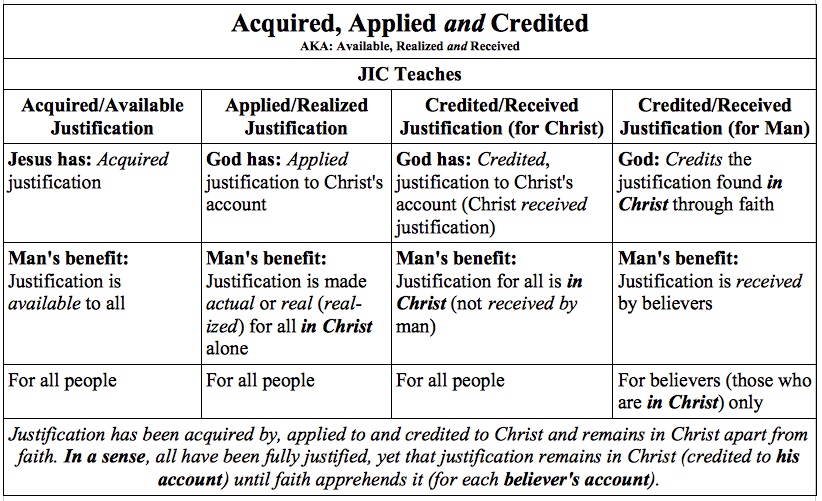

 Many Lutherans (though certainly not all) believe in UOJ (pretty obvious, right?). Many others, however, reject UOJ in favor of (what has become known as) Justification By Faith Alone (JBFA – because, after all, Lutheranism needs more initials and/or acronyms…ya know, we’ve got ELCA, LCMS, WELS, ELS, UOJ, etc. Why not JBFA too? And, just for fun, I’ll add another to the mix in just a bit.) 😉

 Received (Credited)