Category Listings
This section addresses objections surrounding UOJ and is divided into tabs according to 3 categories below:
Category 3 (UOJ Proof Passages) could have easily fallen under either of the first two categories. For this reason and due to the fact that each proof passage contains a fairly detailed explanation, UOJ Proof Passages became its own category.
Instructions
Each individual objection is presented as a question, a statement (in response to a question), or a proof passage…all in keeping with the each of the 3 categories, in a closed accordion style entry (to save space). Once opened, each listed entry contains the answer or analysis for each objection. To see each answer/analysis, simply click the large orange “+” symbol next to each question/statement. When finished with each answer/response, you can either close the response (click on the big orange “-” symbol) and open the next one or simply click on the next “+” symbol and the previous response will close automatically.
While it may be helpful to read each category tab, with each of its listed objections, all the way through one-at-a-time, you may also find it useful to skip around a bit.
Category 1 - Direct Objections to UOJ
 How Will You Know?
In the end, Scripture teaches what it teaches. It’s up to each individual Christian to determine for himself how to interpret what God has revealed to us in his word and what he has not. And, I would urge each Christian to think and seek to understand for himself, rather than simply “buying into” whatever his church body teaches. We are each to be sheep of the Good Shepherd, not sheep to our denomination.
Personally, I would argue that the biblical evidence seems overwhelmingly against God having declared all (including the unbeliever) to be justified in any way, shape or form other than by way of that which remains in Christ and becomes ours exclusively through saving faith…alone.
What is UOC?
Universal Objective Condemnation (or UOC, as I have come to call it), by itself, disproves UOJ.
According to UOC, the whole world, according to their normal, natural sinful condition (apart from saving faith), stands separated from God and under his condemnation and wrath. This is universally and objectively true for all people whether they believe this or not.
UOJ & UOC Cannot Both Be True
In short, if UOC is true, then UOJ cannot be true, and if UOJ is true then UOC cannot be true.
This is the reality of the situation, no matter how much the proponent of UOJ tries to confuse the issue by attempting to separate the two into a law/gospel distinction – declaring that since condemnation is a matter of law and forgiveness is a matter of the gospel, both can be true of the same person, namely, each unbeliever. (See “Does the unpardonable sin disprove UOJ?” and “Does the gospel withheld disprove UOJ?” for a demonstration that this supposed law/gospel distinction is nonsensical according to Scripture.)
For, the unbeliever cannot rightly be declared, by God, to be condemned, unrighteous and lacking in the removal of (and the forgiveness of) sins as well as being declared justified, righteous and forgiven at the same time.
Elsewhere (in the tabs above), I’ve taken a somewhat detailed look at those “proof” passages which supposedly teach UOJ. At best, they are very questionable – normally due to having been yanked out of proper context (though not always). But what about UOC? Is the Bible also so sketchy on the subject of the universal condemnation of sinful man?
What God Says About UOC
Let’s take a look.
~ 2 Pt 2:9 – The Lord knows how to rescue godly men from trials and to hold the unrighteous for the day of judgment.
~ 1 Co 6:9 (NKJV) – Do you not know that the unrighteous will not inherit the kingdom of God?
~ 1 Pt 3:18 – For Christ died for sins once for all, the righteous for the unrighteous [unjust in NKJV], to bring you to God.
~ Jn 3:18 – Whoever does not believe stands condemned already because he has not believed in the name of God’s one and only Son.
~ Jn 3:36 – Whoever rejects the Son will not see life, for God’s wrath remains on him.
~ Jn 16:8-9 – When he [the Spirit] comes, he will convict the world of guilt in regard to sin and righteousness and judgment: in regard to sin, because men do not believe in me.
~ Acts 3:19 Repent, then, and turn to God, so that your sins may be wiped out, that times of refreshing may come from the Lord.
UOC Verses Explained
While we could include a number of additional passages to the list above, those listed are more than sufficient to prove the point. The unrighteous (the unjust) stand condemned already with God’s wrath remaining on them, while they are also convicted (by the Holy Spirit) of their guilt for their unbelief.
Does this sound like objective justification (UOJ) or universal condemnation (UOC)? The Reality is that each of these passages speaks volumes against UOJ.
UOJ expressly teaches that all people, including the unbeliever, have been declared to be both just and righteous. Yet, the first 3 passages above specifically declare the unbeliever to be unjust or unrighteous.
Next, Jn 3:18 speaks specifically of the unbeliever standing condemned already. This does not say, he will be condemned (after death or on the last day), but that he has already been declared to be condemned (as he stands in his condemnation) as a direct result of his unbelief. The fact that he stands condemned is a statement of his being declared condemned. UOJ would have us believe he has been formally and legally declared both condemned and forgiven at the same time.
Moving on, Jn 3:36 tells us that God’s wrath remains on the unbeliever. Again, this does not say that in the end, he will receive God’s wrath, but that God’s wrath is already there, remaining on him. To be clear, this is not man’s guilt and condemnation (judgement) remaining on him, this is God’s wrath (anger, fury) which remains on him. Why would God’s wrath, anger and fury remain on him if God, himself, has declared him to be forgiven in his own sight?
Further, Jn 16:8-9 tells us that the Holy Spirit is at work in the world, among the unbelievers convicting them of their guilt resulting from their unbelief. Yet, UOJ expressly teaches that even the unbeliever’s guilt for sin has been removed (he has been formally declared “not guilty”), he is guilt free. (Note that when I refer to “guilt” here, I am not referring specifically to guilty feelings, I am referring to actual legal guilt vs. innocence.)
Finally, Acts 3:19 gives us the flip-side of the equation. Not only are unbelievers still guilty and condemned before God, but this verse expressly tells us that they still need to have their sins removed as well…they are still lacking in forgiveness as a result of the removal of sin.
In other words, though proponents of UOJ proclaim that there is a supposed law/gospel distinction to be made regarding universal condemnation (law) and supposed universal justification (gospel), this verse negates that possibility (see also Mt 12:31-32 and the unforgivable sin as well as “Does the gospel withheld disprove UOJ?“).
UOC, by itself, disproves UOJ.
Which is more consistent with the entire testimony of Scripture when we allow Scripture to interpret itself, UOJ or JIC?
What is the Unforgivable Sin/Blasphemy of the Spirit?
Good Lutherans understand that the gift of saving faith is just that…a gift, worked in us through the Holy Spirit by way of the means of grace (the gospel in word and sacrament).
Based upon this firm foundation, when an unbeliever (in their unbelief) rejects this work of the Holy Spirit to bring about saving faith, we can rightly understand this to be blasphemy against that which the Holy Spirit is doing to produce faith – blasphemy against the Holy Spirit, himself.
In other words, blasphemy against the Holy Spirit is effectively to exert one’s persistent unbelief. Or, put still another way, to blaspheme the Spirit is to choose to remain in unbelief, while resisting the Holy Spirit’s work to prompt one toward faith.
Having said this, let’s look at what Scripture calls the unforgiven sin. The fist two passages (from Hebrews and Acts) help to set the stage for the additional three passages below.
Setting the Stage
~ Hebrews 10:29 How much more severely do you think a man [who has fallen away from the faith] deserves to be punished who has trampled the Son of God under foot, who has treated as an unholy thing the blood of the covenant that sanctified him, and who has insulted the Spirit of grace?
~ Acts 7:51 “You stiff-necked people, with uncircumcised hearts and ears! You are just like your fathers: You always resist the Holy Spirit!
In Hebrews, we see that the one who was formerly a believer (but has fallen away from the faith) has, in reality, insulted the Holy Spirit (Spirit of grace). Further, in Acts, we see that Steven, who is speaking to the Jews just before his stoning, states that to reject the gospel message is to “resist the Holy Spirit.”
This brings us to the words of our Lord who states clearly that blasphemy against the Holy Spirit will not be forgiven.
The Unforgivable Sin
~ Mark 3:28-29 I tell you the truth, all the sins and blasphemies of men will be forgiven them. But whoever blasphemes against the Holy Spirit will never be forgiven; he is guilty of an eternal sin.”
~ Luke 12:10 And everyone who speaks a word against the Son of Man will be forgiven, but anyone who blasphemes against the Holy Spirit will not be forgiven.
~ Matthew 12:31-32 And so I tell you, every sin and blasphemy will be forgiven men, but the blasphemy against the Spirit will not be forgiven. Anyone who speaks a word against the Son of Man will be forgiven, but anyone who speaks against the Holy Spirit will not be forgiven, either in this age or in the age to come.
In Mark, we learn that all other sins and blasphemies will be forgiven, but blasphemy against the Spirit will not be forgiven.
In Luke, we learn that 1) anyone who speaks a word against the son will be forgiven, but that 2) anyone who speaks against the Holy Spirit will not be forgiven.
Finally, in Matthew, we learn that 1) every sin and blasphemy (including speaking against the son) will be forgiven, but that 2) anyone who speaks against the Holy Spirit will not be forgiven. Moreover, we also learn that 3) this lack of forgiveness will be the reality for both this age and the age to come.
UOJ Disproved
This last part is the “nail in the coffin” to disproving UOJ. Jesus makes it very clear that blasphemy against the spirit will NOT be declared forgiven, not only in the age to come, but in this age as well. In other words, the proponent of UOJ would suggest that all people (believer and unbeliever alike) are forgiven, even though the unbeliever will not receive the full benefit of this forgiveness, ultimately in the age to come. But, Matthew not only states that forgiveness will not be realized for the unbeliever in the age to come, but forgiveness will not be granted to him in this age either.
It is as though Jesus is effectively saying that the unbeliever is doubly unforgiven. Maybe Jesus, looking ahead to UOJ, just wanted to make sure everyone was clear on the matter. (Ya, think?)
Law/Gospel Distinction is Misapplied
Moreover, proponents of UOJ like to confuse the debate further by suggesting that according to the law, unbelievers are still condemned, while at the very same time, according the gospel, all (including the unbeliever) have been forgiven. But notice that this passage from Matthew does nothing to suggest that the unbeliever is only condemned according to the law. Rather, in direct refutation of UOJ logic, this passage is expressly stating that the gospel of forgiveness is withheld.
In other words, UOJ would have us believe that the law and the gospel are essentially two sides of the same coin. On one side of the coin the unbeliever is condemned by the law, but on the other side he is forgiven by the gospel….supposedly.
The reality of Scripture, however, is that on one side of the coin the unbeliever is condemned while on the other side he is also not forgiven (see also Acts 3:19).
This passage from Matthew, by itself, emphatically disproves UOJ.
Otherwise, according to the proponent of UOJ, what we are supposed to conclude from this passage in Matthew, is that the reality of what Jesus is saying is, “All sins and blasphemies for all people of all time will be forgiven, even the sin of blasphemy against the Spirit. This forgiveness will be applied to each and every individual, even to the unbeliever. Yet, I tell you, even though this sin of blasphemy against the Holy Spirit is forgiven, it will also never be forgiven in this age or in the age to come.”
Now, I ask you, does this sound like our God of order and justice?
But, What About…?
Some might object, “Ah, but…what about the first half of the above passages, which states that ‘all other blasphemies will be forgiven’? Doesn’t this demonstrate the truth of UOJ?” “In each of the gospel accounts mentioned above…” The proponent of UOJ might continue to say, “Jesus is doing the talking. Historically speaking, he spoke these words before he went to the cross, so isn’t Jesus saying that once he dies on the cross to pay for all sin, then, at that time, all men will be forgiven for all of their blasphemies?”
Absolutely not!
How do I know?
Because the second half of each passage won’t allow me to come to a typical UOJ conclusion, as I have already explained.
In fact, what both halves of each passage really suggest is the reality of JIC. If all sin is forgiven in Christ, then while the sin is forgiven, the sinner is not…that forgiveness remains in Christ. Only the one who is in Christ receives that forgiveness. The one outside of Christ (due to his persistent resistance of the work of the Holy Spirit – his blasphemy against the Holy Spirit) remains unforgiven.
The unforgivable sin, by itself, disproves UOJ.
But, you’ll have to decide for yourself, seeking the wisdom and guidance of the Holy Spirit, which makes more sense UOJ or JIC?
Truth or Fine Sounding Argumentation?
One way in which proponents of UOJ attempt to overcome the objections associated with the fact that Scripture clearly states that unbelievers stand condemned under God’s wrath is by making the claim that there is a law/gospel distinction being made between God’s condemnation and God’s forgiveness as explained by UOJ.
According to this line of thinking, it is simply a matter of the law when we understand that unbelievers stand condemned by God. By contrast, it is a matter of the gospel (so it is taught) to understand that these same unbelievers have God’s forgiveness applied to their lives. The two teachings, though seemingly contradictory (according to the proponent of UOJ) can still coexist nicely, once we understand this law/gospel distinction.
~ Col 2:4 I tell you this so that no one may deceive you by fine-sounding arguments.
While this may be a fine-sounding argument, I would suggest that it is a hollow and deceptive philosophy which has been imposed upon the text of Scripture rather than pulled from the text.
~ Col 2:8 See to it that no one takes you captive through hollow and deceptive philosophy, which depends on human tradition and the basic principles of this world rather than on Christ.
Why do I think this is just a fine sounding argument? What about those times when Scripture fails to speak in terms of the unbeliever’s condemnation under the law, but instead, speaks of the gospel being withheld?
More of The Same?
I’ve touched on the concept of “the gospel withheld” in a couple of other Q & A’s, but I believe this deserves its own Q & A, so we can dig into it in more detail.
Quite simply, the gospel withheld, by itself, disproves UOJ.
To be clear, those passages which speak of wrath and condemnation before a holy God, can indeed, rightly be considered law passages, while those passages which speak of justification, forgiveness and righteousness can also rightly be considered gospel passages.
If what I have just said is true, then what’s the problem?
Here it is. The law and the gospel do not…cannot…apply equally to the same person at the same time.
Under Law or Grace?
When we look at the whole of Scripture and allow Scripture to interpret Scripture, we come to realize that the believer is no longer under the law, but under grace. The law no longer applies to him in the same way that it did when he was an unbeliever.
~ Ro 6:14 [Speaking to those who have been brought from death to life – i.e. believers] For sin shall not be your master, because you are not under law, but under grace.
The flip side is also true – the unbeliever is not under grace (in a legal sense), rather he is exclusively under the law. Yes, God bestows some measure of grace on all of creation, but we are not speaking of that, here. We are speaking of God’s grace in a forensic (legal) sense in regards to God’s eternal judgement, specifically in regard to justification, forgiveness and righteousness. In this sense, the unbeliever is not under God’s grace, he is exclusively under the law.
~ Ro 3:19 Now we know that whatever the law says, it says to those who are under the law, so that every mouth may be silenced and the whole world held accountable to God.
The long and the short of it is that those passages which speak of the unbeliever’s condemnation and wrath are specifically statements of condemnation and wrath, under the law.
Moreover, those passages which speak of the believer as having received God’s justification, forgiveness and righteousness are specifically statements of gospel, to those under God’s grace.
Distinction or Blending?
To say that the unbeliever is both condemned and forgiven at the same time is not a distinction between law and gospel, but a blending of law and gospel. It is equivalent to saying that the unbeliever is both under the law and under grace at the same time.
If we are going to use a law/gospel argument, let’s use the law and the gospel correctly (and fully) without blending the two together. Any good Lutheran knows that we should always be careful to use the law and the gospel correctly, including the fact that we should never mix the two together.
But wait…there’s more!
Scripture not only speaks of the unbeliever as standing under God’s wrath and condemnation, but it also speaks specifically of the gospel being withheld from him. In other words, Scripture not only speaks of the law condemning the unbeliever, but at the other end of the spectrum (or on the other side of the coin, if you will) of his NOT being forgiving by the gospel.
I’m no rocket scientist, but it doesn’t take a genius to figure out that the gospel cannot rightly be said to be fully applied (though not credited) and to be fully withheld at the same time.
Again, to be clear, I am not speaking of wrath and condemnation passages, here. I am speaking of gospel withheld passages. There is an important distinction to be made between the two.
Proofs of Gospel Withheld
Let’s take a look at a few passages which specifically speak of the gospel being withheld.
We’ll begin in the Old Testament. An argument could be made that these OT passages do not apply to those in the NT era. I would encourage you to look them up for yourself in their broader context to see if any of these are exclusively for the people of the OT or whether some (or all) are intended to be understood in an ongoing sense.
Moreover, UOJ teaches that God’s forgiveness is essentially retroactive, meaning it not only applies from the cross (or empty tomb, as the case may be) forward, but goes all the way back to creation. So, if you want to argue that these OT passages do not apply, you’ll have to factor this retroactive application into your thinking as you try to wrap your head around the problems with UOJ.
OT Passages:
~ Deut 29:19-20 When such a person hears the words of this oath, he invokes a blessing on himself and therefore thinks, “I will be safe, even though I persist in going my own way.” This will bring disaster on the watered land as well as the dry. The LORD will never be willing to forgive him; his wrath and zeal will burn against that man. All the curses written in this book will fall upon him, and the LORD will blot out his name from under heaven.
This chapter ends with these words from verse 29 (see, I’ve done some of the context homework for you…you’re welcome 😜):
~ “The secret things belong to the LORD our God, but the things revealed belong to us and to our children forever, that we may follow all the words of this law.”
So, what do you think? Could this entire OT passage (verses 19-29) include those of us in the NT era?
Next…
~ Ex 23:20-21 “See, I am sending an angel [Many would say this angel (messenger) is Christ] ahead of you to guard you along the way and to bring you to the place I have prepared. Pay attention to him and listen to what he says. Do not rebel against him; he will not forgive your rebellion, since my Name is in him.
~ Num 14:18 The LORD is slow to anger and abounding in steadfast love, forgiving iniquity and transgression, but he will by no means clear the guilty…
Notice this last verse (Num 14:18) is clearly speaking of God’s slowness to anger and of his abounding and steadfast love as expressed in forgiveness. Yet, even though it speaks of the wonders of God’s love and forgiveness, his abounding love is not bound-less love. His love has boundaries which coincide with his justice and holiness. God will not clear (gospel) the guilty (law).
Did you catch the significance of this verse. If any verse in all of Scripture has potential for being a perfect UOJ proof, the first part of this verse would lead us to believe that this is it!
UOJ assumes God’s love, as expressed through forgiveness, is boundless. Yet, though this verse speaks of God’s abounding love, expressed through forgiveness, it also does that which the rest of Scripture consistently does, it refuses to result in UOJ. The second portion of the verse goes out of its way to explain the whole truth of the matter. Namely, that God’s love, expressed through forgiveness, though abounding is not boundless.
For God’s wrath and judgement remain for the guilty. The guilty have no part in the forgiveness of the first part of the verse. The guilty are not cleared of their guilt as the second part of the verse states. Finally, the guilty are not the guilt free, but remain the guilty as the second part also states.
In short, the gospel is withheld from them.
Let’s move on the the New Testament.
NT Passages:
~ Mt 6:14-15 For if you forgive men when they sin against you, your heavenly Father will also forgive you. But if you do not forgive men their sins, your Father will not forgive your sins.
~ Jn 20:23 If you forgive anyone his sins, they are forgiven; if you do not forgive them, they are not forgiven.”
~ Acts 3:19 Repent, then, and turn to God, so that your sins may be wiped out, that times of refreshing may come from the Lord.
~ Mt 12:32 Anyone who speaks a word against the Son of Man will be forgiven, but anyone who speaks against the Holy Spirit will not be forgiven, either in this age or in the age to come.
Conclusion
As you can hopefully see from the above passages, the unbeliever’s condemnation before God is more than a matter of a law/gospel distinction. Scripture not only informs us that the unbeliever is condemned under the law, but, in keeping with the testimony of Scripture, he is not forgiven either.
While these two sides of the same truth ought to be self evident, UOJ attempts to confuse the issue by claiming a supposed law/gospel distinction which is ultimately a blending of law and gospel (rather than a distinction between the two) as explained above.
What it comes down to is this: The word of God very clear states that those who do not find themselves among the made-new children of God remain unforgiven, while the words of men claim (contrary to God) that these same unbelievers are forgiven. Bearing in mind that I have attempted to demonstrate (under the 3rd category tab, “UOJ Proof Passages”) UOJ has never legitimately (in context) been proved from Scripture, in the first place.
Either you believe our God of order, has both forgiven and not forgiven the unbeliever at the same time, or you (at the very least) are willing to question the idea…if not forsake it altogether.
If enough people question it, maybe Lutheran theologians will eventually feel compelled to legitimately discuss and debate…including actually listening to and considering an alternative (more biblical) view.
As for me, I have to conclude that God said what he meant and meant what he said…”not forgiven” means not forgiven, rather than meaning not forgiven and also forgiven. Call me crazy.
The gospel withheld, by itself, disproves UOJ.
Which is more consistent with the entire testimony of Scripture (both Old and New Testaments), UOJ or JIC?
What is The Ministry of The Keys?
On three occasions, Jesus gave his disciples (including you and me) the authority to bind and to loose sins. On one of these occasions, Jesus referred to this authority as using the keys of the kingdom of heaven.
~ Mt 16:19 I will give you the keys of the kingdom of heaven; whatever you bind on earth will be bound in heaven, and whatever you loose on earth will be loosed in heaven.”
~ Mt 18:18 “I tell you the truth, whatever you bind on earth will be bound in heaven, and whatever you loose on earth will be loosed in heaven.
~ John 20:23 If you forgive anyone his sins, they are forgiven; if you do not forgive them, they are not forgiven.”
In the first two passages above, we have similar wording, “whatever you bind…will be bound.” Here, it is worth noting that many would argue that a better translation might be, “what ever you bind…will have been bound.”
In other words, the binding has already been done in heaven and disciples of Jesus are merely recognizing this and pronouncing it to those who persist in their unbelief. Put still another way, the sins are not bound in heaven because of the pronouncement, rather the pronouncement comes due to the fact that sins remain bound in heaven.
Compare to UOJ
Now, let’s think this through, in light of UOJ. The pronouncement (on earth, if you will) that the unbeliever remains bound to his sins, is the direct result of the truth of this same reality in heaven…due to unbelief. In other words, this is the reality in the eyes of God. God sees the unbeliever as still bound to his sins, until faith should lay hold of the forgiveness of sins. Apart from faith, God does not see forgiveness, he sees sins held bound.
Want further evidence? Just look at the other half of these same two verses. By contrast, Jesus states that once sins are forgiven, disciples should pronounce the forgiveness of sins (or the loosening of sins). Again, we have a less than stellar translation on this half of the verses…whenever disciples pronounce the loosening of sins, it is due to the fact that faith has become evident (by confession, at least) and that the sins have therefore already been forgiven in heaven by the time a disciple pronounces it.
Now, the proponent of UOJ, may make the claim that the fact that the forgiveness of sins already exists before being pronounced, actually serves to prove the truth of UOJ. He might suggest that sins are already forgiven before forgiveness is pronounced, therefore UOJ must be true. But as I have just explained, there is also another possibility…that due to his new-found faith, forgiveness has become a reality, before the pronouncement of it. So, the simple fact that forgiveness exists before the pronouncement of it, does nothing to prove UOJ.
At this point, Jn 20:23 steps in to further disprove UOJ. In John, Jesus does not say, “whatever you bind…will have been bound,” rather he says (paraphrasing), “whatever you do not forgive, will not have been forgiven.”
Nail in the coffin…case closed!
The Ministry of the Keys disproves UOJ.
Let Scripture Interpret Scripture
While the teaching of UOJ would have us believe that all people of all time have been declared not guilty, free of sin, justified and even righteous, when we allow Scripture to interpret itself, we find that through the Ministry of the Keys we must reject this notion.
Jesus intends for us to go out and to share the good news with others, but what good news would proponents of UOJ have us believe we are to share? We are (according to UOJ) supposed to preach the good news that God has forgiven all people (applied this forgiveness to each individual), believer and unbeliever alike.
In other words, evangelizing to an unbeliever might look something like this:
Christian: “Friend, there is good news! God has forgiven all of your sins…full forgiveness applied to you in the eyes of God. And, this is true even if you don’t believe it!”
Unbeliever: “Great! If what you are saying is true, then why would I need to be a Christian – a believer?”
Christian (using the binding key): “Well, because if you don’t then you are still bound to your sins.”
Unbeliever: “But, you just said all of my sins are forgiven, even if I don’t believe it. How can I possibly be forgiven and bound to my sins at the same time?”
Christian: “Uhhh, that’s a great question. All I know is that, this is what my church says that the Bible says.”
Unbeliever: “Well, then either your church, or your God (or both) make no sense, since what you’ve just said completely contradicts itself. I thought you “Bible believing” Christians were all about absolute truth. How can truth contradict itself? And…explain to me again why would I want to have anything to do with being a Christian..and, for that matter, why would you?”
The Ministry of the Keys, by itself, disproves UOJ.
Which is more consistent with the entire testimony of Scripture, UOJ or JIC?
What is Meant by Spiritual Identity?
This is a critically important doctrine which is largely overlooked or misunderstood throughout much of Christianity. Personally, this just blows my mind due to the fact that the testimony of Scripture is so obvious on the matter. When I first discovered this reality for myself, I was sure I was the only big dope who didn’t understand it…due to its being so obvious in the text of Scripture. Since, then I have only become more and more convinced that many (if not most) Christians (did you catch how nice I was being?…notice I did not say, “other dopes” 😉) do not understand it.
I’ll attempt to keep my explanation brief, yet thorough enough to understand.
Unconverted Man
Essentially, it comes down to this: According to Scripture, man is made up of two fundamental parts – flesh (or, body) and spirit (Mt 26:41 & 2Co 7:1). According to our normal, natural, fallen condition, we are all sinful in both flesh and spirit from conception forward. It would be true to say of the unbeliever, that he not only commits sin, but that he is sin. He is sinful through-and-through. He can do nothing to please God and can only sin all of the time. God puts it this way:
~ Ps 51:5 Surely I was sinful at birth, sinful from the time my mother conceived me.
~ Isa 64:6 All of us have become like one who is unclean, and all our righteous acts are like filthy rags.
~ Heb 11:6 Without faith it is impossible to please God.
~ Ro 14:23 Everything that does not come from faith is sin.
You might think of it like this…
 Imagine I am covered in sloppy, wet mud from head to toe. I am a walking mud-pile, with only two white eyeballs showing through all of the filth.
Though I may desire to do some nice things for you, you would likely prefer I did not. Though I might offer to give you a hug; to make your lunch or to wash your new white shirt, you would likely decline my offers.
Why?
Because everything I would do – everything I would touch – would be covered in filth. Everything I had done would be tainted by the filthy stains I had left behind. In this filthy condition, I could not help but to leave filth’s stains behind, in all I’d do.
So it is with my sin. When sinful through-and-through (in both flesh and spirit), everything I think, say and do is tainted by sin. This is why God cannot see anything other than filthy rags when, even my best attempts to please him, are done apart from saving faith. This is why God must declare:
~ Ro 14:23 Everything that does not come from faith is sin.
And:
~ Heb 11:6 Without faith it is impossible to please God.
Converted Man
By contrast, however, when the Holy Spirit produces faith in the heart of man, he also transforms him, he births new life in him and the man becomes a new creation.
I want to be very clear here. Many Christians today are confused by the sinner/saint status of the Christian. Because we still sin, many (in my experience, it is not just many but most) Christians seem to believe that God merely chooses to see us as new and/or righteous. They believe that God has NOT actually made us righteous, but only chooses to see us that way. “After all,” they seem to conclude. “I am obviously still a sinner. How could I possibly be actually, literally perfect or righteous?” They believe there is only a change in status (how God sees us), but not a change in condition (how God has made us to be). Sure, they may realize they have some new, improved desires, but they seem to see this as only the result of a new attitude, not a fully new condition.
But, Scripture doesn’t allow for these faulty conclusions. God has made it very clear that he not only sees us as new (sees us as righteous), but he has actually, literally made us new in spirit. Though our sinful flesh remains, the spirit of the true Christian is entirely new, robed in the righteousness of Christ.
Don’t take my word for it. Here is what God has to say about it:
~ Ezek 36:25-26 I will sprinkle clean water on you, and you will be clean; I will cleanse you from all your impurities… I will give you a new heart and put a new spirit in you.
~ Jn 3:3-6 In reply Jesus declared, “I tell you the truth, no one can see the kingdom of God unless he is born again…I tell you the truth, no one can enter the kingdom of God unless he is born of water and the Spirit. Flesh gives birth to flesh, but the Spirit gives birth to spirit.
~ 2 Co 5:17 Therefore, if anyone is in Christ, he is a new creation; the old has gone, the new has come!
~ Isa 61:10 I delight greatly in the LORD; my soul rejoices in my God. For he has clothed me with garments of salvation and arrayed me in a robe of righteousness
~ 1 Co 6:17 Anyone joined to the Lord is one spirit with him. (CSB)
~ Ro 8:10 But if Christ is in you, your body is dead because of sin, yet your spirit is alive because of righteousness.
This last verse (Ro 8:10) gives us the clearest picture of just what it is that I am referring to. As Christians, we have been given new life in spirit. We are literally perfectly righteous – robed in the righteousness of Christ, one spirit with him. Yet, this new spirit is wrapped up (so to speak) in our remaining sinful flesh. We are literally a saint and a sinner at the same time. Not because God merely chooses to see us as a saint even though we are really only a sinner, but because we have been perfected in Christ (in spirit), even though a sinful flesh remains.
This is key! For God sees us (views us, looks at us) not according to the flesh, but according to our having been made a new creation in spirit.
~ 1 Sam 16:7 The LORD does not look at the things man looks at. Man looks at the outward appearance, but the LORD looks at the heart.”
~ 1 Pt 3:4 Instead, it [a woman’s beauty] should be that of your inner self, the unfading beauty of a gentle and quiet spirit, which is of great worth in God’s sight.
~ Jn 4:23-24 Yet a time is coming and has now come when the true worshipers will worship the Father in spirit and truth, for they are the kind of worshipers the Father seeks. God is spirit, and his worshipers must worship in spirit and in truth.”
~ Ro 12:1 Therefore, I urge you, brothers, in view of God’s mercy, to offer your bodies as living sacrifices, holy and pleasing to God–this is your spiritual act of worship.
Summary & Conclusion
Therefore, the unbeliever, who is sinful through-and-through in both flesh and spirit can do nothing good in God’s sight. While the Christian, on the other hand, is viewed only according to his righteousness in Christ. Yes, God is aware of the sins of his flesh and may even discipline him in order to keep him in the true faith and from falling away (once again dying in spirit). But he is seen (and judged, if you will) by God according to his made-new spiritual identity.
Now, that we (hopefully) have this clear in our minds, what does this have to do with UOJ?
Proponents of UOJ state that God has declared all (even the unbeliever) to be justified, forgiven and righteous in his sight…that all (including the unbeliever) have had a change in their status (how God views them), though not a change in their nature (how God has made them to be).
UOJ, therefore, assumes justification (the declaration of a change in status) comes before sanctification (a change in nature). This, however, is never proven by the proponent of UOJ.
I would argue that justification and sanctification essentially happen simultaneously and that God only declares the sinner to be righteous as a result of his having been made righteous by way of a new spirit (see: Related Question below). In other words, God only declares to be true that which is actually true, not that which is untrue.
Otherwise, according to UOJ, God is declaring the man who is still sinful through-and-through (in both flesh and spirit); the man who cannot possibly please God (Heb 11:6); the one whose best efforts at righteous acts are nothing but filthy rags (Isa 64:6); the one whose every action (in fact, he himself) is only sin apart from faith (Ro 14:23), as not only justified, but righteous. Effectively, UOJ states that God declares a lie to be true.
By contrast, according to JIC, God remains true to himself and only declares those who have been made new (those who have been made righteous), to be righteous.
Therefore, spiritual identity, by itself, disproves UOJ.
Which is more consistent with the entire testimony of Scripture, UOJ or JIC?
Scripture Interprets Scripture
One thing I have gratefully learned from my Lutheran heritage is that we must always allow Scripture to interpret Scripture.
In other words, as it applies to UOJ, we cannot forsake one portion of Scripture for the sake of upholding a flawed belief loosely based upon (or read into) other portions of Scripture.
Is the biblical evidence overwhelmingly against the validity of UOJ?
Well, you will have to decide for yourself, hopefully you’ll do so by being honest with all of the text of Scripture, in its proper context. Personally, I would suggest that individually, each of the previous five arguments, 1) the unforgivable sin, 2) universal condemnation, 3) the gospel withheld, 4) the keys, and 5) spiritual identity, each by itself, disproves UOJ. But when combined together, the biblical witness is overwhelmingly against the validity of UOJ, in my view.
Again, you will have to decide for yourself with or without the help of the Holy Spirit as your guide. The choice is yours.
What say you? Which is more consistent with the entire testimony of Scripture, UOJ or JIC?
Now, let’s briefly consider some additional problems with UOJ.
For Now
Technically, according to the current “official” teachings of UOJ, proponents are quick to reject universalism (the belief that all people are saved) as being an unbiblical, heretical, teaching.
Associated with this, proponents of UOJ also reject any notion of new life or eternal life having been granted to all people apart from saving faith…for now.
Example 1
For example, here is a quote from a pro-UOJ resource:
“Objective justification is not the teaching that everyone, regardless of faith or unbelief, will be saved.” (Justification – Am I good enough for God?, Rolf Preus, page 3, Northwestern Publishing House).
Yet, in the very same booklet, it says this:
“Objective justification guarantees that the means of grace really are means of grace.
‘Friend, are you saved?’
‘Yes, I am saved.’
‘Praise the Lord! When were you saved?’
‘When Jesus took away my sins on the cross. It was then that God saved me and justified me by Jesus’ blood.’” (Justification – Am I good enough for God?, Rolf Preus, pages 18-19, Northwestern Publishing House).
Universalism in Disguise?
Do you see the problem? Though UOJ proponents technically reject universalism (when the subject of universalism is brought up), they also effectively promote it (when not making the connection to universalism). In other words, they do not always seem to be putting two and two together, in the whole of their teaching.
Fact, God’s People Are Prone to Wandering
If there is one thing I have learned over the past 20+ years since my Christian conversion, it is this…our own sinful natures, coupled with the influence of Satan, combine to make an often underestimated, yet powerful force which is bound and determined to lead us astray. In all of human history, it’s a fact, many (if not most) of God’s people have been prone to wander to one extent or another.
Here’s what I mean. Today, UOJ proponents openly reject universalism, while subtly they are also being lead astray (by sin and Satan) to promote it at the very same time. Tomorrow (which could be 10, 25 or 50 years from now), UOJ proponents may no longer be rejecting universalism, but instead, may have been led astray, little-by-little, until they have come to openly embrace it.
Today, those who reject UOJ, while members of a UOJ promoting church body, are disfellowshipped for their rejection of UOJ. Tomorrow, those who reject universalism may be disfellowshipped by those same church bodies who will have, at that time, accepted universalism as sound doctrine.
Far more important than remaining in fellowship or being disfellowshipped, however, will be the multitudes who will have been led astray by this false theology to the point of being separated (or remaining separated) from God for eternity. And, all in the name of sound doctrine.
Example 2
As I wrap up the answer to this Q & A question, I will leave you with one more example of UOJ leading to universalism. This too is from a pro-UOJ resource.
“…God has, as a gift of his grace, justified all men, that is, he has declared them righteous and just. As a result, they [what else can “they” refer to but the previous “all men” and “them”?] are awarded life.
Since this is something that has taken place through Jesus’ life death and resurrection and is an objective reality, it may be spoken of as objective justification. It is also called universal atonement.” (Basic Doctrines of the Bible, Armin W. Schuetze, page 42, Northwestern Publishing House). Emphasis and bracketed text are mine.
In addition to calling it “objective justification” and “universal atonement,” I think there is another term for it – “universalism” (in a not-so-subtle disguise).
No Surprise
My hope and prayer is that many will begin to see UOJ for what it really is; that they will see that the biblical evidence is overwhelmingly against UOJ and stop proclaiming it to the multitudes. If not, we should not be surprised when many are led astray into universalism in the future.
Every false doctrine, carried to its logical conclusion, ends in spiritual death.
Think about it.
Which is more consistent with the truth of Scripture and therefore less likely to lead people away from the Savior, UOJ or JIC?
Another Possibility
According to UOJ, God has forgiven all sinners (including unbelievers) whether they believe it (or are even aware of it) or not.
According to UOJ, it is ASSUMED that justification, forgiveness and righteousness (among other things) are all effectively synonymous.
Further, according to UOJ, it is ASSUMED that forgiven sin = forgiven sinner. Moreover, forgiven sinner = all sinners forgiven (believer and unbeliever alike).
Yet, is there another possibility?
In keeping with JIC, forgiven sin ≠ forgiven sinner, except through faith (note, that I used a “does not equal” symbol, there…you caught that, right?).
The questions from proponents of UOJ then become, “How can sin be actually forgiven if each individual has not been forgiven? In other words, how can sins be actually forgiven apart from sinners being actually forgiven, as well?
Simple. As explained earlier in the “God Says” section of this site, this forgiveness for each person’s sins has been forgiven in Christ’s account and is then distributed to individuals (each person’s own account) exclusively through faith.
Why Does This Matter?
Okay, so what if it’s true that sins forgiven, may not equate to each and every sinner forgiven? What’s the point?
I address this subject for a couple of reasons:
1) To illustrate the point that there are numerous assumptions inherent in UOJ theology, which have not been proven.
2) To hopefully emphasize the need for each of us as Christians to think critically and to be willing to question that which we are being taught. And, to do such thinking and questioning in light of Scripture and sound, biblical reasoning.
Let’s use Jn 1:29 to help illustrate my point.
Who Takes Away…
~ John 1:29 The next day John saw Jesus coming toward him and said, “Look, the Lamb of God, who takes away the sin of the world!”
Here, the proponent of UOJ may say, “See, there you have it! Scripture is clear. Christ, the lamb of God, has taken away the sins of the whole world.”
Well, aside from the obvious problems associated with the reality that this verse says nothing of the whole world’s sins having been already taken away. There’s still another issue…but, we’ll look at that in a moment.
First, lets address the obvious.
1) The verse does not say “has taken away” (as in the past) it says “takes away” (as in ongoing).
2) John’s having said, “has taken away” would make no sense, before Jesus went to the cross, in the first place.
3) Who else’s sins, but those of the world’s would Christ be taking away? In other words, just because the verse mentions the sin of the world, doesn’t necessarily mean that the whole world’s sin (all at once) is taken away, at least not in the way UOJ teaches. It can simply mean “…the lamb of God, who takes away sin from those of the world.”
Now, let’s address the less obvious. First, it is important to note that UOJ theologians have said, referring to this verse, that “takes away” means “already forgiven.” Actually, to be more specific, I just read a portion of one paper which said this:
“John 1:29 teaches objective justification. Jesus has taken away the sin of the world. This passage alone should settle the issue. What does take away mean, if not forgive?” (Objective Jusitification by Rolf Preus, http://www.christforus.org/objectivejustification.htm) Emphasis is mine.
Notice the phrase “takes away” in Jn 1:29 is changed by Mr. Preus to both “taken away” and “take away.” While both of these changes help to support UOJ, they are not the same as the biblical text, nor do they hold the same meaning.
Yes, I too put the meaning of the text of Scripture into my own words on this site and elsewhere, but here the meaning of the text is drastically altered to fit a teaching which is being imposed upon the text rather than pulled from it.
But, that’s not really the point. Though sadly, the reality is that I have found this kind of deception as fairly typical in UOJ circles (by the way, when I say “deception,” I am not stating emphatically that Mr. Preus is intentionally being deceptive, I am saying that the deception is there, whether intentionally from Mr. Preus or from the influence of sin and Satan in his own life). The real reason I use this example is to simply make the point that UOJ theologians suggest that “takes away” = already forgiven.
So, let’s run with that.
If “takes away” means already forgiven, then proponents of UOJ would have us understand Jn 29:1 to mean, “The next day John saw Jesus coming toward him and said, “Look, the Lamb of God, who has already forgiven the sin of the world!”
Again, for the sake of argument, let’s say this verse actually means, “…has already forgiven all of the sins of the whole world.” The reality is this: sins, already forgiven, would still do nothing to prove UOJ.
Why?
Because forgiven sins ≠ forgiven sinners, in the way that UOJ promotes.
Do I think God has forgiven all of the sin of the whole world? Yes! Do I think God has applied that forgiveness to each and every individual – believer and unbeliever alike? No! I think and believe that God has applied that forgiveness to Christ’s account and distributes that forgiveness to individuals exclusively through faith.
But, in the end, it doesn’t matter what I think and believe. You have to determine what the bible really teaches for yourself.
I encourage you to think critically and to be willing to question the status quo, in light of Scripture.
What do you think? Does forgiven sin = forgiven sinner, in the UOJ sense? Which makes more sense in light of Scripture, UOJ, JIC, or something else?
(For more on Jn 29:1, see Category Tab #3, “UOJ Proof Passages” above.)
Is It Worth Questioning?
How much is enough?
How do we know when to quit?
At what point do we determine we have legitimately rung-out every last drop of biblical truth from any given doctrine before we find we have gone just a little too far in defining the details?
And, if someone does over-step…just a little…what does it take for someone else (with some level of authority) to come along and recognize this over-stepping for what it is and to make an authoritative change?
Further, what if that slight over-stepping becomes formally documented “truth,” an official church doctrine, part of the seminary curriculum, and the like?
What if, over time, little-by-little, one more nugget of “truth” or one more “proof” passage gets added to the original slight over-stepping?
What if these new “truths” also get added to formal documents, official church doctrine, seminary curriculum, and the like?
What would it take for these supposed truths to be corrected rather than vehemently held onto, no matter what?
Pulling From or Reading Into?
Exegesis vs eisegesis.
Those are the fancy theological terms which simply refer to pulling meaning from the text vs. reading meaning into the text.
Exegesis is to pull meaning from the text of Scripture – allowing Scripture to speak to you.
Eisegesis, on the other hand, is to read meaning into the text of Scripture – imposing meaning upon the text. Put another way, eisegesis is seeing meaning in the text, which just isn’t there.
It can certainly be an easy thing to do, especially in this digital age, when we can so easily “search” for a particular word, phrase or topic and dozens of results pop up…all, out of context.
Context
Read out of context, a number of “proof” passages for UOJ, for example, could easily seem to suggest (on the surface) UOJ could actually be true.
Ahh, but context…context is always king.
Or…should be.
In context, any given passage can take on an entirely different meaning than that which may appear to be the case, when taken out of context. Only in context, can we legitimately expect to find and correctly comprehend the original (the true) meaning of the passage in question.
Any False Doctrine…
The topic of how man comes to be justified before a holy God is arguably the central, most important doctrine in all of Scripture.
When errors arise regarding any doctrine of Scripture, by-and-large, we do well to address them one-by-one. We do well to “put down” error with the light of God’s truth. We do well to quickly extinguish the flaming arrows of the evil one before his lies have the opportunity to take root and grow.
“Any false doctrine, carried to its logical conclusion, ends in spiritual death.”
If you have been around conservative Lutheran circles for any length of time, you may have heard this statement before.
I happen to agree with this statement.
If we need to take every precaution to squash any false teaching, in an attempt to avoid spiritual death (or preserve spiritual life, as the case may be) how much more important is it to pay particularly close attention to those teachings which have to do with justification.
Too Much of a Good Thing?
I don’t know exactly how the teaching of UOJ came to be, but if I had to guess, I would think it had something to do with addressing some sort of real or perceived doctrinal error. Or, maybe it was simply an attempt to find an answer to some previously unanswered question.
Either way, is it possible that somewhere along the way someone (or more than one someone) stepped into error, while trying to define things too precisely?
Possible…is it just possible?
If so, what would it take to correct it?
At what point do we determine we have legitimately rung-out every last drop of biblical truth from any given doctrine before we find we have gone just a little too far in defining the details?
Have proponents of UOJ attempted to define things a little too precisely?
How will you handle the word of God?
Which is more consistent with the entire testimony of Scripture, UOJ or JIC or something else?
To find out more about UOJ “proof” passages in context, see Category 3 – UOJ Proof Passages.
Category 2 – Analyzing the Defense of UOJ
Attempts at Defending UOJ
How does the proponent of UOJ go about defending UOJ when legitimate questions or objections are raised? Is the UOJ defense valid? Is the defense biblical? Is it based upon sound logic and reasoning, in light of Scripture?
Here, in Category 2 (Analyzing the Defense of UOJ), I have attempted to put forth a number of common defenses given by proponents of UOJ when a legitimated question or an objection is raised, followed by my own analysis of those defenses.
In Category 1, everything was listed in a strictly Q & A format. Here, each listing is in a question/objection, defense, then analysis format (sometimes with multiple defenses and analyses following the same question/objection).
Upon opening each listing you will find 1) the original question/objection restated, 2) additional details about the defense from proponents of UOJ and 3) my analysis of that defense. I encourage you to determine for yourself whether or not each defense of UOJ is a valid one, in light of Scripture and plain reasoning.
Category 3 – UOJ Proof Passages
Reasonable Doubt
Below are a number of commonly used “proof” passages used to support UOJ. With each of these passages of Scripture, much could be said in an effort to disprove or at least raise a reasonable doubt regarding the validity of UOJ. Instead of getting into great detail with each passage, however, I will simply offer here a very brief (as brief as possible, while still giving sufficient detail) analysis regarding the use of each passage as a proof for UOJ.
The Burden of Proof
Bear in mind (and this is important), the burden of proof falls on the proponent of UOJ to prove his case from Scripture, not on the one questioning the use of a passage, to disprove it’s use. This is particularly true when the proponent of UOJ is so adamant in his theology, to the point of disfellowshipping those who would question the validity of UOJ, seemingly without serious questioning, analysis, discussion or debate.




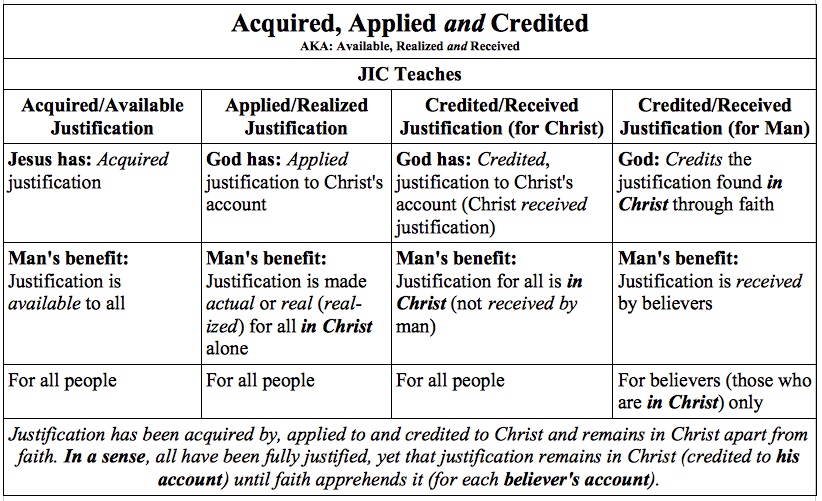

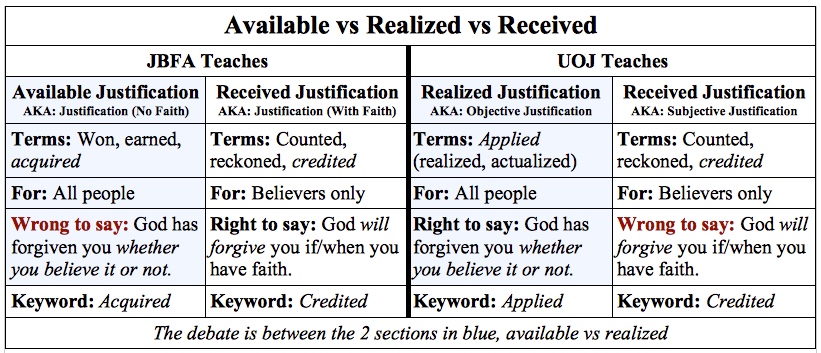
 Many Lutherans (though certainly not all) believe in UOJ (pretty obvious, right?). Many others, however, reject UOJ in favor of (what has become known as) Justification By Faith Alone (JBFA – because, after all, Lutheranism needs more initials and/or acronyms…ya know, we’ve got ELCA, LCMS, WELS, ELS, UOJ, etc. Why not JBFA too? And, just for fun, I’ll add another to the mix in just a bit.) 😉

 Received (Credited)