Glad you’re here (or click here for a PDF of this site’s content).
For many years, the teaching of Universal Objective Justification (we’ll call it UOJ) has sparked a lot of debate and/or confusion as Lutheran Christians have attempted to “wrap their heads around” the true meaning and significance of this all-important doctrine. (For clarity, this site addresses the topic of UOJ as taught by Lutherans not other variations such as are found in other Christian circles.)
The objectives of this site are to:
1. Take UOJ and boil it down to it’s bare bones in an effort to make it as clear and easy to understand as possible (not always so easy to accomplish)
2. Point out some of the confusion and controversy surrounding UOJ, while attempting to keep things as simple as possible in order to avoid further misunderstanding and/or confusion
3. Lay out a clear and concise scriptural view of justification
4. Address common questions/objections about UOJ in general and/or (more specifically) the information provided on this site
5. Keep things lighthearted as we dive into such an important and heavy subject
6. Honor and glorify God with the information presented here
Navigating the Site The site has been laid out primarily as a one-page parallax site. The majority of the content is on this one page and is divided into sections which coincide with the main menu navigation (above), as well as the floating sidebar navigation menu (to the right). Each section (and its content) naturally flows into the next as you either scroll down or navigate (using the menus) down the page. It’s recommended that you read through each section in order (beginning to end), as you make your way down the page.
Having said that, you might find you desire to skip around a bit once you reach the Q & A section, which itself, is divided into 3 Category Tabs with a series of Q & A’s listed under each tab.
The Q & A section is pretty extensive, so don’t forget to round out your journey through the site content, by continuing to the Final Thoughts section.
That’s about all I’ve got for you in this introduction, so let’s jump right in.
The Basics of UOJ First things first. UOJ stands for Universal Objective Justification. Each word is very important. Let’s look at each term individually:
“When we put all three of these terms together, what we end up with is this: All people for all time have been legally declared, “not guilty.”
Universal The universal aspect of UOJ refers to the fact that Jesus’ sacrifice on the cross was for all people, of all time…it’s (get this…) universal. So too, according to the teaching of UOJ, God has justified the whole world (all people, for all time…everybody…not one single person left out), through the “once-for-all” sacrifice of Christ.
Objective The objective aspect of UOJ refers to (now, don’t over think this just yet) the concept that the universality of God’s justification is true, even if some people don’t believe it. Put another way, according to the doctrine of UOJ, all people (the whole world, every single person…well, hopefully you’ve got that part by now) have been justified whether or not anyone is aware of it, understands it, or believes it. It is said to be objectively true, even if you don’t know about it. One might say, “It’s not true when or because you believe it, rather you should believe it because it is true.”
Justification Justification simply refers to God’s formal (if you will) legal declaration that a sinner has been found “not guilty” in the eyes of God. This is not because a person is without sin, but because each and every sin has been accounted for, by way of Christ’s once-for-all sacrifice on the cross.
UOJ in a Nutshell When we put all three of these terms together, what we end up with is this: All people for all time have been legally declared, “not guilty,” not because each one is without sin (or because their sin does not matter), but because Christ’s sacrifice on the cross was fully sufficient and therefore no one during his lifetime (this side of eternity) is legally held accountable for his wrongdoings in the eyes of God (more on this in a moment).
In other words, UOJ teaches us that according to God’s courtroom judgement, justice has been served and therefore, all have been found “not guilty.”
Once again, UOJ states clearly that this is objectively true, even if no one believes it. In other words, this universal justification is not dependent upon faith. This legal declaration is said to be true with or without faith.
I know, I know, I can practically hear (through your internet connection) all of the objections being raised. What about faith? Doesn’t the Bible teach justification by faith? Wasn’t the Reformation all about justification by faith A-L-O-N-E!
Well, before we can rightly move on from here, there is one more very important word which gets added to the UOJ mix…the word, “subjective.”
The Subjective Aspect of UOJ Understood correctly, UOJ teaches us that even though God’s declaration of “not guilty” applies to all people of all time, even if they do not believe it (or are even aware of it), no one receives the benefit of this declaration unless he “apprehends” it through saving faith. This is known as Subjective Justification.
We might think of it this way, UOJ teaches that all (each and every one) are objectively justified with or without faith, but each one is subjectively (personally) justified only through faith. Therefore (though not in this lifetime, as mentioned above), the unbeliever will be held accountable for his sin in eternity (the next “life”).
Confused?
Hold on, there’s more. Unfortunately, things may seem to get a bit worse before they get better. But, hang in there, I’ve done my very best to keep the complicated nature of the topic as simple as possible and (I hope) you will find much clarity in all I have included, particularly when we look at the God Says section of the site. But, we’re not quite there yet. Stay with me.
Justification For All Here’s a statement for you. “Justification for the whole world, both believer and unbeliever alike!”
Yay! Sounds great, doesn’t it?
Did you know there is a sense in which both proponents and opponents of UOJ could agree on the above statement? It’s true. Yet, it is true only because each side would cling to one of two very different meanings for the statement.
And, I would suggest this is the key concept for a correct understanding of UOJ and the debate associated with it. This is what it all boils down to. Everything hinges on this. (Are you getting the hint? This really matters!) When it comes to the subject of UOJ, the importance of what I am about to share cannot be overstated.
Here it is:
Available or Realized (Acquired or Applied)? Is justification “merely” available on behalf of the whole world or has it been fully realized for the whole world?
What’s the difference?
Many Lutherans (though certainly not all) believe in UOJ (pretty obvious, right?). Many others, however, reject UOJ in favor of (what has become known as) Justification By Faith Alone (JBFA – because, after all, Lutheranism needs more initials and/or acronyms…ya know, we’ve got ELCA, LCMS, WELS, ELS, UOJ, etc. Why not JBFA too? And, just for fun, I’ll add another to the mix in just a bit.) 😉
As I stated, each side (proponents of UOJ as well as proponents of JBFA) could agree on my carefully worded statement from above, “Justification for the whole world, both believer and unbeliever alike!”
Yet, each side would cling to a different meaning behind this statement. And, it all comes down to (what I have come to call) the distinction between available vs realized justification.
Please hear me correctly. I suspect many have concluded that the debate is all about whether or not the objective aspect of UOJ is true or not. And, in a sense, that would be an accurate assessment. But, the whole thing goes even deeper than this. More than just whether or not objective justification is true, is the question of exactly how the objective aspect of justification is defined.
You see, I personally believed in UOJ for quite some time…or, so I thought.
“Objective justification (as it is officially defined) means that forgiveness is more than “merely” available, yet it is less than fully received…it’s realized justification.
But after years of digging into it deeper, trying to figure out why (on the one hand) I believed UOJ, even while (on the other hand) I found that it didn’t quite sit well with me either, I finally came to understand there was a subtle (or not so subtle) distinction to be made in my belief system. I had come to recognize that all along, I had been effectively believing that objective justification meant that justification, forgiveness, righteousness, etc. were all fully available on behalf of each and every individual person, but not realized for all. Christ had (in my view) won each person’s forgiveness and so in a sense, there was real-deal, viable, tangible (if you will) forgiveness for all, yet this forgiveness was not fully realized (again, in my view) for each person (including the unbeliever). In other words, what I had finally come to understand for myself is that for many years I had been trying to force “realized justification for all” into my “available justification for all” understanding of Scripture. One might even say that all along I had been believing all were forgiven (inChrist), yet through available, not realized justification.
That last sentence is soooo important, I’m going to repeat it (but, I’ll wait to fully explain it in the next section). Here it is…”One might even say that all along I had been believing all were forgiven (in Christ), yet through available, not realized justification.”
In the end, an online debate led me to more fully recognize the details of this conflict within my own understanding of justification. Moreover, I suspect there could be a similar conflict (or misunderstanding) for many others as well. Therefore, I have become compelled to not only understand the matter better for myself, but also to share my findings with others.
The long and the short of it is this…as it turned out, I discovered that my understanding (my belief in UOJ) was not really UOJ (as it is actually defined) after all!
Objective justification (as it is officially defined) means that forgiveness is more than “merely” available, yet it is less than fully received…it’s realized justification.
What?
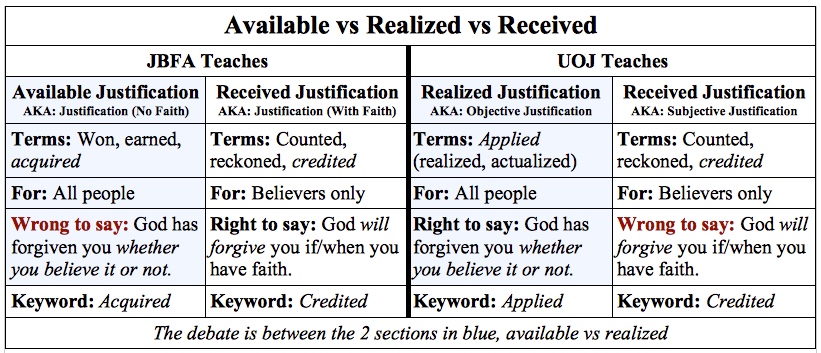
Let’s unpack each of these three terms – available vs realized vs received. (By the way, this could get a bit confusing – such is the nature of UOJ – but, I have included a visual representation at the end of this discussion for clarity…stick with me.)
Available (Acquired) Let’s start with the JBFA view of what happened at the cross. Available justification has to do with the idea that, at the cross, Christ won, earned or acquired (whatever you’d like to call it) justification for all, yet it has NOT been realized for anyone apart from faith. In other words, though it is available, it does not specifically (individually) apply to (is not applicable for) the unbeliever in any way, shape or form due to his unbelief.
Put still another way, according to this view, it would be correct to say, “Throughfaith your sins are forgiven.” but would be wrong to say, “You are forgiven whether you believe it or not.”
The takeaway from this point of view is that justification is only available for the unbeliever because it has only been acquired (not realized) for him on his behalf until faith should come along and apprehend it. The keyword as we move forward on this site is acquired.
Realized (Applied) By contrast, realized justification (what I also refer to as applied justification, in that it is applicable, though not fully received by each individual…more on this in a bit) is simply a way of describing what is taught regarding the objective aspect of UOJ. According to UOJ, all people (including each and every unbeliever) have been actually justified, meaning justification is a real, genuine, literal (whatever you’d like to call it) aspect (reality) of their personal existence. In other words, justification has been fully real-ized (actualized or made real) in regard to each person’s individual life, yet, though this reality (according to UOJ) is said to be true, it is not a reality to the same extent that received justification is.
In keeping with this view, it would be correct to say, “You are forgiven whether you believe it or not.” as well as saying, “But, you don’t receive the benefits of this forgiveness except through faith. Without faith, though you are forgiven (through a legal declaration), you ALSO still stand condemned in your sins.” Yet, it would be wrong to say, “God will forgive you, if/when you have faith.”
The takeaway from this point of view is that justification has been fully realized for the unbeliever. It already applies to him in his life (is applicable to him), yet has not become his received possession until faith should come along and lay hold of it. The keyword as we move forward on this site is applied.
Now, it is worth noting that some proponents of UOJ may take exception with my use of the word applied, here. They might argue that the word applied can be used to mean the same thing as credited. Agreed. It can mean that. And some have used it in this way. But, on this site, I have used it (and will continue to use it) in a different way (to mean real-ized) just as others have done so elsewhere. If you find you take exception to this (no offense), but I encourage you to get over it. On this site, it simply means applicable or real-ized…just run with it.😉 When I mean to say credited, I will use the word credited (or Scripture quotations may use counted or reckoned).
Received (Credited) Finally, there is received (or credited) justification. Both sides (UOJ and JBFA) effectively agree on received justification. Namely, that God has fully credited justification, forgiveness, righteousness to the believer’s account which has, as a result, been received through his faith.
This is what those on the side of UOJ would call the subjective aspect of UOJ, while those in the JBFA camp would say it is the only form (if you will) of justification.
The takeaway from this point of view is that justification has been fully credited and received. The keyword as we move forward on this site is credited.
Clear as mud?
If so, maybe this can add some clarity:
Table 1
For Further Clarity In an attempt to simplify the complicated (convoluted) nature of the topic of UOJ, what I have attempted to do next is to show both sides of the equation (both God’s and Man’s) as it pertains to both JBFA and UOJ. In other words, I have essentially demonstrated both the cause and the effect of justification.
For example, according to JBFA, what God has done through Jesus at the cross is that he has acquired justification. The resulting benefit for man, therefore, is that his justification has been made available to him through faith in Christ.
The whole situation looks something like this:
Table 2
Clarity or Confusion? So, where do you find yourself at this point? Is everything becoming clear or is it still muddled? Do you understand completely or are things still rather confusing? UOJ and the whole UOJ/JBFA debate can certainly be a lot to grasp. Hopefully, the real clarity will come when we dig into the text of Scripture itself to see what God has to say about justification.
Get ready? This is, by far, my favorite part of the site. Let’s feed on some good old bread from heaven, shall we?
Confusion The subject of UOJ is a controversial one, if for no other reason, because it can be soooo confusing for soooo many. And, in my experience, the way in which it is often taught only leads to further confusion.
Such as this…often times when teaching on the subject of UOJ pastors, professors and others use biblical concepts (and the words associated with them) interchangeably/synonymously. For example, the conversation will not be exclusively about justification alone, but instead it will be about justification, acquittal, forgiveness, and righteousness with each of these terms being used interchangeably. More than this, the discussion often comes with little to no explanation as to why these words can or should be used interchangeably or how someone came to this conclusion.
Now, imagine sitting through an hour-long Bible class while continually going back and forth from justification to forgiveness to righteousness to acquittal and back to justification again and so on. Ugh!
Beyond Confusion But, the controversy associated with UOJ goes well beyond mere confusion. Many would argue that the doctrine of justification is at the heart and center of all of Scripture. How is man made right with God and restored to him? Is this not what the Christian faith, indeed the whole of our existence in a fallen world, is all about?
Any variation in beliefs on this topic and we can expect debate, attempts at correction, sinful temperatures rising and yes, controversy.
Furthermore, over the years, numerous church members, pastors and even whole congregations have been disfellowshiped from their church body for disagreeing with UOJ.
Yes, UOJ is a confusing and controversial teaching.
Simplicity & Clarity But what if the doctrine of justification doesn’t need to be so complicated? What if it doesn’t need to be so divisive?
What if…
What if Scripture actually speaks more clearly than those on either side of the debate have allowed themselves to consider or to comprehend?
What if…gasp…those on both sides of the debate are…actually…right? Huh?
What’s Possible? Some will say, “But, that’s not possible!”
Or, is it? Don’t dismiss this possibility too quickly. Don’t forget, “With God, all things are….”
Well…just keep reading.
First, we’ll look at both sides of the debate in some detail. Then, we’ll look to see how God’s truth may have already brought both sides of the debate together, while debaters were busy focusing too heavily on Lutheranwritings rather than on that which was right in front of them in God’s Word all along.
Could it really be that simple? See for yourself.
First things first, though. So, what exactly is this debate all about anyhow?
X
Due to certain features used, this site is best viewed on computer or tablet (horizontally). Phone? Not so much...just sayin'.

 When we put all three of these terms together, what we end up with is this: All people for all time have been legally declared, “not guilty,” not because each one is without sin (or because their sin does not matter), but because Christ’s sacrifice on the cross was fully sufficient and therefore no one during his lifetime (this side of eternity) is legally held accountable for his wrongdoings in the eyes of God (more on this in a moment).
 Many Lutherans (though certainly not all) believe in UOJ (pretty obvious, right?). Many others, however, reject UOJ in favor of (what has become known as) Justification By Faith Alone (JBFA – because, after all, Lutheranism needs more initials and/or acronyms…ya know, we’ve got ELCA, LCMS, WELS, ELS, UOJ, etc. Why not JBFA too? And, just for fun, I’ll add another to the mix in just a bit.) 😉

 Received (Credited)