Category Listings
This section addresses objections surrounding UOJ and is divided into tabs according to 3 categories below:
Category 3 (UOJ Proof Passages) could have easily fallen under either of the first two categories. For this reason and due to the fact that each proof passage contains a fairly detailed explanation, UOJ Proof Passages became its own category.
Instructions
Each individual objection is presented as a question, a statement (in response to a question), or a proof passage…all in keeping with the each of the 3 categories, in a closed accordion style entry (to save space). Once opened, each listed entry contains the answer or analysis for each objection. To see each answer/analysis, simply click the large orange “+” symbol next to each question/statement. When finished with each answer/response, you can either close the response (click on the big orange “-” symbol) and open the next one or simply click on the next “+” symbol and the previous response will close automatically.
While it may be helpful to read each category tab, with each of its listed objections, all the way through one-at-a-time, you may also find it useful to skip around a bit.
Category 1 - Direct Objections to UOJ
What is UOC?
Universal Objective Condemnation (or UOC, as I have come to call it), by itself, disproves UOJ.
According to UOC, the whole world, according to their normal, natural sinful condition (apart from saving faith), stands separated from God and under his condemnation and wrath. This is universally and objectively true for all people whether they believe this or not.
UOJ & UOC Cannot Both Be True
In short, if UOC is true, then UOJ cannot be true, and if UOJ is true then UOC cannot be true.
This is the reality of the situation, no matter how much the proponent of UOJ tries to confuse the issue by attempting to separate the two into a law/gospel distinction – declaring that since condemnation is a matter of law and forgiveness is a matter of the gospel, both can be true of the same person, namely, each unbeliever. (See “Does the unpardonable sin disprove UOJ?” and “Does the gospel withheld disprove UOJ?” for a demonstration that this supposed law/gospel distinction is nonsensical according to Scripture.)
For, the unbeliever cannot rightly be declared, by God, to be condemned, unrighteous and lacking in the removal of (and the forgiveness of) sins as well as being declared justified, righteous and forgiven at the same time.
Elsewhere (in the tabs above), I’ve taken a somewhat detailed look at those “proof” passages which supposedly teach UOJ. At best, they are very questionable – normally due to having been yanked out of proper context (though not always). But what about UOC? Is the Bible also so sketchy on the subject of the universal condemnation of sinful man?
What God Says About UOC
Let’s take a look.
~ 2 Pt 2:9 – The Lord knows how to rescue godly men from trials and to hold the unrighteous for the day of judgment.
~ 1 Co 6:9 (NKJV) – Do you not know that the unrighteous will not inherit the kingdom of God?
~ 1 Pt 3:18 – For Christ died for sins once for all, the righteous for the unrighteous [unjust in NKJV], to bring you to God.
~ Jn 3:18 – Whoever does not believe stands condemned already because he has not believed in the name of God’s one and only Son.
~ Jn 3:36 – Whoever rejects the Son will not see life, for God’s wrath remains on him.
~ Jn 16:8-9 – When he [the Spirit] comes, he will convict the world of guilt in regard to sin and righteousness and judgment: in regard to sin, because men do not believe in me.
~ Acts 3:19 Repent, then, and turn to God, so that your sins may be wiped out, that times of refreshing may come from the Lord.
UOC Verses Explained
While we could include a number of additional passages to the list above, those listed are more than sufficient to prove the point. The unrighteous (the unjust) stand condemned already with God’s wrath remaining on them, while they are also convicted (by the Holy Spirit) of their guilt for their unbelief.
Does this sound like objective justification (UOJ) or universal condemnation (UOC)? The Reality is that each of these passages speaks volumes against UOJ.
UOJ expressly teaches that all people, including the unbeliever, have been declared to be both just and righteous. Yet, the first 3 passages above specifically declare the unbeliever to be unjust or unrighteous.
Next, Jn 3:18 speaks specifically of the unbeliever standing condemned already. This does not say, he will be condemned (after death or on the last day), but that he has already been declared to be condemned (as he stands in his condemnation) as a direct result of his unbelief. The fact that he stands condemned is a statement of his being declared condemned. UOJ would have us believe he has been formally and legally declared both condemned and forgiven at the same time.
Moving on, Jn 3:36 tells us that God’s wrath remains on the unbeliever. Again, this does not say that in the end, he will receive God’s wrath, but that God’s wrath is already there, remaining on him. To be clear, this is not man’s guilt and condemnation (judgement) remaining on him, this is God’s wrath (anger, fury) which remains on him. Why would God’s wrath, anger and fury remain on him if God, himself, has declared him to be forgiven in his own sight?
Further, Jn 16:8-9 tells us that the Holy Spirit is at work in the world, among the unbelievers convicting them of their guilt resulting from their unbelief. Yet, UOJ expressly teaches that even the unbeliever’s guilt for sin has been removed (he has been formally declared “not guilty”), he is guilt free. (Note that when I refer to “guilt” here, I am not referring specifically to guilty feelings, I am referring to actual legal guilt vs. innocence.)
Finally, Acts 3:19 gives us the flip-side of the equation. Not only are unbelievers still guilty and condemned before God, but this verse expressly tells us that they still need to have their sins removed as well…they are still lacking in forgiveness as a result of the removal of sin.
In other words, though proponents of UOJ proclaim that there is a supposed law/gospel distinction to be made regarding universal condemnation (law) and supposed universal justification (gospel), this verse negates that possibility (see also Mt 12:31-32 and the unforgivable sin as well as “Does the gospel withheld disprove UOJ?“).
UOC, by itself, disproves UOJ.
Which is more consistent with the entire testimony of Scripture when we allow Scripture to interpret itself, UOJ or JIC?
Another Possibility
According to UOJ, God has forgiven all sinners (including unbelievers) whether they believe it (or are even aware of it) or not.
According to UOJ, it is ASSUMED that justification, forgiveness and righteousness (among other things) are all effectively synonymous.
Further, according to UOJ, it is ASSUMED that forgiven sin = forgiven sinner. Moreover, forgiven sinner = all sinners forgiven (believer and unbeliever alike).
Yet, is there another possibility?
In keeping with JIC, forgiven sin ≠ forgiven sinner, except through faith (note, that I used a “does not equal” symbol, there…you caught that, right?).
The questions from proponents of UOJ then become, “How can sin be actually forgiven if each individual has not been forgiven? In other words, how can sins be actually forgiven apart from sinners being actually forgiven, as well?
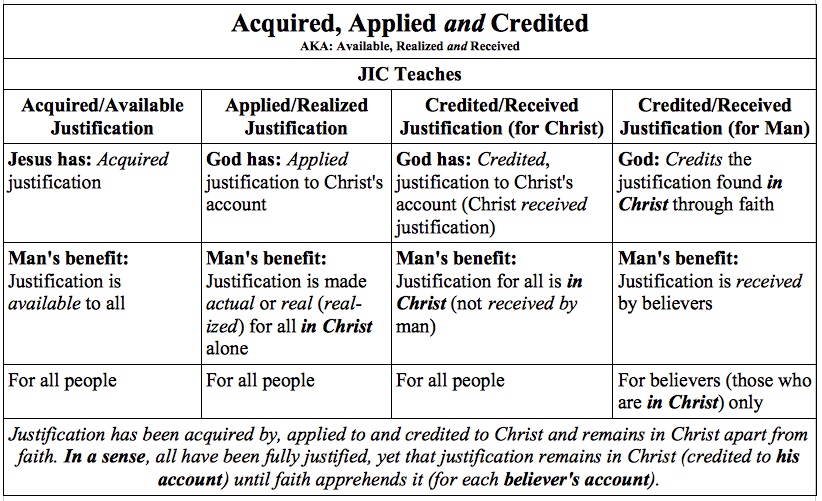
Simple. As explained earlier in the “God Says” section of this site, this forgiveness for each person’s sins has been forgiven in Christ’s account and is then distributed to individuals (each person’s own account) exclusively through faith.
Why Does This Matter?
Okay, so what if it’s true that sins forgiven, may not equate to each and every sinner forgiven? What’s the point?
I address this subject for a couple of reasons:
1) To illustrate the point that there are numerous assumptions inherent in UOJ theology, which have not been proven.
2) To hopefully emphasize the need for each of us as Christians to think critically and to be willing to question that which we are being taught. And, to do such thinking and questioning in light of Scripture and sound, biblical reasoning.
Let’s use Jn 1:29 to help illustrate my point.
Who Takes Away…
~ John 1:29 The next day John saw Jesus coming toward him and said, “Look, the Lamb of God, who takes away the sin of the world!”
Here, the proponent of UOJ may say, “See, there you have it! Scripture is clear. Christ, the lamb of God, has taken away the sins of the whole world.”
Well, aside from the obvious problems associated with the reality that this verse says nothing of the whole world’s sins having been already taken away. There’s still another issue…but, we’ll look at that in a moment.
First, lets address the obvious.
1) The verse does not say “has taken away” (as in the past) it says “takes away” (as in ongoing).
2) John’s having said, “has taken away” would make no sense, before Jesus went to the cross, in the first place.
3) Who else’s sins, but those of the world’s would Christ be taking away? In other words, just because the verse mentions the sin of the world, doesn’t necessarily mean that the whole world’s sin (all at once) is taken away, at least not in the way UOJ teaches. It can simply mean “…the lamb of God, who takes away sin from those of the world.”
Now, let’s address the less obvious. First, it is important to note that UOJ theologians have said, referring to this verse, that “takes away” means “already forgiven.” Actually, to be more specific, I just read a portion of one paper which said this:
“John 1:29 teaches objective justification. Jesus has taken away the sin of the world. This passage alone should settle the issue. What does take away mean, if not forgive?” (Objective Jusitification by Rolf Preus, http://www.christforus.org/objectivejustification.htm) Emphasis is mine.
Notice the phrase “takes away” in Jn 1:29 is changed by Mr. Preus to both “taken away” and “take away.” While both of these changes help to support UOJ, they are not the same as the biblical text, nor do they hold the same meaning.
Yes, I too put the meaning of the text of Scripture into my own words on this site and elsewhere, but here the meaning of the text is drastically altered to fit a teaching which is being imposed upon the text rather than pulled from it.
But, that’s not really the point. Though sadly, the reality is that I have found this kind of deception as fairly typical in UOJ circles (by the way, when I say “deception,” I am not stating emphatically that Mr. Preus is intentionally being deceptive, I am saying that the deception is there, whether intentionally from Mr. Preus or from the influence of sin and Satan in his own life). The real reason I use this example is to simply make the point that UOJ theologians suggest that “takes away” = already forgiven.
So, let’s run with that.
If “takes away” means already forgiven, then proponents of UOJ would have us understand Jn 29:1 to mean, “The next day John saw Jesus coming toward him and said, “Look, the Lamb of God, who has already forgiven the sin of the world!”
Again, for the sake of argument, let’s say this verse actually means, “…has already forgiven all of the sins of the whole world.” The reality is this: sins, already forgiven, would still do nothing to prove UOJ.
Why?
Because forgiven sins ≠ forgiven sinners, in the way that UOJ promotes.
Do I think God has forgiven all of the sin of the whole world? Yes! Do I think God has applied that forgiveness to each and every individual – believer and unbeliever alike? No! I think and believe that God has applied that forgiveness to Christ’s account and distributes that forgiveness to individuals exclusively through faith.
But, in the end, it doesn’t matter what I think and believe. You have to determine what the bible really teaches for yourself.
I encourage you to think critically and to be willing to question the status quo, in light of Scripture.
What do you think? Does forgiven sin = forgiven sinner, in the UOJ sense? Which makes more sense in light of Scripture, UOJ, JIC, or something else?
(For more on Jn 29:1, see Category Tab #3, “UOJ Proof Passages” above.)
Category 2 – Analyzing the Defense of UOJ
Attempts at Defending UOJ
How does the proponent of UOJ go about defending UOJ when legitimate questions or objections are raised? Is the UOJ defense valid? Is the defense biblical? Is it based upon sound logic and reasoning, in light of Scripture?
Here, in Category 2 (Analyzing the Defense of UOJ), I have attempted to put forth a number of common defenses given by proponents of UOJ when a legitimated question or an objection is raised, followed by my own analysis of those defenses.
In Category 1, everything was listed in a strictly Q & A format. Here, each listing is in a question/objection, defense, then analysis format (sometimes with multiple defenses and analyses following the same question/objection).
Upon opening each listing you will find 1) the original question/objection restated, 2) additional details about the defense from proponents of UOJ and 3) my analysis of that defense. I encourage you to determine for yourself whether or not each defense of UOJ is a valid one, in light of Scripture and plain reasoning.
Category 3 – UOJ Proof Passages
Reasonable Doubt
Below are a number of commonly used “proof” passages used to support UOJ. With each of these passages of Scripture, much could be said in an effort to disprove or at least raise a reasonable doubt regarding the validity of UOJ. Instead of getting into great detail with each passage, however, I will simply offer here a very brief (as brief as possible, while still giving sufficient detail) analysis regarding the use of each passage as a proof for UOJ.
The Burden of Proof
Bear in mind (and this is important), the burden of proof falls on the proponent of UOJ to prove his case from Scripture, not on the one questioning the use of a passage, to disprove it’s use. This is particularly true when the proponent of UOJ is so adamant in his theology, to the point of disfellowshipping those who would question the validity of UOJ, seemingly without serious questioning, analysis, discussion or debate.